Building transaction monitoring into your compliance workflow?
Finexer gives UK platforms FCA-authorised bank transaction data – structured, consent-based, audit-ready.
Brief:
Transaction monitoring solutions that sound identical on paper perform completely differently once live. The difference isn’t in the rules engine-it’s in the data underneath. This framework scores providers on data completeness, lookback period, alerting configurability, and audit-trail depth. Use it to find the solution that catches real risk without burying your team in false alerts.
Your compliance team runs 50 alerts this week. Forty-eight are false positives. They stop investigating unusual transactions because the noise is too high. This is the real cost of choosing the wrong transaction monitoring solutions: not missed fraud, but alert fatigue that stops your team from acting on the legitimate signals.
The scale of the problem
UK financial institutions reported over 500,000 Suspicious Activity Reports in 2025, many triggered by monitoring systems with high false-positive rates. Yet FCA enforcement actions, including the £44m penalty against Nationwide Banking Group (2024) and Metro Bank enforcement, consistently penalise both under-reporting AND false-positive-driven over-reporting. Choosing an AML transaction monitoring solution with weak data quality doesn’t just cost your team hours; it exposes your firm to regulatory risk.
Most vendor comparisons focus on rules, AI, or sanctions screening. None of them mentions why monitoring quality depends on the data underneath. An AML transaction monitoring solution with perfect logic but stale or incomplete transaction data generates more false positives, not fewer. The leading transaction monitoring solutions understand this: the rules engine is only as good as the data feeding it.
That’s the gap this evaluation framework closes. Most leading transaction monitoring solutions vendors make identical marketing claims. Here’s how to score them where it actually matters.
What Should a Transaction Monitoring Solution Include?
Before scoring vendors, confirm they include these five baseline elements:
| Element | What It Does? | Why It Matters? |
| Real-time data feed | Captures transactions as they clear, not hours later | Stops activity in progress; prevents batched-delay detection gaps |
| Configurable alert rules | Let you set thresholds, patterns, and customer segments | Reduces false positives by matching your actual risk profile |
| Audit trail | Records every alert, every override, every investigation | Non-negotiable for FCA/JMLSG audit and SAR justification |
| Lookback capability | Access to 12+ months of historical data | Spots behaviour change; enables baseline-drift detection |
| Alert suppression/tuning | Suppress known-good patterns (e.g., payroll, recurring vendors) | Cuts false-positive volume by 30–50% when done right |
If a vendor’s transaction monitoring solutions lack any of these five, you’ll inherit the compliance burden they skip.
How Do You Evaluate Transaction Monitoring Solutions?
Rather than comparing feature lists, use a structured compliance checklist approach to score vendors consistently across data quality, historical depth, alert tuning, and audit readiness.
Criterion 1: Data Completeness and Freshness
The question: Does the solution see all transaction types, all the time?
What to check?
- Does it capture pending transactions or only settled ones? (Pending detection = faster intervention.)
- Does it handle cross-border payments, standing orders, and failed transactions?
- What’s the lag between transaction posting and alert generation? (Real-time via webhooks is best; batched feeds at 24+ hours breed false positives because context changes overnight.)
Why does it matter?
Real-time detection stops suspicious activity in progress. Batched feeds miss the window entirely- by the time the alert fires 24 hours later, the money is gone, and the transaction context has changed. Pending transaction capture matters because risk mitigation happens before settlement; settled-only monitoring arrives too late.
Red flag: A vendor that doesn’t mention data latency.
Criterion 2: Lookback Period and Historical Context
The question: How far back can you pull transaction history for behaviour-change detection?
What to check?
- 12 months minimum; 24 months is better for leading transaction monitoring solutions.
- Can you establish “normal” customer profiles before anomalies trigger alerts?
- Does the solution auto-baseline, or do you configure it manually?
Why does it matter?
A customer with a six-year transaction history suddenly wiring £500k abroad looks abnormal. A customer with only six weeks of data looks normal. Lookback depth separates AML transaction monitoring solutions that catch real risk from those that generate false-positive avalanches.
Red flag: Vendors offering only a 90-day lookback for AML transaction monitoring solutions. This is insufficient for behaviour-baseline detection.
Criterion 3: Alerting Configurability and Tuning
The question: Can you suppress noise without losing signal?
What to check?
- Can you suppress alerts by merchant category (e.g., all supermarkets)?
- Can you set different thresholds per customer segment?
- Does the solution learn from your overrides, or do you tune each time manually?
Why does it matter?
This is alert-fatigue prevention. Leading transaction monitoring solutions include tuning tools; cheaper AML transaction monitoring solutions don’t. The difference is immediate: tuning can cut false-positive volume by 30–50% when configured for your actual risk profile.
Criterion 4: Audit Trail and Investigation Support
The question: When FCA audits your AML transaction monitoring solutions, can you justify every alert decision?
What to check?
- Does the audit log show the rule that fired, the threshold, the customer context, and the investigator’s decision?
- Can you export investigation records?
- Does it time-stamp suppressions and overrides?
Why does it matter?
JMLSG guidance requires you to evidence your monitoring decisions. A solution without audit depth is a compliance liability.
Quick Reference: Scoring Any Transaction Monitoring Solution
Use this table to evaluate vendors side-by-side:
| Evaluation Criterion | What to Check | Best-in-Class Signal | Red Flag |
| Data Completeness & Freshness | Real-time feeds, all transaction types, pending + settled | Webhook per transaction; sub-minute lag | Batch-only; 24hr+ delay; missing transaction types |
| Lookback Period | Historical depth for baselines | Extended historical depth (12+ months preferred) | Minimal lookback (e.g., 90 days) |
| Alerting Configurability | Tuning, suppression, rule customisation | Merchant category suppression; segment-level thresholds; auto-learn | No tuning available; one-size-fits-all rules only |
| Audit Trail Quality | Investigation logging, override tracking, SAR justification | Complete rule-fired record; FCA-audit-ready export | Minimal logging; can’t justify alert decisions |
Why Does Data Quality Matter for Transaction Monitoring?
Here’s the mechanical truth: monitoring rules are only as good as the data they run on.
The best leading transaction monitoring solutions with pristine categorisation (knowing that a £50 Tesco charge is retail, not high-risk remittance) spot outliers faster. An AML transaction monitoring solution without context flags every unusual merchant name as suspicious, drowning your team in noise.
Real-time webhooks matter because batched feeds create the “context lag” problem: a customer sends two transfers-one legitimate, one suspicious-six hours apart. If your monitoring sees them as batched the next morning, it can’t separate them. Real-time feeds see each transaction with its exact context the moment it posts. This is what separates leading transaction monitoring solutions from the rest.
For a deeper technical context on how transaction categorisation feeds monitoring accuracy, see transaction categorisation accuracy.
The Finexer Angle: Data as Monitoring Infrastructure
Most monitoring vendors sell the rules engine. Finexer supplies what sits underneath: the data layer that makes good monitoring possible. For platforms building a broader compliance stack, Finexer’s Verification product complements this data layer with identity verification and AML/KYC capabilities, helping strengthen end-to-end onboarding and monitoring workflows.
What Finexer delivers?
- Real-time transaction webhooks – No batch delay; each transaction fires an event the moment it posts, enabling genuine real-time monitoring instead of 24-hour-delayed alerts
- 7-year lookback capability – Historical baselines span complete market cycles, so behaviour-change detection has statistical depth
- Enriched transaction data – Merchant categorisation, counterparty context, and transaction type inference built-in; reduces cryptic merchant names and categorisation gaps
- PCI DSS-compliant infrastructure – Secure data handling; meets compliance requirements for financial platforms
- Almost all major UK banks supported – Consumer, business, and challenger account coverage means no exclusions when your customers switch banks
How does this feed monitoring?
This combination addresses the exact failure points that plague AML transaction monitoring solutions: real-time feeds stop the context-lag problem, enrichment cuts false positives by giving rules better inputs, and a 7-year lookback enables behaviour-baseline detection that 90-day systems can’t match.
Combined with AML screening and monitoring logic, this data layer turns monitoring from a noise generator into a risk detection tool for leading transaction monitoring solutions.
Conclusion
Choosing transaction monitoring solutions means evaluating the data layer first, the rules engine second. False positives aren’t a feature trade-off-they’re a sign that data quality is failing. Score vendors on data completeness, lookback depth, configurability, and audit trails. That’s where the best solutions separate from the rest.
Most teams discover this too late, after alert fatigue has already paralysed their investigations. Start with the framework above, test with your own transaction patterns, and pick the solution that reduces noise instead of amplifying it
What are transaction monitoring solutions used for in UK platforms?
Transaction monitoring solutions are used to continuously analyse financial transactions for suspicious activity, AML risks, and irregular behaviour. UK platforms under AML obligations use these systems to monitor client financial activity, detect compliance risks, and generate Suspicious Activity Reports where required under the Money Laundering Regulations 2017.
What is the transaction monitoring process for compliance platforms?
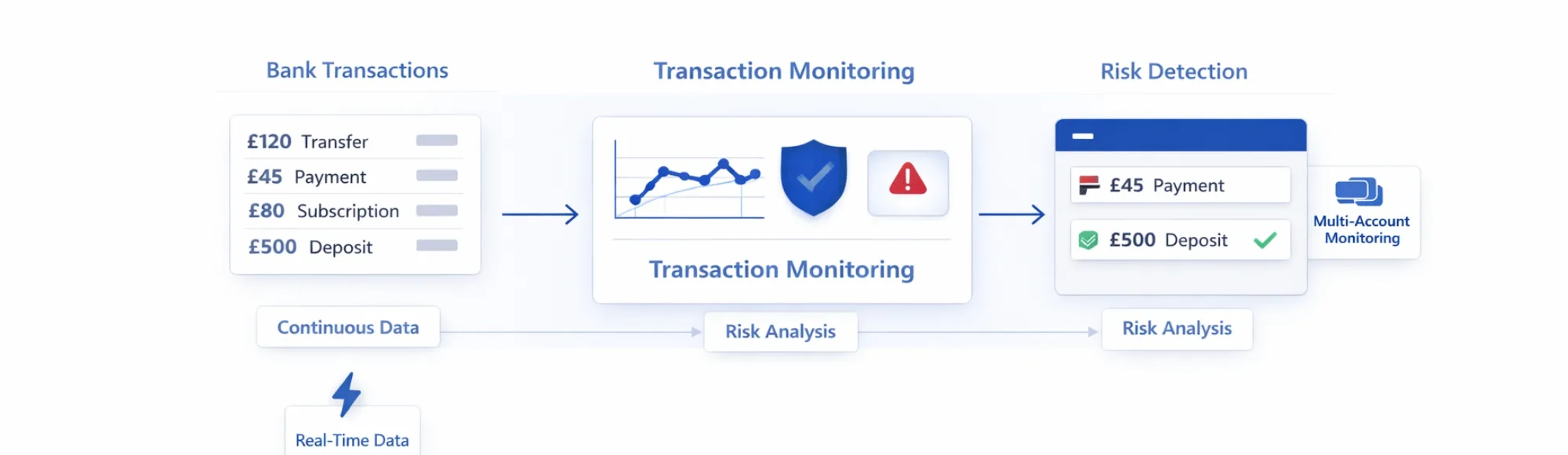
The transaction monitoring process involves four stages – collecting structured bank transaction data, analysing patterns for anomalies, detecting and flagging risk indicators, and generating compliance reports. Each stage depends on continuous, structured bank data feeds rather than periodic manual imports to produce reliable monitoring outputs.
Is Finexer suitable for platforms building transaction monitoring solutions?
Yes. Finexer is FCA-authorised and provides AIS infrastructure covering 99% of UK banks – delivering structured bank transaction data with merchant identifiers, category codes, and up to 7 years of transaction history. Platforms integrate Finexer’s AIS to power continuous transaction monitoring solutions with real-time webhooks and multi-account data coverage.
See how real-time transaction data and 7-year lookback reduce alert fatigue in practice
Explore with AI
About the Author

Paul Lucraft
Paul Lucraft is a payments industry strategist and advisor with more than two decades of experience across banking, card networks, and financial services infrastructure. His expertise covers fraud prevention, payment risk management, financial strategy, and the operational development of card payment systems. He previously held senior roles at Mastercard Europe where he served as General Manager for the UK and Ireland, overseeing fraud risk, operational governance, and payment network strategy across the region. Earlier in his career, Paul worked at Lloyds TSB and TSB Bank leading fraud strategy, credit collections, and card business finance operations.