Shortlisting an AIS API looks simple until the third provider website promises “real-time bank data through a single integration.” Suddenly every vendor sounds identical – exactly when evaluation criteria matter more than marketing copy.
The stakes are higher in 2026 than ever. Open banking is now everyday UK infrastructure: user connections reached 17.5 million by January 2026, served by 145 authorised third-party providers, and banks handled 24 billion API calls in 2025 – up 27% year on year.
Account information services connections alone grew 35% last year. If you’re adding bank-data features now, you’re building on rails regulators expect to expand, with the FCA’s open finance roadmap and new open banking rule-making powers arriving through 2026.
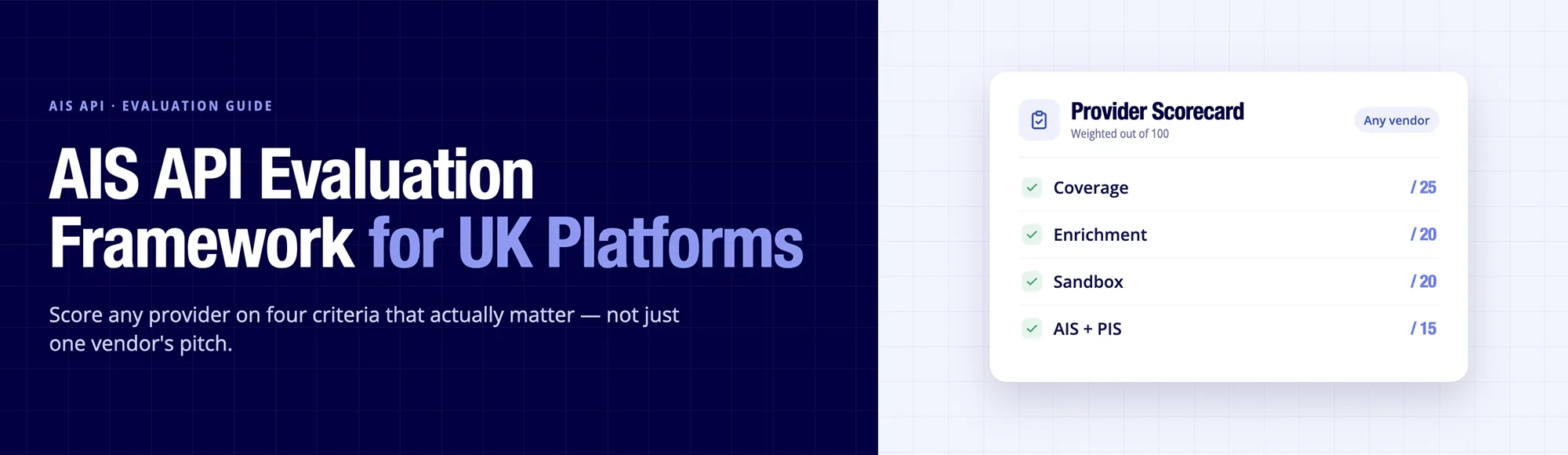
This guide presents a practical evaluation framework that applies to any AIS API, including Finexer’s. (If you want the product-first view instead, Finexer’s AIS API page covers that angle; this article is the checklist you’d score it against.)
The four evaluation criteria that actually separate providers
Regulation levels the floor: Every legitimate UK provider of account information services is FCA-authorised, uses bank-grade consent flows, and never touches user credentials. Don’t spend evaluation time on table stakes. Spend it where one AIS API genuinely diverges from the next.
1. Coverage depth – personal and business accounts
Every provider quotes a bank count. Almost none volunteer the two numbers that matter more:
- Market-share coverage, not bank count: 2,000 European connections mean little if your users bank with UK institutions that the provider handles poorly. Ask for the percentage coverage of your user base’s banks. There’s no official benchmark here, but industry guidance commonly treats 85%+ coverage in your target market as the workable floor – every uncovered bank below that line eventually surfaces as a support ticket.
- Business account coverage: This is the classic evaluation trap. Personal current accounts are well covered across the industry’s account information services; business and SME accounts are not. If your platform serves accountants, lenders, or B2B SaaS, ask specifically which business banks are supported for account information services – and how much transaction history each returns. Some banks expose seven years of data; others expose as little as two.
2. Data enrichment – raw feeds vs. usable data
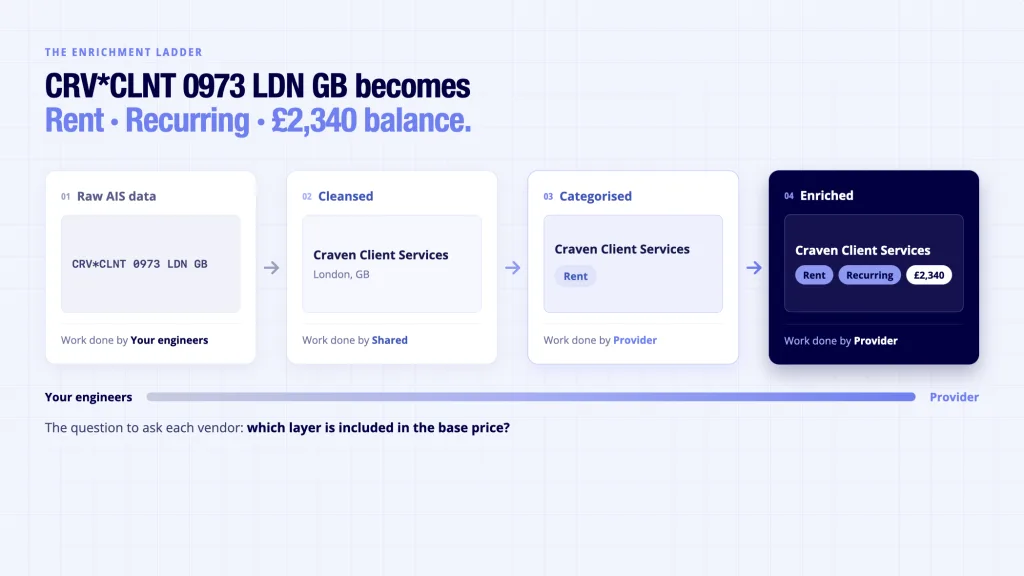
An AIS API returning raw transaction strings (“CRV*CLNT 0973 LDN GB”) shifts the enrichment burden onto your team. Providers differ sharply:
| Data Layer | What You Get | Who Does the Work? |
|---|---|---|
| Raw AIS data | Balances, transactions, account holder details as banks send them | Your engineers |
| Cleansed | Normalised merchant names and references | Shared |
| Categorised | Transactions grouped (rent, payroll, utilities and more) | Provider |
| Enriched | Running balances reconstructed, income detection, recurring-payment flags | Provider |
The question to ask each vendor: which layer is included in the base price, and which layer sits behind an add-on? Several well-known providers sell categorisation as a separate product tier. Also probe gap-handling – some UK banks fail to return running balances at all, and only a minority of providers reconstruct them rather than passing the hole downstream to you.
3. Sandbox and developer experience
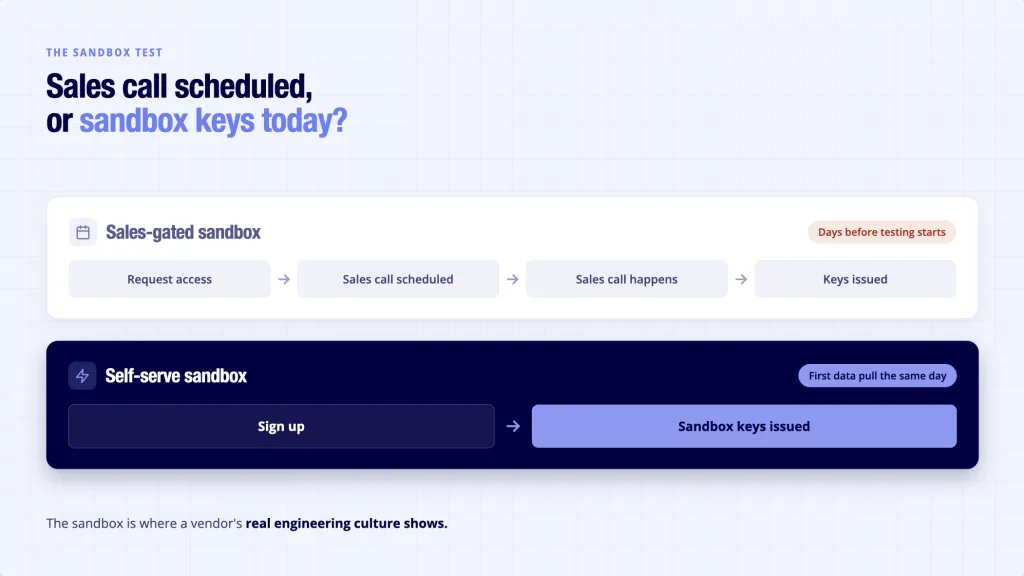
The sandbox is where a vendor’s real engineering culture shows. Evaluate before signing anything:
- Self-serve access: Can a developer get sandbox keys today, without a sales call?
- Realistic test data: A sandbox with three perfect dummy accounts hides the messy edge cases (pending transactions, revoked consents, bank downtime) that dominate production.
- Webhooks in test mode: Consent expiry and new-transaction events are where integrations break; you need to simulate them.
- Documentation freshness: Check the changelog date. Stale docs predict stale support.
A practical benchmark: Your engineer should get a first successful data pull in the sandbox within a day. If that takes a week, production will overrun too.
4. AIS + PIS bundling
Account information services rarely stay data-only for long. Platforms that start by reading balances usually end up initiating payments – refunds, invoice collection, payouts.
Evaluate whether the provider holds both AIS and PIS permissions under one FCA authorisation and one integration, or whether payments would mean a second vendor, second contract, and second consent journey for your users. With commercial variable recurring payments going live under the new UKPI scheme in 2026, choosing a data-only vendor today can quietly become a migration project next year.
Scoring your shortlist
Put every AIS API candidate through the same table. The weightings are our suggested starting point, not an industry standard – rebalance to your priorities. The scoring below is Finexer’s editorial evaluation framework rather than an FCA or industry-standard methodology. Adjust the weightings to reflect your own product priorities:
| Criterion | Score Out of 100 | What “Good” Looks Like |
|---|---|---|
| UK coverage incl. business accounts | 25 | ~90%+ of your users’ banks; SME accounts confirmed in writing |
| Enrichment included | 20 | Categorisation + balance reconstruction in base tier |
| Developer experience | 20 | Same-day sandbox, event webhooks, current docs |
| AIS + PIS in one integration | 15 | Both permissions, one API, one consent flow |
| Reliability & support | 10 | Published uptime, named support path when banks fail |
| Commercials | 10 | Usage-based pricing that scales with connections |
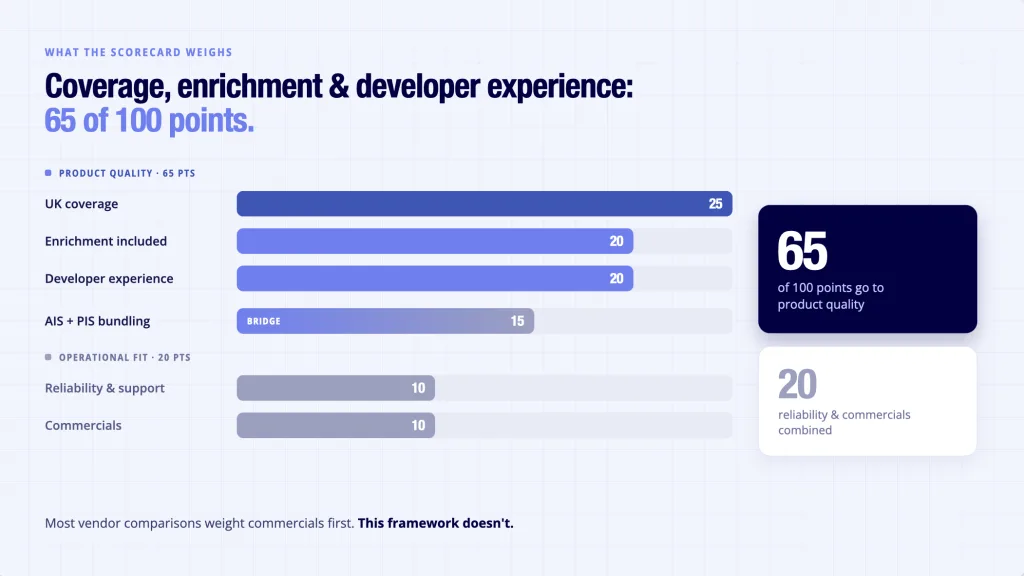
It is important to put the greatest emphasis on coverage because unsupported banks quickly become integration and support issues. Enrichment and developer experience follow because they directly affect implementation effort and product quality. AIS + PIS bundling reflects the growing convergence of data access and payment initiation in UK Open Banking.
For the wider landscape context, our banking API integration guide covers how these connections work end-to-end, and the most popular banking API examples piece shows how different providers approach the same problems.
Where does Finexer sit against these criteria?
Applying the framework to ourselves – transparently, as one evaluated option among several:
- Regulatory Footing: Finexer Ltd is FCA-authorised (FRN 925695) as an Authorised Payment Institution for both account information services and payment initiation services – so criterion 4, AIS+PIS in one integration, is met by design rather than by partnership.
- UK-first Coverage: Finexer’s Data (AIS) API is built specifically for UK banks and UK platforms – accounting and ERP tools, lawtech, payroll, proptech – rather than as a pan-European product with UK support bolted on.
- Enrichment in the Core Product: Transaction categorisation and a balance-enrichment engine that reconstructs running balances even when banks fail to provide them, plus webhooks for new accounts, transactions, and consent events.
- Consent Tooling out of the Box: White-label consent screens, shareable consent links, automated re-consent reminders before expiry, and one-click revocation for either party.
- Security Posture: AES-256 encryption, GDPR compliance, Cyber Essentials certification, and ICO registration.
For licensing context, read how AISP infrastructure works in the UK – useful if you’re weighing a provider’s permissions against pursuing your own.
The bottom line
Provider websites won’t make this decision for you – the scorecard will. Get business-account coverage confirmed in writing, check which enrichment layer is in the base tier, time your engineer in the sandbox, and make sure payments won’t force a second vendor later. Scored this way, a shortlist of five usually collapses to two within a week.
What is an AIS API?
An AIS API is the interface an FCA-authorised provider exposes so your application can retrieve a user’s bank account data – balances, transactions, and account details – in real time and with the user’s explicit consent. It is how regulated account information services are delivered to your product – the “read” half of UK open banking; payment initiation is the “write” half.
What are the integration steps?
A typical AIS API integration sequence: (1) get sandbox credentials and test the consent flow; (2) build the journey where users pick a bank and authenticate; (3) handle the data endpoints – accounts, balances, transactions; (4) wire up webhooks for consent expiry and new data; (5) complete due-diligence checks; (6) go live behind a feature flag.
What data does an AIS API return?
Account identifiers and holder names, real-time balances, transaction history (typically 2–7 years, varying by bank), transaction metadata such as references and merchant details, and – with enrichment – categories, running balances, and income signals from the account information services layer.
How long does integration take?
With a modern AIS API provider: a working sandbox proof-of-concept in 1–3 days, a production-ready integration in 2–4 weeks, including consent UX and error handling. Timelines stretch when the sandbox is gated behind sales or business-account edge cases surface late – which is why criteria 1 and 3 deserve the heaviest scrutiny.
Evaluating providers this quarter? Run Finexer through the scorecard yourself – sandbox access is free.
Explore with AI
About the Author

Ravi Ranjan
Ravi Ranjan is Co founder & CEO of Finexer