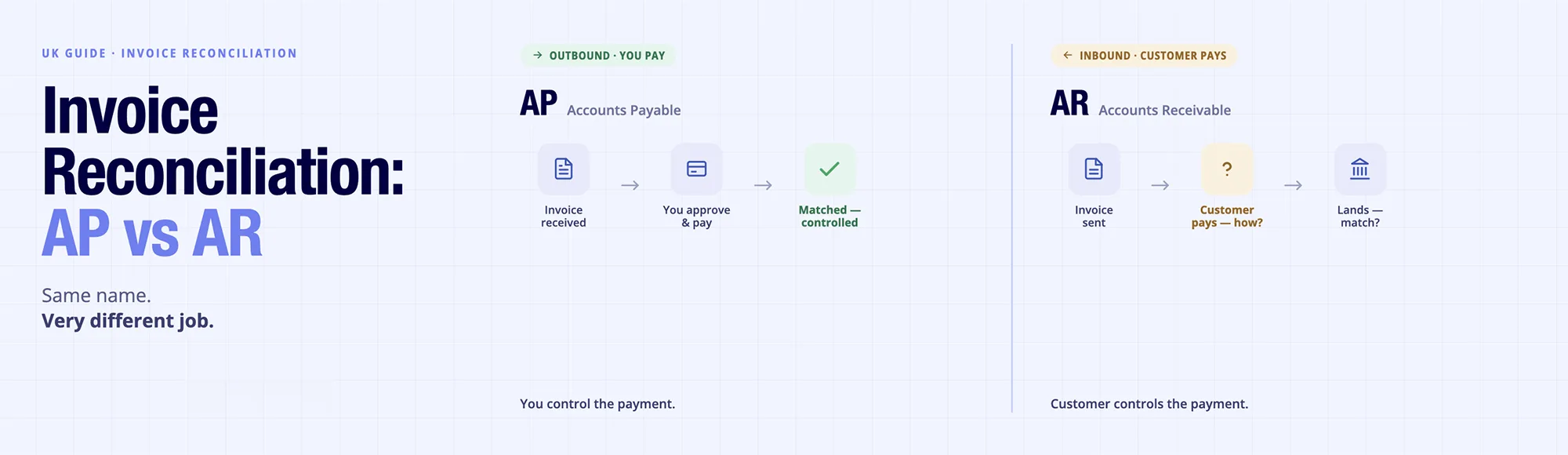
Do the maths before you switch, not after
See exactly how many hours automated bank reconciliation saves at your firm’s actual transaction volume.
Manual bank reconciliation has always been time-consuming, but quarterly reporting under MTD for ITSA has made it a recurring operational cost rather than an annual task. In my work with UK accounting firms evaluating reconciliation automation, the first question is rarely whether to automate; it’s whether the hours saved justify the investment for their client volume.
TL;DR: Automated bank reconciliation ROI scales with transaction volume. A firm reconciling 100 clients manually can spend around 100 hours a month on the task; automation cuts that to about 17 hours. at a typical £50/hour accountant rate that’s a saving of over £4,000 every month.With MTD for ITSA now requiring quarterly reporting, UK firms are increasingly calculating whether the time savings justify the investment.
By Ravi, Head of Platform Partnerships at Finexer
“The firms asking the sharpest questions about automated bank reconciliation right now aren’t doing it out of curiosity. MTD for ITSA went live in April, the first quarterly deadline has already been and gone and every client on quarterly reporting multiplies the reconciliation workload by roughly five times a year. The maths has to work before the next quarter, not eventually.”
The Real Cost of Manual Bank Reconciliation in 2026
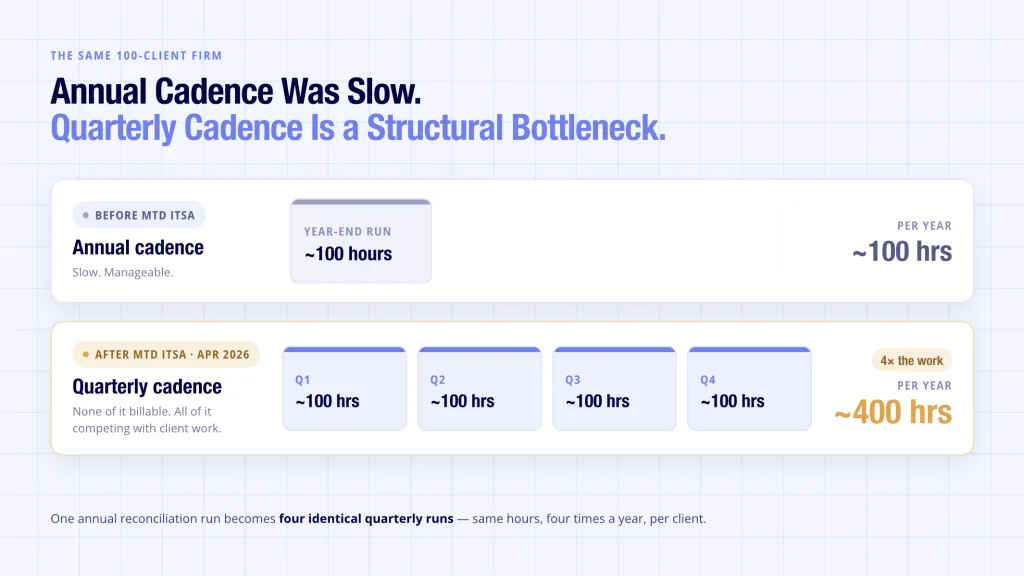
A mid-sized UK accounting firm reconciling 100 clients a month spends 45 to 65 minutes per client on manual bank reconciliation: logging into each client’s bank portal, downloading statements in whatever format the bank provides, reformatting columns to match the accounting software and matching transactions line by line.
That’s before counting the time spent chasing discrepancies, duplicate entries and missing transactions that surface only after the manual match is already done. None of it is billable. All of it competes directly with the quarterly reporting cycle that MTD for Income Tax Self-Assessment introduced when it went live on 6 April 2026, with the first submission deadline for the initial £50,000-plus threshold already passed on 7 August 2026.
Every client now on quarterly digital reporting needs this reconciliation done four times a year instead of once. The manual workflow that was merely slow at annual cadence becomes a structural bottleneck at quarterly cadence.
What a Solution to Reconciliation Automation Actually Needs
Five requirements separate automatic bank reconciliation that genuinely closes the manual gap from tools that just add a dashboard on top of the same delay.
- Real-time bank data, not scheduled feeds – Does the platform pull transaction data as it settles or only through a batch import that refreshes once or twice a day?
- Automatic matching without manual reformatting – Does data arrive structured and ready to match, or does someone still need to fix columns and date formats before matching can start?
- Exception-only review – Once matching runs, does the accountant only see genuine mismatches, or do they still have to eyeball every transaction to confirm it matched correctly?
- Coverage across every client’s bank – Does the platform connect to the challenger banks your clients actually use, not just the three or four largest high-street names?
- Quarterly-cycle readiness – Can the reconciliation workflow run cleanly four times a year per client without the manual overhead scaling in step with the reporting frequency?
Most reconciliation tools handle the first two reasonably well. Very few handle the third and fifth without a real-time bank data layer underneath them.
Manual vs Automated Reconciliation: The Time and Cost Comparison
| Factor | Manual Reconciliation | Automatic Bank Reconciliation |
|---|---|---|
| Data extraction and formatting | 30–45 minutes per client/month | 0 minutes (fully automated) |
| Transaction matching | 15–20 minutes per client/month | 5 minutes (reviewing exceptions only) |
| Total time per client/month | 45–65 minutes | ~5–10 minutes |
| Bank feed type | Portal download or scheduled batch | Real-time via Open Banking |
| Error or discrepancy discovery | During periodic review, days or weeks later | At the point of mismatch, same cycle |
The gap widens further once quarterly MTD submissions are layered on top as the manual side of that table now runs four times a year per client rather than once.
The ROI Calculator: Hours and Cost Saved by Transaction Volume
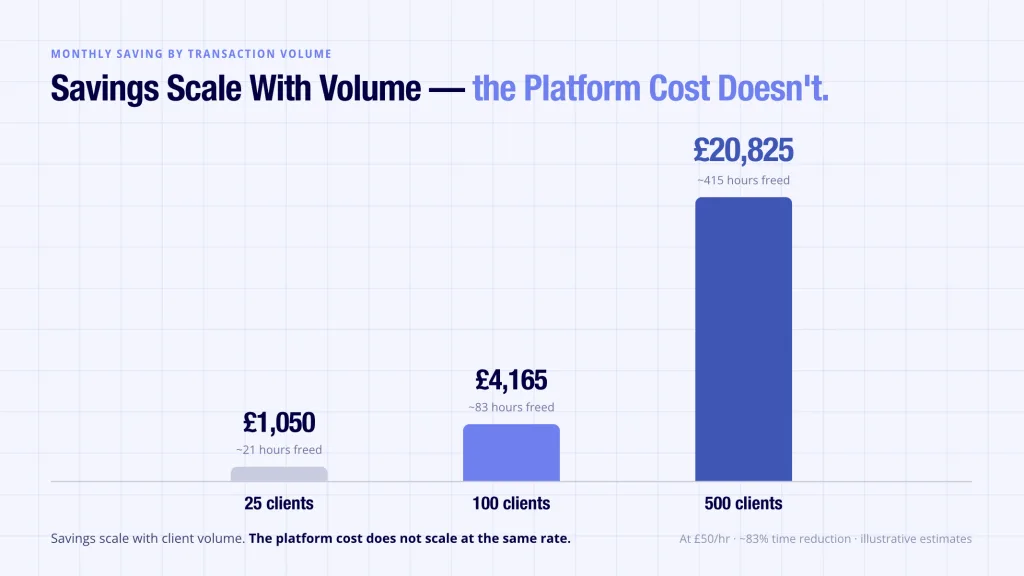
The maths scales with how many clients a firm reconciles each month, using the £50/hour accountant rate and the manual-vs-automated time gap above.
| Firm Size (Clients/Month) | Manual Hours/Month | Automated Hours/Month | Monthly Cost (Manual) | Monthly Cost (Automated) | Monthly Saving |
|---|---|---|---|---|---|
| Small (25 clients) | ~25 hours | ~4 hours | £1,250 | £200 | £1,050 |
| Mid-size (100 clients) | ~100 hours | ~17 hours | £5,000 | £835 | £4,165 |
| High-volume (500 clients) | ~500 hours | ~85 hours | £25,000 | £4,175 | £20,825 |
Based on £50/hour accountant rate. Approximately 83% time reduction across all tiers. Figures are illustrative estimates.
At every tier, the saving is roughly 83% of the manual time cost, consistent with the up-to-90% time reduction firms report once matching moves from manual to automatic. For a documented account of this shift in practice, bank reconciliation case studies cover how firms measured the transition from manual to automated workflows.
Why Real-Time Matching Beats Daily-Batch Reconciliation
Daily-batch reconciliation, even when automated, still leaves a window where a payment has settled but the accounting platform hasn’t seen it yet. A client’s invoice payment lands at 9am; the batch feed doesn’t refresh until the following morning.
Real-time reconciliation closes that window by matching transactions as they arrive rather than on a schedule, which matters most for firms running quarterly MTD submissions where the reporting deadline doesn’t wait for the next batch cycle. The same real-time principle applies beyond bank reconciliation alone; automated payment reconciliation covers how this extends to matching payments against invoices specifically.
How Finexer Supports Automated Bank Reconciliation
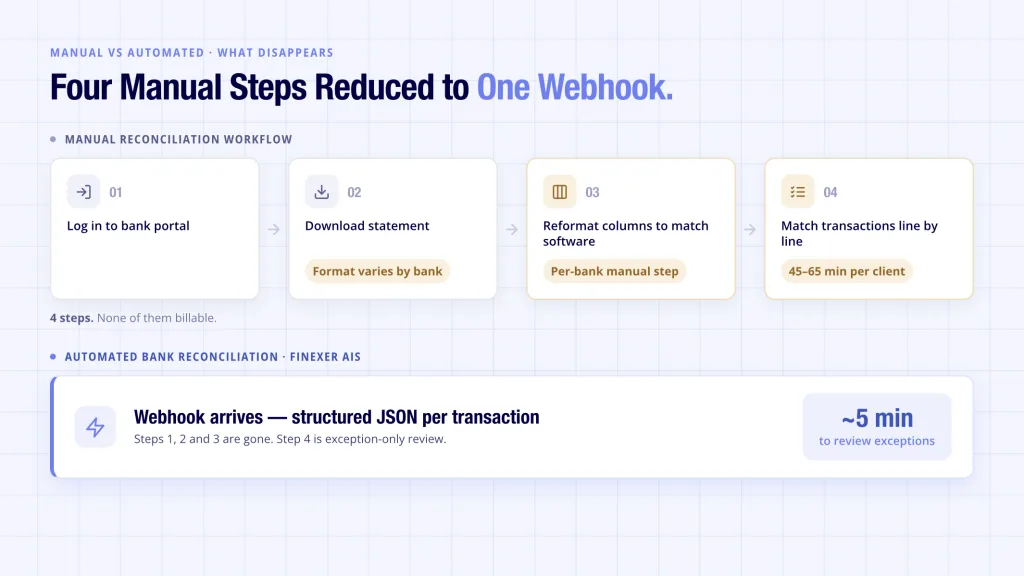
Firms running the ROI numbers above need the underlying bank data layer to actually deliver real-time, structured transactions, not just a nicer interface on top of the same delayed feed.
Finexer’s Data API retrieves transaction data directly from a client’s bank account once they’ve authenticated and consented, delivering structured JSON per transaction via webhook as new activity posts, rather than a daily statement import that needs reformatting before it’s usable. This is the mechanism behind the hours-saved calculation above: matching runs against live, normalised data instead of a downloaded file.
- Structured, normalised transaction data per bank, so matching logic doesn’t break per client’s bank
- Real-time webhooks as new transactions post, replacing scheduled batch imports
- Up to 7 years of transaction history for audit and exception resolution
- Multi-account access for clients banking across several UK institutions
- Almost all UK banks covered
- FCA-authorised AISP and PISP (FRN925695)
- 3–5 weeks onboarding support
- Usage-based pricing
What Is Reconciliation Automation?
Reconciliation automation is the process of matching bank transaction data against accounting records without manual data entry, using structured, real-time bank feeds instead of downloaded statements.
It differs from a simple bank feed integration because automation includes the matching logic itself, not just the data connection: transactions are compared against the ledger automatically, and only genuine mismatches require human review. For firms weighing this against the manual workflow’s per-client cost, the calculation above is the same one that determines whether reconciliation automation pays for itself within the first month or the first quarter, depending on client volume.
What is automated bank reconciliation?
Automated bank reconciliation is the process of matching bank transaction data against accounting records using real-time bank feeds and automatic matching rules, replacing manual statement downloads and line-by-line comparison. It typically cuts reconciliation time from 45–65 minutes per client per month to under 10 minutes.
Can bank reconciliation be fully automated?
Routine matching, where amount, reference and counterparty all align, can run without human input, but genuine exceptions, such as duplicate entries, missing transactions and amount mismatches still need an accountant’s judgement. The goal of automation is to reduce that pool to exceptions only, not to remove review entirely.
What is the difference between automated bank reconciliation and account reconciliation?
Bank reconciliation specifically matches bank transaction data against the cash ledger, while account reconciliation is the broader process of verifying any account balance, including accounts receivable, payable and intercompany accounts, against supporting records. Automated bank reconciliation is one component of the wider account reconciliation process.
Does automated bank reconciliation help with MTD for Income Tax?
Yes, because MTD for ITSA requires digital records with no manual re-entry between systems, and real-time bank reconciliation keeps client records current throughout each quarterly cycle rather than reconstructed at the deadline. This matters more from April 2026 onward, as quarterly submissions multiply the reconciliation workload per client.
How quickly can a firm switch from manual to automated reconciliation?
Integration timelines vary by provider, but Finexer’s onboarding support typically takes 3–5 weeks from integration start to go-live. Firms often start with a smaller client segment to validate the matching rules before rolling automation out across the full client base.
See how Finexer’s Data API delivers the real-time bank feed behind the ROI numbers above, for your actual client volume
Explore with AI
About the Author

Ravi Ranjan
Ravi Ranjan is Co founder & CEO of Finexer