
Verify Before You Pay
Confirm the account name matches the supplier, before the money moves.
TL;DR: Invoice bank details are the account name, sort code, account number, and reference that tell a payer where money should go. That part is easy. The harder question is what to do when you’re paying an invoice someone else raised. This guide covers what belongs on a UK invoice, how invoice redirection fraud changes invoice details without changing the invoice’s appearance, and where account name verification fits into a finance team’s process before payment leaves the account.
One sort code changed; one payment was approved without a second look and one finance team had to explain to the board why a five-figure sum landed in the wrong account.
That’s invoice redirection fraud, and it rarely looks like fraud. It looks like an ordinary supplier invoice, with ordinary invoice bank details, sitting in an ordinary inbox.
Paul, Compliance Lead at Finexer, puts it plainly: “Most invoice fraud isn’t caught by spotting a fake logo or an odd font. It’s caught by confirming the account name on the invoice still matches the supplier you’ve paid before.”
This guide draws on Finexer’s work as an FCA-authorised (FRN 925695) Open Banking infrastructure provider supporting UK platforms and finance teams with bank-based verification, alongside direct guidance from Paul on payee checks.
What Belongs on a UK Invoice
A UK invoice needs four pieces of invoice bank details to be payable at all:
- Account name: the registered name on the receiving bank account
- Sort code: the six-digit code identifying the bank and branch
- Account number: the eight-digit number identifying the specific account
- Payment reference: usually an invoice number, so the supplier can match the payment to the right invoice
Get these four right and a payment can be sent. For a full breakdown of what else a compliant UK invoice should include, see this guide to invoice payment details.
But correct-looking invoice details and genuine invoice details are not the same thing.
When Invoice Details Aren’t What They Seem
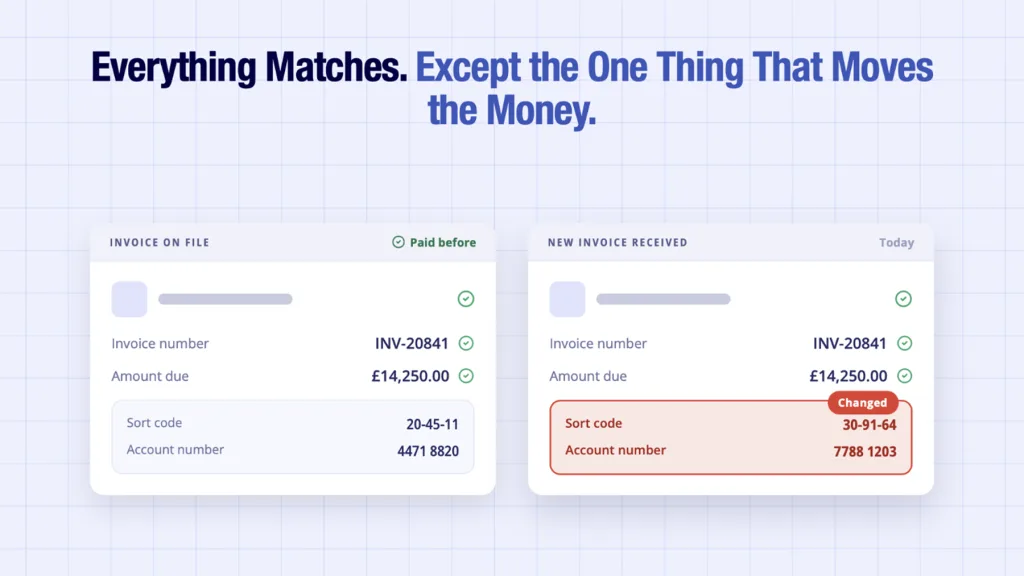
Invoice redirection fraud works by intercepting or impersonating a real supplier and sending a version of their invoice with one thing changed: the bank details.
The logo matches. The invoice number matches. The amount owed matches. Only the sort code and account number are different, often altered just before an invoice is due, or sent as an urgent “updated bank details” notice.
It’s hard to catch by eye. The fraud lives in a string of digits most people never double-check.
How to Verify Invoice Details Before You Pay
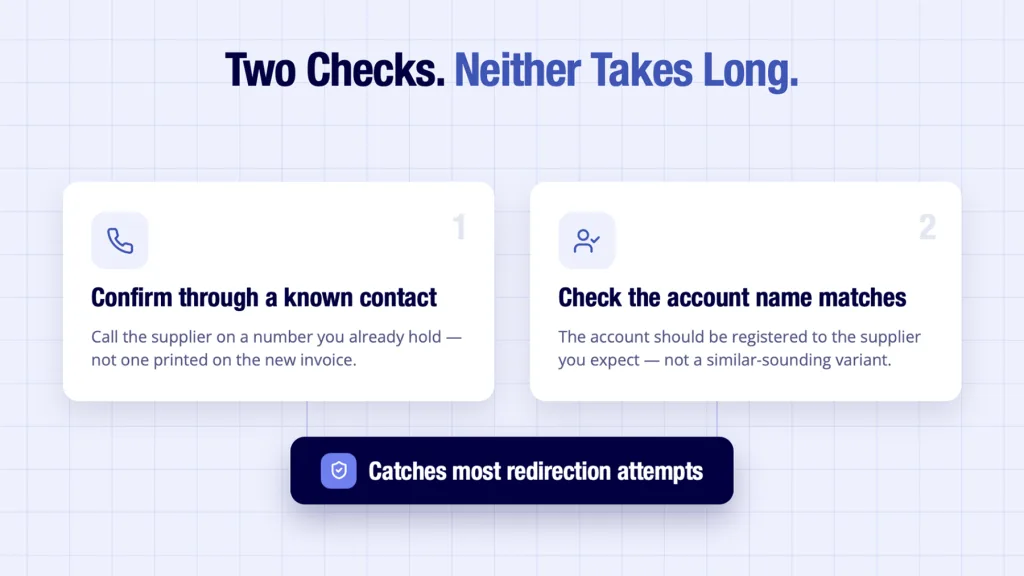
Before releasing payment on any invoice, especially one carrying changed invoice with bank details, a finance team can apply two checks that catch most redirection attempts:
Confirm changes through a known contact. If bank details have changed since the last payment, call the supplier using a number you already have on file, not one printed on the new invoice.
Check the account name against the expected supplier. A genuine payment to “Smith & Co Ltd” should show an account registered to that name, not a similar-sounding variant or an individual’s name.
Neither takes long. Both stop the most common version of this fraud.
Where Account Name Verification Fits
The second check above, matching the account name to the expected payee, is what account name verification automates. Instead of relying on a phone call every time, a platform can confirm the name registered to a bank account against the supplier name it expects, in real time, before payment is authorised.
This is the same principle used in bank account verification: checking a name against a bank record rather than trusting whatever is printed on a document.
Process Controls That Actually Work
Verification helps at the point of payment, but two internal controls reduce how often a team even reaches that point:
| Control | What it does |
|---|---|
| Restricted change access | Only named finance staff can update a supplier’s bank details on file |
| Dual approval on changes | Any change to stored bank details needs sign-off from a second person before it takes effect |
Teams tracking supplier records and payment status inside an invoice management tool can build both controls into the workflow itself, rather than relying on memory.
How Finexer Verification Fits In
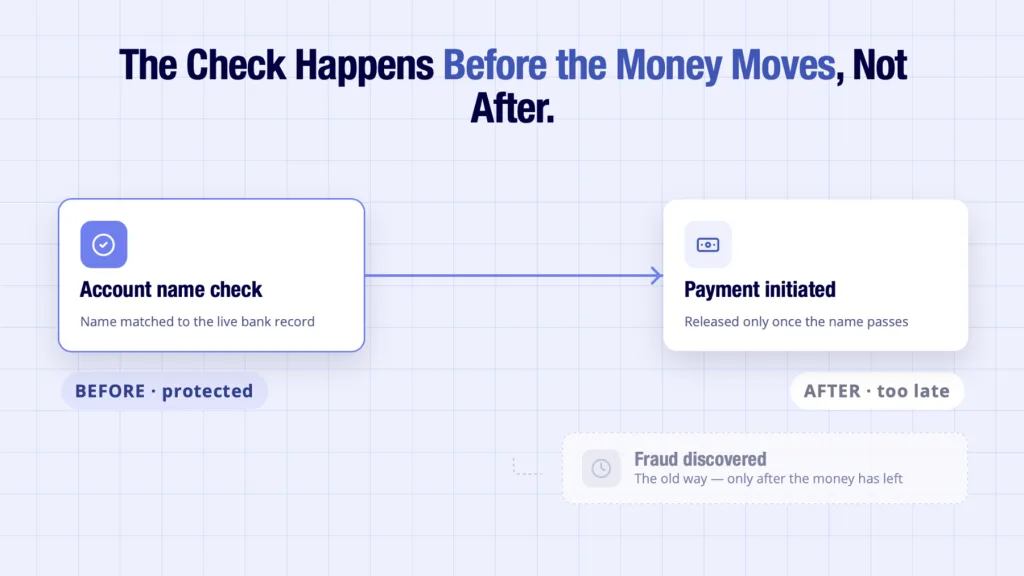
The core problem is easy to state: a finance team cannot always tell, by looking at an invoice, whether the bank details on it belong to the supplier they think they’re paying.
Finexer’s Verification product addresses this directly through bank-based name verification: a real-time match between the account name a platform expects and the name actually registered to that account at the bank, checked before a payment is initiated through Finexer Payments.
For this specific problem, the relevant parts of Verification are:
- Bank-based name verification against live bank records, not static invoice data
- A real-time result returned before payment authorisation, not after
- A pass/fail signal a finance team can build into existing approval steps
Verification confirms a name against a bank record. It doesn’t screen for sanctions, check adverse media, or assess who owns an account, and it doesn’t guarantee that no fraud will get through. It closes the specific gap where a changed invoice would otherwise pass unnoticed.
Where This Matters Most
Accounting & ERP platforms sit closest to the invoices finance teams process every day, which makes payee verification a workflow feature rather than an add-on. Platforms exploring this space can see how open banking for accountants extends beyond reconciliation into payment safety.
Payroll and invoicing platforms face the same exposure at higher volume: contractor and supplier bank detail changes arrive constantly, and one unverified change processed in a batch run can be costly.
Does a correct sort code and account number prove an invoice is genuine?
No. A sort code and account number only confirm that an account exists and can receive funds, not that it belongs to the supplier named on the invoice. Account name verification checks that second, more important fact.
Who should be allowed to change a supplier’s bank details on file?
As few people as possible, and never on the strength of an emailed invoice alone. Restrict this to named finance staff and require a second person to approve any change before it takes effect.
Does account verification stop all invoice fraud?
No single check does. Verification closes the specific gap where a bank account doesn’t match the expected payee, but it works alongside, not instead of, the internal process controls a finance team already runs.
What is the difference between invoice payment details and invoice bank details?
Invoice payment details cover everything a supplier includes so they can be paid, layout, VAT, terms, references, alongside the bank details themselves. Invoice bank details specifically means the account name, sort code, account number, and reference used to route the payment.
See how Finexer’s Verification product confirms an account name against the bank record before payment, so changed invoice details are caught before money moves.
Explore with AI
About the Author

Ravi Ranjan
Ravi Ranjan is Co founder & CEO of Finexer