TL;DR: If your invoices still rely on card-based Pay Now buttons, you’re paying for a payment journey that was never designed for business invoicing. Online invoice and payment processing built on Open Banking embeds Pay by Bank directly into invoices, initiates payments via Faster Payments and automatically reconciles receipts using bank data, thereby turning invoices into payment and reconciliation workflows instead of disconnected finance tasks.
Every unpaid invoice costs more than the amount outstanding.
It ties up working capital, creates another finance follow-up, generates another reconciliation task and leaves your customer wondering whether the payment actually went through. For SaaS platforms that send hundreds or thousands of invoices every month, those small operational delays become an expensive way of doing business.
At Finexer, we work with UK platforms building invoicing, accounting, payroll and finance products. One recurring pattern appears across almost every implementation: businesses have modern invoice creation but decades-old payment and reconciliation processes.
Whether you’re a Product Manager evaluating payment options or a CTO planning your next invoicing feature, this guide explains why Pay by Bank is changing online invoice and payment processing, how it differs from traditional card payments and what to look for before choosing an infrastructure provider.
“The invoice isn’t the problem. The gap between ‘Payment Requested’ and ‘Funds Received’ is where finance teams lose visibility. Open Banking closes that gap because payment events and bank confirmations become part of the same workflow rather than separate systems.” – Ravi Ranjan, Finexer
Why Traditional Online Invoice and Payment Processing Creates More Work Than It Removes
Traditional invoice and payment processing solves only one part of the workflow: collecting money.
They rarely solve the operational work that follows.
A customer receives an invoice, clicks a card-based Pay Now button, enters card details, completes authentication and waits for confirmation. Behind the scenes, the finance team still needs to identify the payment, match it to the correct invoice, investigate exceptions and reconcile accounts.
The challenge becomes larger as invoice volumes grow.
Many invoice platforms depend on card processors because card payments are familiar. Typical merchant fees of around 1.5%–3.5% also become part of the cost structure, while settlement commonly occurs after one or two business days depending on the payment provider and merchant arrangement.
For many SaaS providers, the question is no longer whether customers can pay online.
It’s whether the payment experience should remain card-first when Open Banking provides a direct bank payment alternative.
What Should Modern Online Invoice and Payment Processing Deliver?
Modern online invoice and payment processing should connect invoicing, payment and reconciliation into one workflow, not leave finance teams stitching events together afterwards.
Before selecting an Open Banking provider, look for these capabilities.
1. Embedded Pay by Bank links
Customers should be able to initiate payment directly from the invoice without manually copying bank details.
2. Payment confirmation during the payment journey
Knowing that a customer has authorised payment provides operational visibility long before month-end reconciliation.
3. Automatic reconciliation
The payment should be matched against the invoice automatically after funds reach the receiving account, reducing manual finance work.
4. Event-driven architecture
Real-time webhooks allow platforms to react immediately when payment status changes rather than repeatedly polling for updates.
5. FCA-authorised infrastructure
Any provider initiating payments or accessing bank data should be appropriately FCA-authorised under the relevant Open Banking permissions.
How Pay by Bank Changes the Invoice Journey
Pay by Bank replaces card entry with direct bank authentication.
Instead of entering card details, the customer clicks the Pay by Bank button embedded within the invoice.
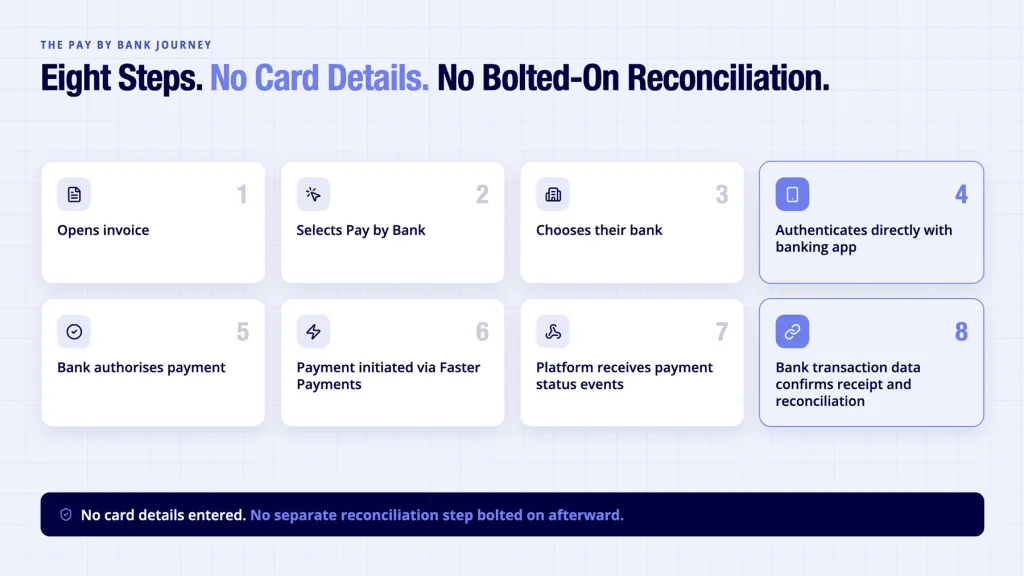
The workflow typically looks like this:
The customer opens the invoice.
They select Pay by Bank.
They choose their bank.
They authenticate directly with their banking application.
The bank authorises the payment.
Payment is initiated via Faster Payments.
The platform receives payment status events.
Bank transaction data later confirms receipt and reconciliation.
Unlike a traditional card checkout, the payment journey stays connected to the invoice lifecycle rather than ending once the payment gateway reports success.
Understanding exactly how invoice tracking software works helps explain why maintaining visibility across every payment event is just as important as collecting the payment itself.
This distinction becomes particularly valuable for accounting platforms, ERP providers, payroll software and invoicing products where payment visibility matters as much as payment collection.
Card-Based Pay Now vs Pay by Bank
Feature
Traditional Card Pay Now
Open Banking Pay by Bank
Customer authentication
Card details + SCA
Bank authentication
Payment route
Card networks
Faster Payments
Typical merchant fees
Around 1.5–3.5%
Lower than card processing
Settlement
Often 1–2 business days
Instant via Faster Payments
Chargebacks
Applicable
Different dispute model
Automatic bank-data reconciliation
Usually requires additional workflow
Supported through AIS and payment events
The comparison isn’t about declaring one payment method better than another.
Card payments remain appropriate for many retail and consumer scenarios. However, for invoice-based business payments, direct bank transfers supported by Open Banking often align more closely with how businesses already manage receivables.
Regulatory Context: Why Open Banking Makes This Possible
Open Banking in the UK exists because regulated providers can securely access banking capabilities with customer consent.
Two services work together in invoice and payment scenarios.
Payment Initiation Services (PIS) initiate the payment after the customer authorises it with their bank.
Account Information Services (AIS) provide read-only access to bank transaction data, again only with customer consent, to confirm that funds have arrived and support reconciliation.
These services are governed by the Financial Conduct Authority (FCA), operate under the UK’s Open Banking standards developed by Open Banking Limited, and typically use the Faster Payments payment rail governed by Pay.UK.
This separation matters.
AIS never initiates payments.
PIS never retrieves transaction history.
Together, however, they allow invoice workflows to move beyond payment collection towards verified payment tracking.
The Gap: Why Payment Gateways Don’t Solve Reconciliation
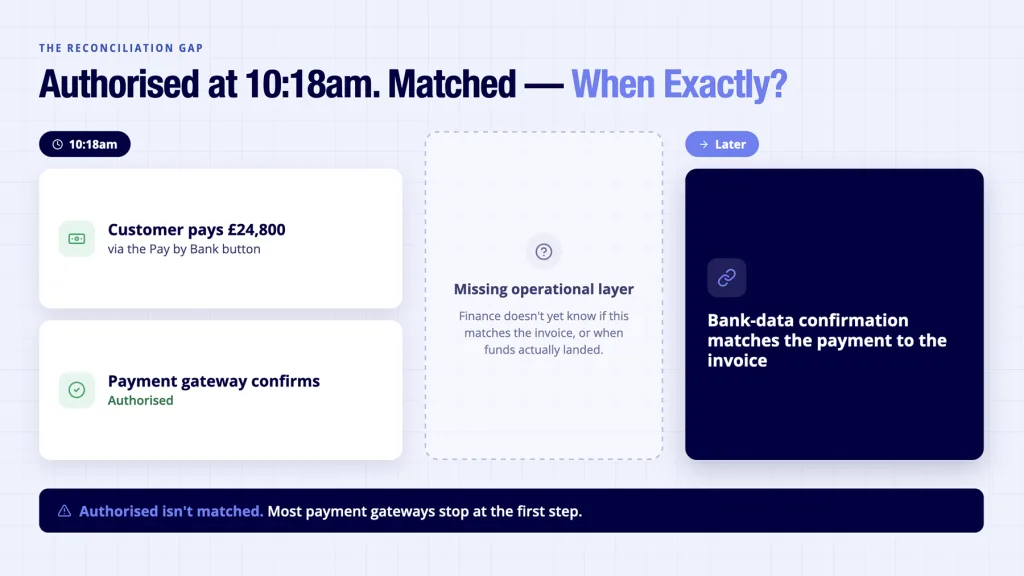
Most payment gateways stop once they confirm that a payment has been authorised.
Finance operations don’t.
Suppose a customer pays a £24,800 invoice at 10:18 am using the Pay by Bank button embedded inside your platform. Payment authorisation is only one milestone. Your finance team still wants to know when funds arrive, whether the correct reference accompanies the payment, whether the invoice should now be marked as settled and whether any exception requires manual review.
That’s the missing operational layer.
Real-time invoice visibility requires payment initiation events and bank-data confirmation working together. Otherwise, finance teams continue exporting reports, comparing references and manually updating invoice statuses despite having accepted digital payments.
Traditional payment gateways weren’t built to solve that operational problem. Open Banking creates the opportunity to do exactly that.
How Finexer’s OB Invoice Tracker Connects Payments and Reconciliation
Finance teams don’t need another payment button; they need visibility from invoice creation to settlement.
Finexer’s OB Invoice Tracker combines Payment Initiation Services (PIS) and Account Information Services (AIS) into a single Open Banking workflow. Instead of treating payment collection and reconciliation as separate processes, it provides the regulated infrastructure that allows platforms to track invoice status from payment request through to settlement.
The mechanism works like this:
Your platform generates an invoice containing a Pay by Bank link.
The customer clicks the link and authorises payment with their bank.
PIS initiates the payment via Faster Payments.
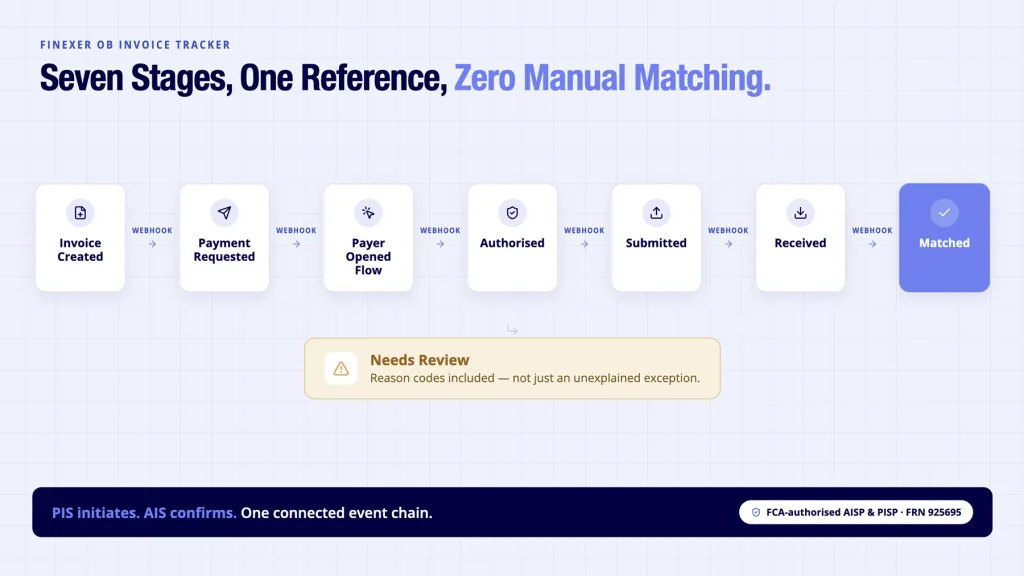
Payment status webhooks report each stage of the payment journey:
Invoice Created
Payment Requested
Payer Opened Flow
Authorised
Submitted
Received
Matched
Separately, AIS monitors the receiving bank account (with customer consent) and confirms when funds arrive.
The platform receives structured events that can automatically match incoming funds to the correct invoice.
If exceptions occur, the status model also supports:
Partial Payment
Overpayment
Failed or Rejected
Expired
Needs Review
Rather than presenting finance teams with an unexplained exception, Needs Review returns reason codes that allow the platform to determine the next action.
This creates a clearer operational picture than treating payment initiation and reconciliation as unrelated activities.
Likewise, if you’re evaluating the payment-link implementation itself, this guide to embedding Pay by Bank into invoices explains the technical approach:
Why Platforms Choose Finexer for Invoice and Payment
The operational challenge isn’t collecting money; it’s knowing exactly where every invoice sits after the payment request has been sent.
Finexer’s OB Invoice Tracker gives SaaS platforms the regulated Open Banking infrastructure required to connect payment initiation with verified payment confirmation while allowing the platform itself to own the customer experience and business logic.
Relevant capabilities include:
FCA-authorised AISP and PISP (FRN925695)
White-label deployment under your own brand
Usage-based pricing
Real-time webhook events throughout the invoice lifecycle
3–5 weeks onboarding support
Saves up to 90% transactional costs compared with card processing for Pay by Bank payments
If your platform serves payroll or invoicing software providers, Finexer’s Payroll & Invoicing use case provides additional implementation examples:
What Is Invoice Processing?
Invoice processing is the workflow that moves an invoice from creation to payment confirmation and financial reconciliation.
For many organisations, invoice processing still involves multiple disconnected systems. An invoice may be generated inside an ERP platform, paid through a card gateway, reconciled against a bank statement and finally closed inside accounting software. Each hand-off introduces another opportunity for manual intervention.
Open Banking reduces those hand-offs.
When a customer pays using Pay by Bank, PIS initiates the payment after bank authorisation, while AIS later confirms receipt of funds from the receiving account. Combined with structured webhook events, platforms can automate much of the reconciliation work that traditionally required finance teams to compare payment references manually.
That doesn’t eliminate every exception – partial payments, overpayments and missing references still require business rules – but it significantly reduces the amount of routine matching that finance teams perform every day.
What is online invoice and payment processing?
Online invoice and payment processing is the digital workflow that allows businesses to issue invoices, accept electronic payments and track payment status. Open Banking extends this by enabling Pay by Bank payments alongside automated bank-data reconciliation.
What payment methods can online invoices support?
Modern invoicing platforms can support card payments, Pay by Bank, manual bank transfers and other electronic payment methods. The appropriate choice depends on transaction costs, customer preferences and operational requirements.
Does Pay by Bank replace card payments?
Not necessarily. Card payments remain appropriate for many consumer purchases and retail scenarios, while Pay by Bank provides another payment option that can be particularly attractive for invoice-based business payments where transaction costs and reconciliation matter.
How does Open Banking help automate invoice reconciliation?
Open Banking combines payment initiation with bank-data confirmation. PIS initiates the payment after customer authorisation, while AIS confirms receipt of funds from the bank account, allowing platforms to automate invoice matching using structured payment events.
Can SaaS platforms embed Pay by Bank into their own invoices?
Yes. SaaS providers can integrate an Open Banking infrastructure provider such as Finexer and embed Pay by Bank links directly into invoices under their own branding. Customers continue to authenticate with their own banks while the platform receives payment status events through APIs and webhooks.
Replace disconnected invoice workflows with verified payment visibility.
See how Finexer’s OB Invoice Tracker combines Pay by Bank and automatic reconciliation to help SaaS platforms modernise online invoice and payment processing.