
Open banking comes with a small pile of acronyms, and AISP is usually the one people first come across. Maybe a provider’s website mentioned it, or your compliance team asked whether your product needs to be one. Either way, the terms sound more complicated than they really are.
Here is the short version. Banks, apps and payment firms each play a fixed role in open banking, and the acronyms simply name those roles. This guide answers what an AISP is, compares AISP vs PISP, and shows where ASPSP and TPP fit into the Open Banking landscape. By the end, you’ll have a clear understanding of each role, how they interact, and which permissions matter for your product or business.
Key takeaways
- AISP meaning in one line: A regulated firm with read-only access to bank account data, shared only with the customer’s consent.
- AISP vs PISP is read vs write. One views account information; the other initiates payments from the account.
- An ASPSP is the bank itself. AISPs and PISPs are third parties (TPPs) that connect to it.
- Many UK providers hold both licences, which is why one integration can cover data and payments together.
What is an AISP, and What Does the Acronym Stand for?
The AISP full form is Account Information Service Provider: A firm authorised to retrieve bank account data on a customer’s behalf.
An AISP Can Look, but Never Touch
Access is read-only. An AISP can fetch balances, transactions and account details after the customer gives consent, but it cannot move a penny. Consent is specific, time-limited and revocable at any time.
How do AISPs Work in Everyday Products?
A budgeting app showing every account in one dashboard is the classic account information service provider example. Cloud accounting bank feeds, lender affordability checks and tenant referencing all run on the same account information services layer.
What is the Difference between AISP vs PISP?
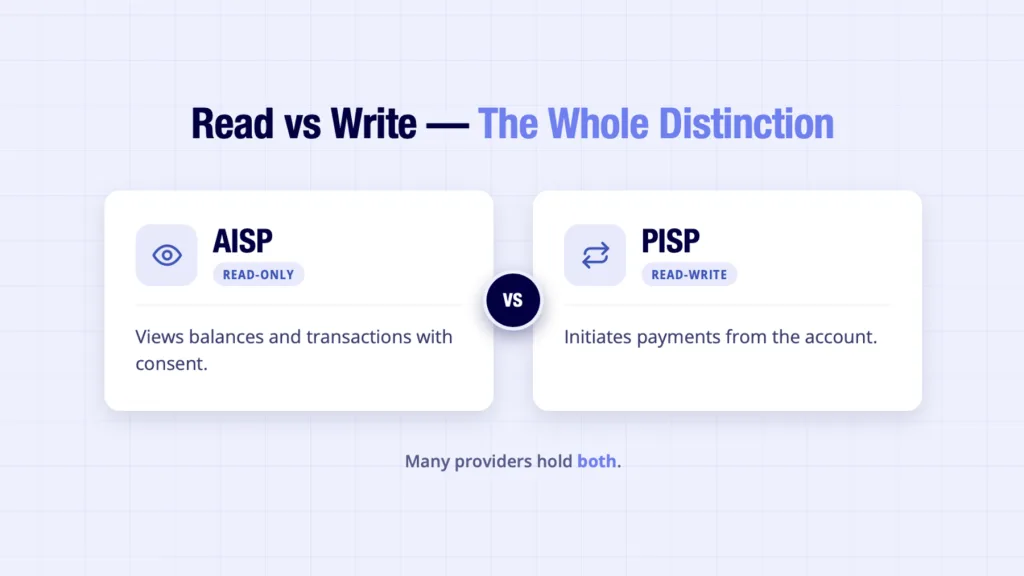
The cleanest way to hold AISP vs PISP in your head is read versus write.
| Term | Stands for | Access | What it does | Everyday example |
|---|---|---|---|---|
| AISP | Account Information Service Provider | Read-only | Views balances and transactions | Budgeting app, bank feeds |
| PISP | Payment Initiation Service Provider | Read-write | Starts payments from the account | Pay-by-bank checkout |
| ASPSP | Account Servicing Payment Service Provider | Holds the account | The bank or building society itself | Barclays, Monzo |
| TPP | Third Party Provider | Umbrella term | Any AISP or PISP | Fintech providers |
PISP Meaning: Initiating Payments with Customer Consent
PISP meaning in practice: with the customer’s approval, the provider instructs the bank to send a payment. Pay-by-bank checkout, invoice settlement, and account-to-account payouts are the common payment initiation service examples you will meet in UK products today.
The Two Roles Solve Different Product Needs
If your product needs to know something about an account, that is account information services territory. If it needs money to move, that is payment initiation. Many products need both, which leads to the licensing point below.
Is an AISP the Same as an ASPSP?
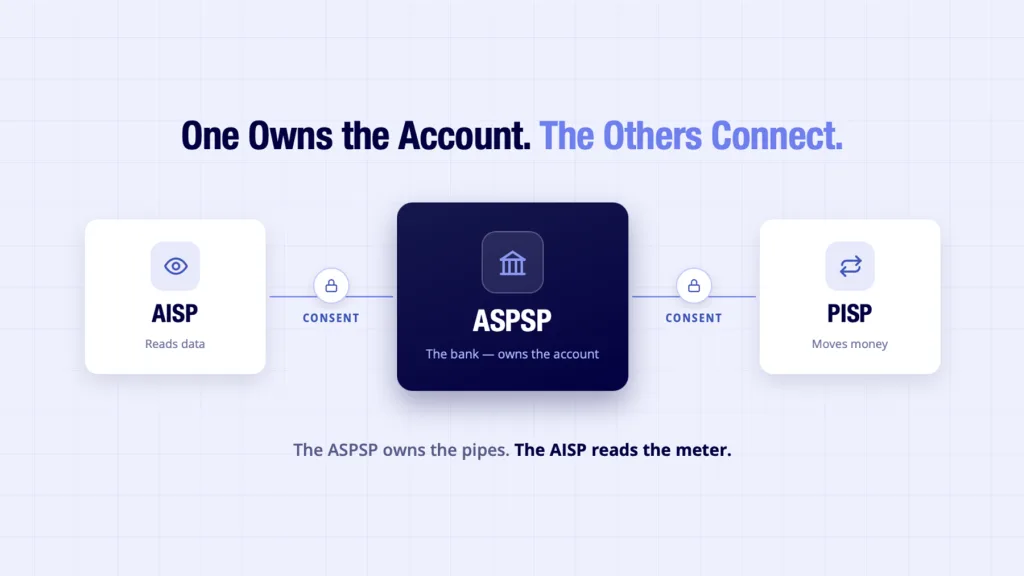
No, and the distinction is the fundamental of open banking.
The ASPSP is the account holder’s bank: It services the account and must open secure interfaces to authorised third parties. An AISP is one of those third parties, a TPP that connects in with consent. In short, the ASPSP owns the pipes; the AISP reads the meter. As of January 2026, 145 regulated firms operate as third-party providers in the UK, serving 17.5 million live user connections (Open Banking Limited).
Why do Many Providers Hold Both AISP and PISP Licences?
Because real products rarely stay on one side of the read-write line.
- An invoicing tool reads transactions to spot payment, then collects the next invoice by pay-by-bank. That is both roles in one journey.
- Dual-licensed providers offer data and payments under one FCA authorisation, one integration and one consent journey.
- Regulation treats the roles separately, so Open Banking compliance obligations differ slightly for each permission a firm holds.
- You can verify any provider’s permissions yourself: Search the FCA register, the public record behind each authorisation.
- For buyers, dual licensing is mostly a simple win: one contract and one due-diligence exercise instead of two.
How Do You Check Whether a Provider is a Genuine AISP?
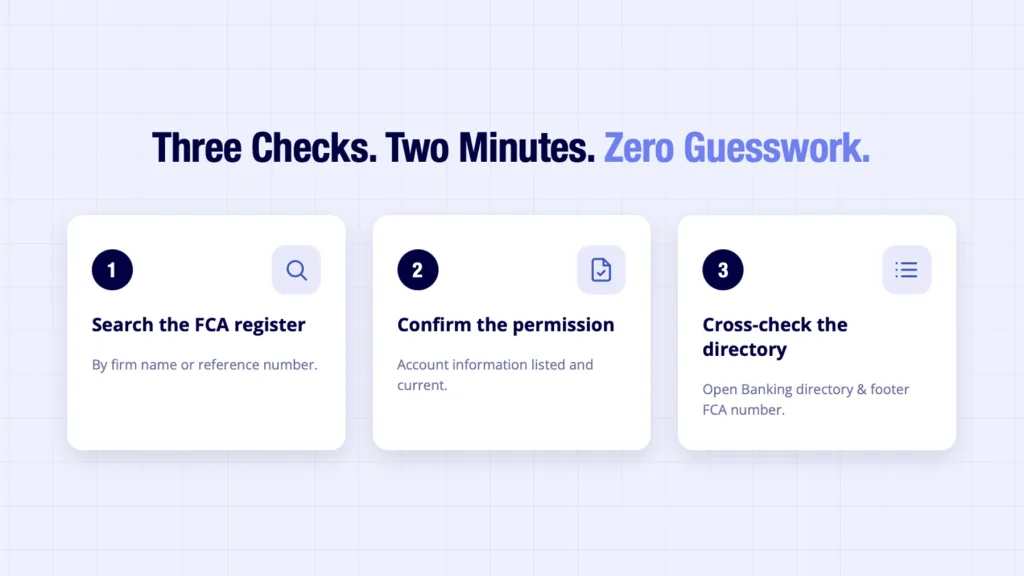
Every legitimate provider is publicly verifiable in minutes, and checking is worth the habit.
The FCA Register is the Official Record
Search the firm’s name or reference number on the register and confirm the account information permission is listed and current. Any AISP UK FCA record shows exactly which services the firm may provide, so a provider claiming data access without that entry is a red flag.
Two more quick checks help: the firm should appear in the Open Banking directory, and its website should state its FCA reference number plainly, usually in the footer.
Where does Finexer sit among these terms?
Finexer is a dual-licensed UK provider, which places it on both sides of the table above.
- FCA-authorised (FRN 925695) for account information services and payment initiation, so AISP and PISP permissions sit under one roof.
- Finexer’s Data (AIS) product delivers the read-only side: real-time balances and transactions with categorisation and balance enrichment included.
- Payments and Verification complete the write side and the checking layer, covering 99% of UK banks.
- Usage-based pricing, white-label consent screens and 3 to 5 week onboarding, built UK-first for SaaS, accounting, proptech and payroll platforms.
For the practical next steps, see AISP build vs buy on whether to use a provider or seek your own permissions, and AISP examples for named UK firms in each category.
The Bottom Line
Once you understand the difference between an AISP, PISP, ASPSP and TPP, choosing the right Open Banking partner becomes much simpler. Rather than navigating regulatory terminology, you can focus on selecting the capabilities your product actually needs.
What does AISP stand for?
The AISP full form is Account Information Service Provider. It is a firm the FCA authorises to access bank account information, read-only, with the customer’s consent. You can confirm any AISP UK FCA status on the public register. If you want the one-line answer to what an AISP is: a regulated data-reader for bank accounts.
What is the practical difference in AISP vs PISP?
Read versus write. An AISP views account data; a PISP initiates payments. A budgeting dashboard is an account information service provider example; pay-by-bank checkout and payouts are payment initiation services examples. Many firms are both.
Is an AISP the same as an ASPSP?
No. The ASPSP is the bank that holds and services the account. An AISP is a third party that reads data from it, through interfaces the bank is required to provide. One owns the account; the other visits with permission.
Do I need to become an AISP to use bank data?
Usually not. Most platforms build on a regulated provider’s permissions instead of applying to the FCA register themselves, which takes months and carries ongoing obligations. Working through a provider means the provider holds the licence and your product consumes the data. What is an AISP relationship worth building directly? Typically only when bank data is your core business rather than a feature. If it is a feature, a provider route gets you live in weeks, and you can revisit the decision later with real usage data in hand.
See how businesses use Finexer’s Open Banking platform to access real-time account data, initiate payments, and launch faster with a single integration.
Explore with AI
About the Author

Clare Pearson
Clare Pearson is a senior payments professional with extensive experience across the global financial services and payments industry. She specialises in Open Banking, payment infrastructure, and financial technology transformation, with expertise spanning product delivery, operational strategy, regulatory compliance, and large-scale payments programmes. Clare currently serves as a Non-Executive Director at Finexer and a panel member for the Payment Systems Regulator (PSR), advising on the development of payment systems policy and innovation