
Most open banking API use cases UK guides show business outcomes. Real open banking use cases differ when you see the actual API structures. This covers what developers actually build.
Concrete open banking API examples at the endpoint level, backed by real data structures and practical implementation decisions that help turn a weekend proof-of-concept into a production-ready application. Why open banking UK beats alternatives becomes clear once you see actual API responses.
API responses are not just “account data” – they include structure, timestamp format, pagination cursors, and edge cases. This guide skips business outcomes and dives into responses, common pitfalls, and decisions you’ll make building your first open banking API use cases integration.
Key takeaways
- AIS endpoints return account balances, transaction history, and account holder details. A single GET request retrieves structured transaction objects with amount, merchant, category, and ISO date fields.
- PIS endpoints initiate payments from the user’s account with explicit consent, returning a unique payment reference and status. Developers track completion through webhooks or polling.
- The most common open banking API examples today are account aggregation (multi-bank views), affordability checks (income detection from transaction patterns), and Pay by Bank checkout (card-free payments).
- Open banking API providers handle the FCA compliance layer. Your job is building the user experience on top of the authentication handoff.
What Are AIS Endpoints, and What Do They Power?
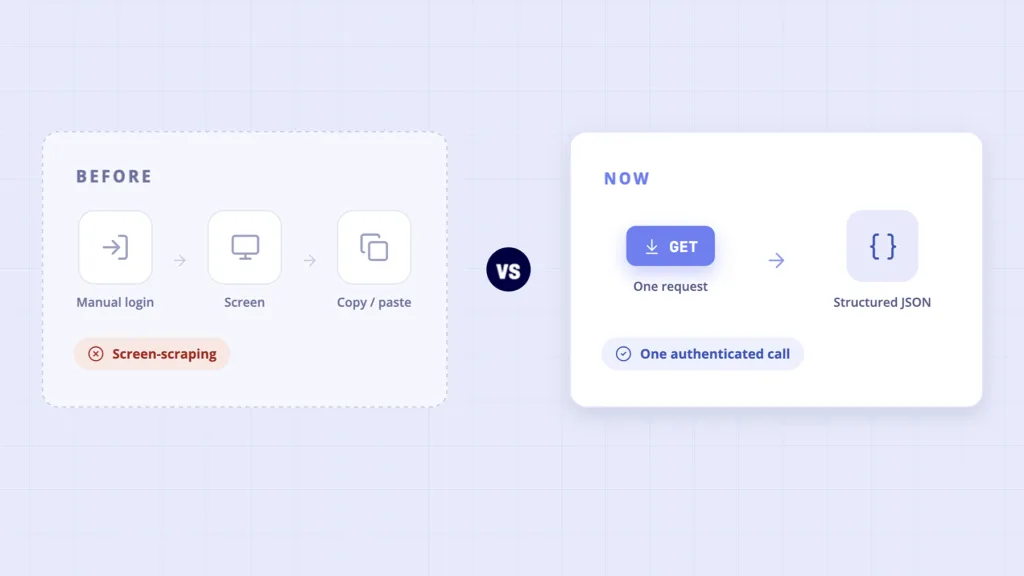
An AIS endpoint exposes read-only access to bank account data. A single authenticated call replaces manual login or screen-scraping.
AIS Account Retrieval: The Foundation of Every Use Case
A typical open banking API example call returns account balances in JSON: a list of accounts with current balance, available balance, and last-updated timestamp. The structure is the same across banks, which is why open banking API use cases are simpler than screen-scrAPIng: no merchant-specific parsing needed.
From here, open banking API examples branch into three main use cases.
Use Case 1: Account Aggregation and Multi-Bank Dashboards
Account aggregation, a common open banking API personal use case via multi-bank dashboards, is why teams reach for open banking API providers first. A user grants consent once, and your app retrieves balances and recent transactions from all their banks in a single view.
What You Integrate: GET /accounts (list accounts), GET /transactions (retrieve 90+ days), and webhooks for new transactions. Merchant names arrive cleaned, not raw bank codes. Pagination uses cursors instead of page numbers. Save the nextCursor value from each response to fetch the next set of results.
Use Case 2: Affordability Checks and Income Detection
Lenders use data retrieval via open banking to assess affordability without manual payslip uploads. You retrieve 3–12 months of transactions and detect recurring income by looking for payments marked with “category”: “INCOME”. Group transactions by merchant, calculate intervals, and set a confidence threshold. Monthly paychecks have high confidence; one-off transfers don’t. This is why open banking API use cases outpace manual checks: you’re reading real data, not guessing.
Use Case 3: Reconciliation and Transaction Categorisation
Real open banking use cases include accounting tools matching invoices to bank transactions automatically using real-time data retrieval via GET /transactions. Transaction categorisation (e.g., “category”: “OFFICE_SUPPLIES”) eliminates building a merchant taxonomy. Transaction references are often blank or unreliable, so match on amount and date first, then reference as confirmation.
What Open Banking API Examples Can You Build with PIS Endpoints?
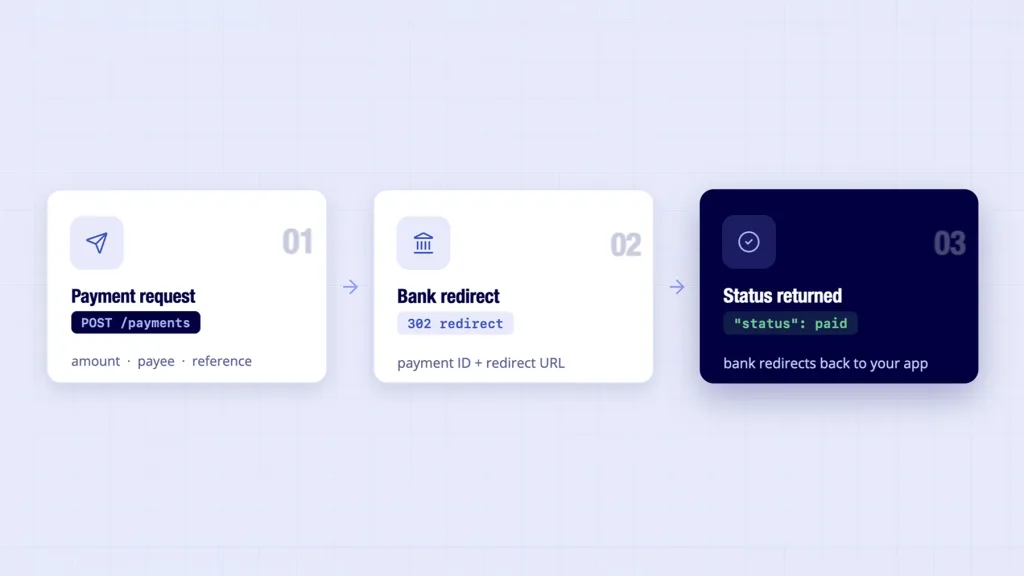
A PIS endpoint allows your app to move money from the user’s account. They’re the technology behind Pay by Bank checkouts, enabling lower fees, stronger security, and near-instant settlement.
PIS Payment Initiation: The Checkout Flow
A PIS payment request includes amount, payee, and reference. The API returns a payment ID and a redirect URL for the user to authenticate at their bank. Once authenticated, the bank redirects back with payment status. That redirect is the authentication layer for open banking API examples: no passwords shared with your app.
Use Case 1: Pay by Bank Checkout (Card-Free E-Commerce)
Pay by Bank (an open banking API use case for checkout) starts with a POST /payments request to create the payment. You can then track its status using GET requests or webhooks. Always include an Idempotency-Key header to prevent duplicate payments if a request is retried. The result is near-instant settlement with no card chargebacks.
Use Case 2: Bulk Payouts and Employee Disbursements
Payroll uses batch POST /payments to disburse to employees. Open banking UK payroll schedules payments for future dates using requestedExecutionDate. The API confirms the date or suggests an alternative if that date is a weekend or holiday. Respecting that response prevents payroll from moving on the wrong day.
Use Case 3: Variable Recurring Payments (VRP) and Subscription Billing
VRP (Variable Recurring Payments) establishes a blanket permission to collect varying amounts within agreed limits. A user consents to “collect up to £50 per month”, and you initiate collections automatically. Track the cumulative amount and reset monthly. Exceeding the limit triggers rejection.
Here’s a quick comparison to provide distinctive insights into AIS and PIS:
| Feature | AIS (Account Information Services) | PIS (Payment Initiation Services) |
|---|---|---|
| Purpose | Read bank account data | Initiate bank payments |
| Access | Read-only | Payment initiation |
| Typical endpoints | GET /accounts, GET /transactions | POST /payments |
| Common use cases | Account aggregation, affordability checks | Pay by Bank, payouts, VRP |
| Customer consent | Required | Required |
How Open Banking API Examples Fit Together: Authentication and Consent
API endpoints setup requires a consent handshake. The user connects to their bank, approves permissions, and your app receives access and refresh tokens. Refresh tokens last longer (90 days) than access tokens, so implement token rotation to avoid expiry.
The table below will provide insightful information on how each use case can benefit from an open banking API:
| Use Case | Primary Endpoint | Output |
|---|---|---|
| Account aggregation | GET /accounts | Multi-bank dashboard |
| Affordability checks | GET /transactions | Income and spending analysis |
| Expense reconciliation | GET /transactions | Automatic transaction matching |
| Pay by Bank checkout | POST /payments | Customer payment |
| Payroll payouts | POST /payments | Employee disbursements |
| Variable Recurring Payments | POST /payments + Consent | Subscription billing |
Where Does Finexer Fit In?
Finexer helps open banking users UK and across Europe build applications and implement open banking API use cases through a single regulated platform.
- Finexer’s Connect API handles the authentication layer above, so you focus on building the UX, not managing OAuth handshakes or token expiry.
- Finexer’s AIS API returns structured account and transaction data with transaction categorisation built in (no merchant taxonomy to maintain). Real-time webhooks notify your app of new transactions the moment they arrive at the bank.
- PIS (payments) sits alongside AIS under the same integration, so multi-step flows like “verify affordability then collect payment” operate through one authorised connection.
- 99% UK bank coverage, including business accounts for sole traders and SMEs.
- Sandbox access with realistic test data (pending transactions, failed payments, edge cases) means you validate error handling before production.
For how to operationalise these open banking API examples at scale, see how to use Open Banking API for production design patterns.
The bottom line
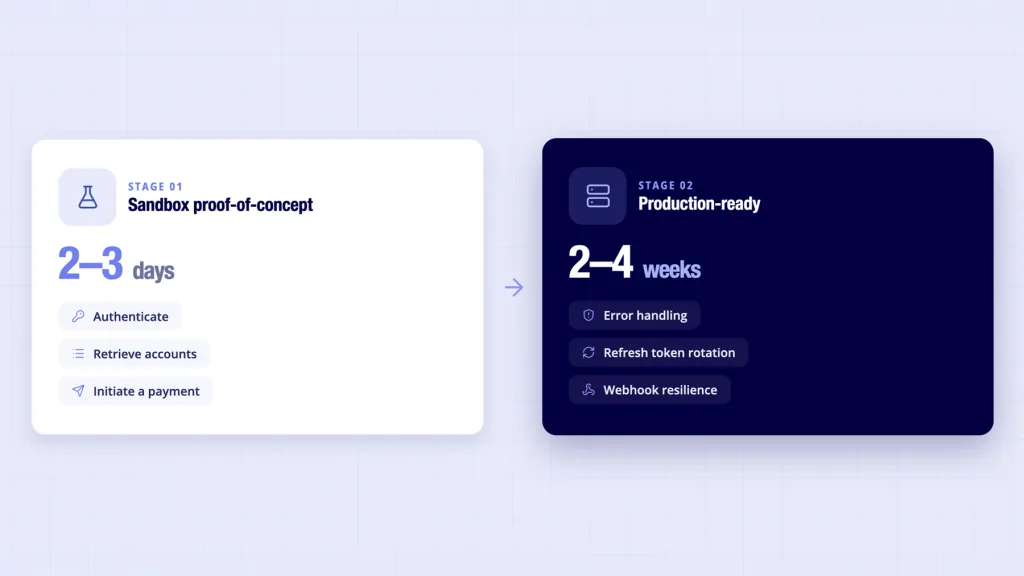
A working open banking API integration and a production one differ in technical depth and error handling. Understanding each endpoint, consent mechanics, and pagination failures separates three-week projects from three-month ones. Start in a sandbox with real data structures, test error cases (failed payments, expired tokens), and move to production only after you’ve validated them thoroughly. This prevents costly integration failures down the line.
What are the best open banking API use cases today in the UK?
Some of the best open banking API use cases UK teams deploy include account aggregation (multi-bank views), affordability checks using transaction data, Pay by Bank checkout, bulk payouts, and expense reconciliation. Why open banking dominates these use cases is that each needs real-time bank data or real-time payment initiation, which legacy APIs can’t provide.
What can you build with an AIS API?
Any product that reads account data: budgeting apps, accounting software, lending platforms, insurance underwriting, tenant screening. The AIS endpoint returns account balances, transaction history, and account holder identity with live updates. Real-time data is the technical differentiator.
What can you build with a PIS API?
Any product that moves money: pay-by-bank checkouts, payroll disbursements, invoice collection, marketplace payouts, VRP subscriptions. PIS eliminates card fees and fraud exposure, which is why open banking API examples in payments are growing fastest.
How long does integration take if you use an open banking API provider?
Sandbox proof-of-concept in 2–3 days (authenticate, retrieve accounts, initiate a payment). Production-ready integration (error handling, refresh token rotation, webhook resilience) in 2–4 weeks. The provider handles FCA compliance; your job is connecting endpoints to your UX. Why this matters: you’re not building a regulated service, you’re consuming one.
Can I run these open banking API examples without an open banking API provider?
Technically yes (apply to the FCA for your own licence), but practically no. Licensing takes 6+ months, costs tens of thousands annually, and requires ongoing compliance overhead. Every major open banking API use cases company today uses a provider.
See how Finexer’s AIS, PIS, and Verification APIs help you build production-ready Open Banking integrations through a single regulated platform.
Explore with AI
About the Author

Yuri
Yuriy Yakushko is a fintech founder and software engineer with over 20 years of experience building financial technology. He’s passionate about creating scalable, secure infrastructure that helps businesses modernise how they access financial data and manage payments.