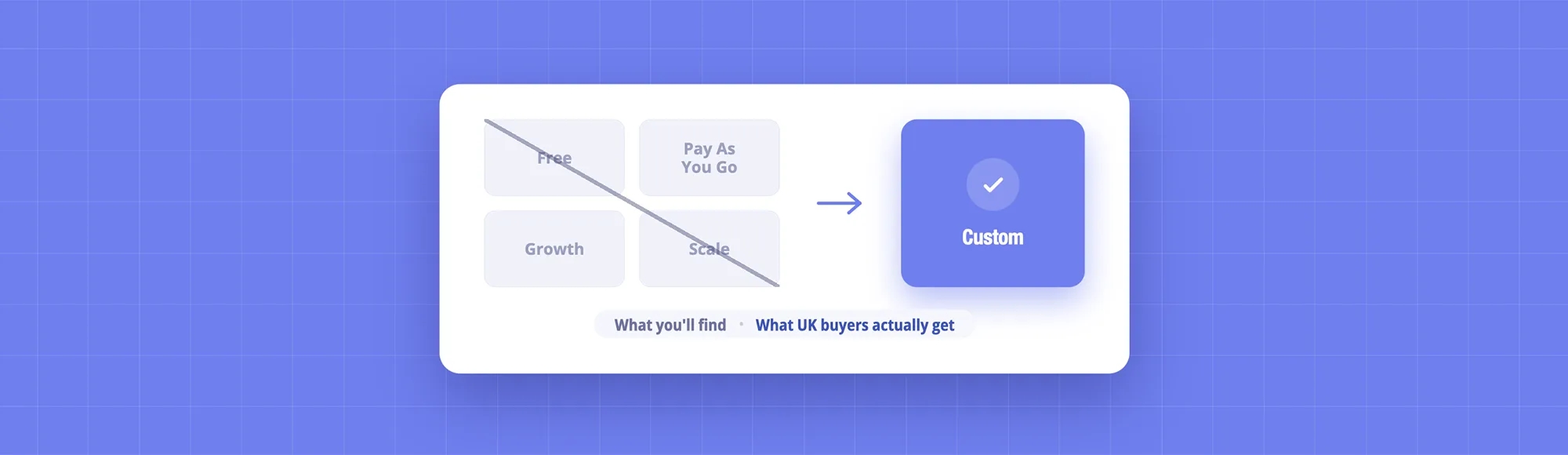
The biggest surprise about Plaid pricing isn’t how much it costs.
It’s that many UK businesses never actually see a price.
They see a sales form.
If you’ve searched for Plaid pricing UK, you’ve probably found screenshots of transparent US pricing pages, only to discover that they don’t apply to your business. Instead of choosing a plan, UK buyers typically begin a commercial discussion that determines pricing, onboarding and commercial terms.
TL;DR: The most important thing to understand about Plaid pricing is that UK businesses generally do not purchase through the same self-serve pricing model available to many US customers. Instead, commercial discussions determine pricing based on products, projected usage and implementation requirements. For startups and scale-ups, that changes procurement, budgeting and deployment timelines long before the first API call is made.
This article is based on publicly available pricing information, Plaid documentation, UK Open Banking market practices and publicly disclosed enterprise pricing patterns as of July 2026. Commercial agreements vary by customer, so buyers should always confirm current pricing directly during procurement.
“Pricing isn’t just about cost. It’s about predictability. When engineering teams can’t estimate infrastructure costs before procurement begins, budgeting becomes another technical dependency rather than a commercial decision.” – Ravi Ranjan, Finexer
The Challenge with Plaid Pricing in the UK
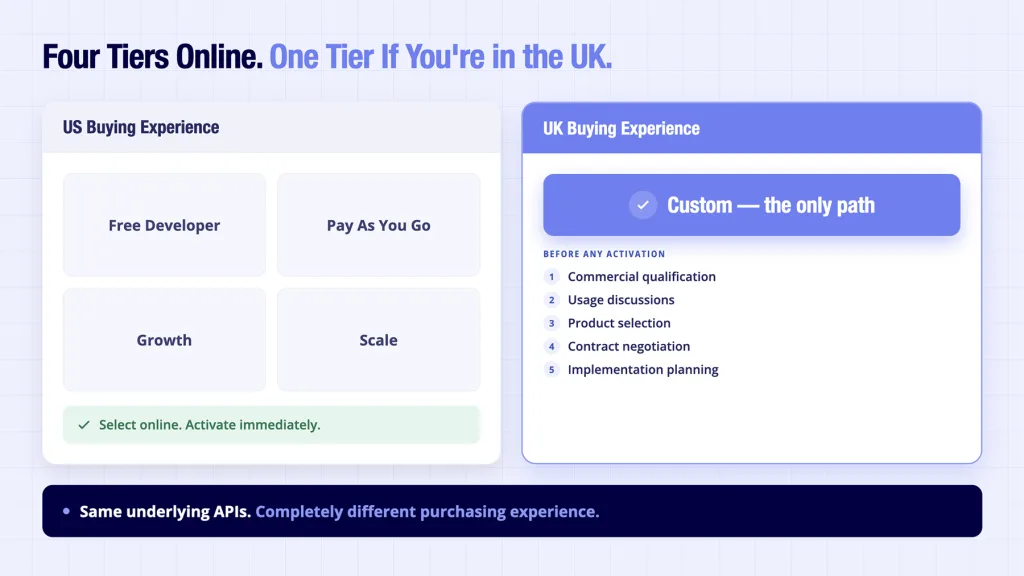
Plaid pricing UK differs from what many buyers expect because the UK commercial model isn’t built around publicly selectable subscription tiers.
That’s where much of the confusion begins.
A founder researching Open Banking APIs often finds articles describing the following:
- Free Developer plans
- Pay As You Go
- Growth
- Scale
Those descriptions largely reflect the US buying experience.
A UK fintech, accounting platform or SaaS business usually follows a different journey.
Instead of selecting a package online, the process commonly begins with the following:
- commercial qualification
- usage discussions
- product selection
- contract negotiation
- implementation planning
None of these are inherently negative.
Enterprise infrastructure often works this way.
The issue is expectation.
Many buyers believe they’ll be able to activate an account immediately, only to discover that pricing is determined through a sales process.
That distinction matters when product roadmaps depend on predictable implementation timelines.
What Actually Determines Plaid Pricing?
Plaid pricing is product-based rather than simply subscription-based.
Different APIs are priced differently because they solve different problems.
Broadly speaking, buyers encounter several pricing components.
| Pricing Component | Typical Commercial Model |
|---|---|
| Account connectivity | Usage-based |
| Transactions | Subscription plus usage |
| Identity | One-time or per-use pricing |
| Auth | Per-call pricing |
| Enterprise support | Custom contract |
| Monthly minimums | Common for enterprise agreements |
Rather than paying one flat enterprise fee, businesses typically combine several products into a commercial agreement.
That means two companies using Plaid can have completely different pricing structures despite integrating the same provider.
What UK Buyers Should Expect During Procurement
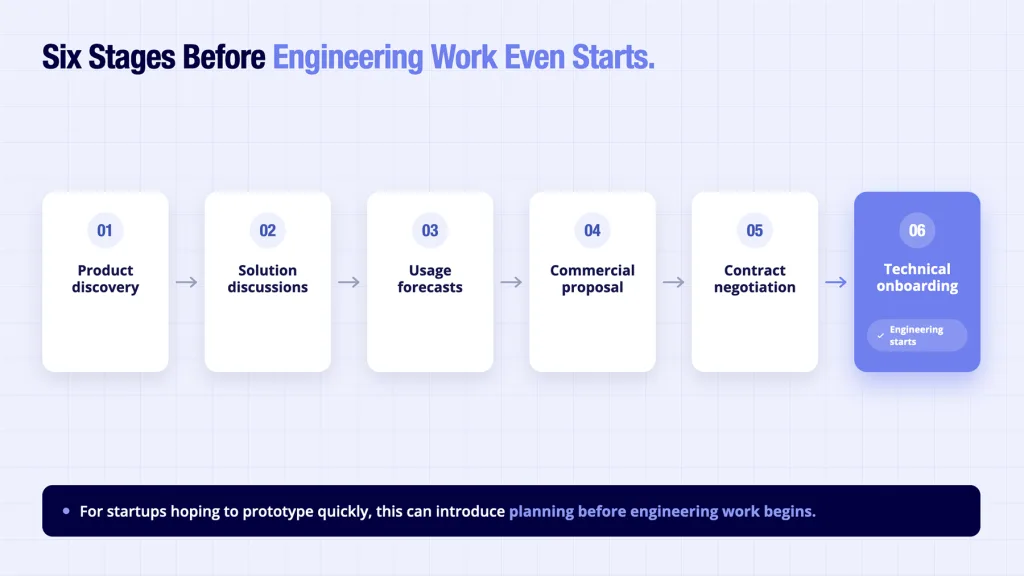
For UK businesses, evaluating Plaid pricing UK usually involves more than requesting a quotation.
The commercial journey often includes the following:
- Product discovery
- Solution discussions
- Usage forecasts
- Commercial proposal
- Contract negotiation
- Technical onboarding
For established enterprises, this process is familiar.
For startups hoping to prototype quickly, it can introduce additional planning before engineering work even begins.
This doesn’t mean Plaid is unsuitable for startups.
It simply means procurement expectations should reflect the commercial model being offered.
What Costs Should You Budget For?
The quoted API price is only one part of the investment.
Implementation costs frequently include several additional categories.
Engineering
Developers must integrate APIs, manage authentication flows, handle consent lifecycles and build monitoring around production systems.
Infrastructure
Secure hosting, encryption, logging and operational monitoring all contribute to total implementation cost.
Compliance
Financial applications operating within UK Open Banking frameworks must consider FCA requirements, Strong Customer Authentication (SCA), GDPR and operational governance.
Support
As production usage grows, businesses often require higher support levels, additional environments or commercial assistance beyond developer documentation.
For many organisations, these indirect costs exceed API charges during the first implementation phase.
What Should Startups Evaluate Beyond Price?
The cheapest API isn’t automatically the least expensive solution.
Instead of comparing headline prices alone, evaluate providers using a broader scorecard.
1. Pricing transparency
Can you estimate costs before speaking with sales?
Predictable pricing makes budgeting significantly easier during product planning.
2. Product coverage
Do you need only AIS?
Or will your roadmap later require payment initiation, identity verification or recurring payments?
Switching providers later often costs more than choosing appropriately at the outset.
3. Deployment timeline
Some infrastructure can be implemented relatively quickly.
Others require longer procurement and onboarding processes.
Understanding that timeline early prevents launch delays.
4. Commercial flexibility
Does pricing scale naturally with transaction volume?
Or do commercial agreements require renegotiation as usage grows?
Businesses scaling rapidly should consider how pricing evolves over several years-not simply the first contract.
5. UK market focus
Global providers naturally optimise for global customer bases.
UK-focused infrastructure providers may instead prioritise domestic bank connectivity, Open Banking standards and local commercial support.
No approach is universally superior.
The right choice depends on your product strategy.
Comparison Snapshot
| Evaluation Criteria | Self-Serve SaaS | Enterprise Commercial Model |
|---|---|---|
| Immediate pricing visibility | ✓ | Usually No |
| Online activation | ✓ | Usually No |
| Custom commercial terms | Limited | ✓ |
| Enterprise procurement | Limited | ✓ |
| Contract flexibility | Lower | Higher |
| Suitable for complex implementations | Sometimes | ✓ |
Neither model is inherently better.
One optimises for speed.
The other optimises for commercial flexibility.
The key is understanding which buying experience matches your organisation before procurement begins.
The Gap: Why Pricing Pages Don’t Answer the Real Question
Most discussions around plaid pricing focus on dollars per API call.
That’s rarely what delays implementation.
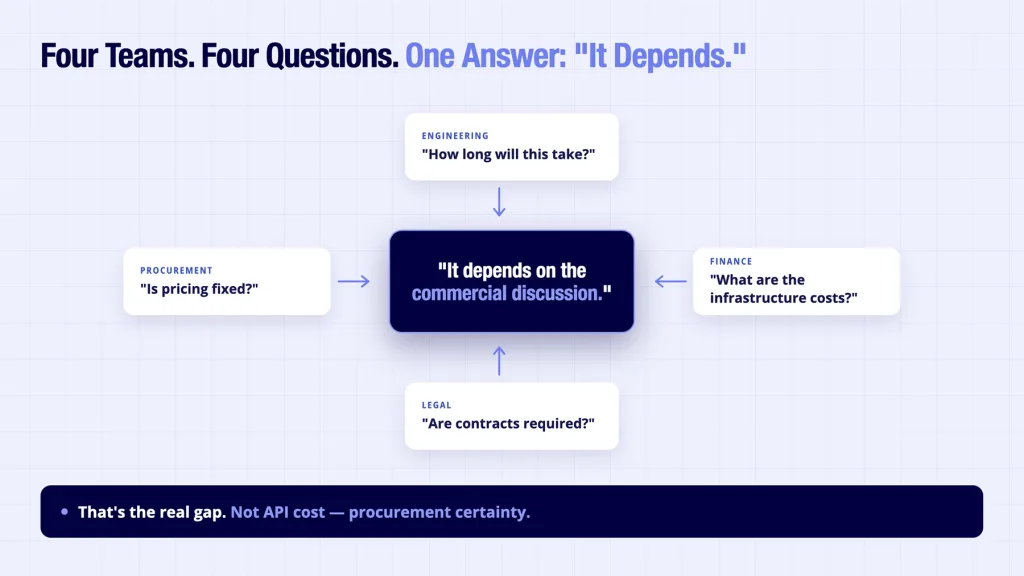
Imagine a product manager preparing next quarter’s roadmap.
Engineering estimates four weeks.
Finance asks for infrastructure costs.
Legal asks whether contracts are required.
Procurement asks whether pricing is fixed.
The answer to every question becomes:
“It depends on the commercial discussion.”
That’s the real gap.
Pricing isn’t only about API costs.
It’s about procurement certainty.
And for many UK startups, that’s the difference between launching this quarter – or the next.
Where Finexer’s Data Infrastructure Fits
Understanding Plaid pricing naturally leads to another question.
What if your business wants a different commercial model?
Businesses looking beyond Plaid pricing often discover that the commercial model matters just as much as the API itself.
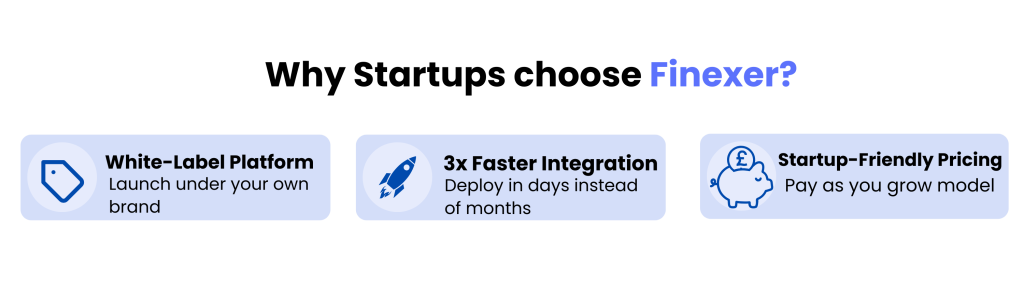
While enterprise contracts suit many larger organisations, startups and scaling platforms frequently prefer predictable, usage-based pricing.
That’s where evaluating infrastructure – not simply providers – becomes important.
For organisations comparing commercial approaches, Finexer’s Data API provides Open Banking data connectivity across almost all UK banks with a usage-based commercial model, helping teams estimate infrastructure costs earlier in the buying journey.
Finexer provides Open Banking data infrastructure designed specifically for UK businesses building financial products, accounting software, lending platforms and embedded finance applications.
Unlike generic comparisons between providers, the objective is to match commercial structure with business requirements.
Here’s what that typically looks like.
Designed for UK Open Banking
Businesses evaluating Plaid pricing UK often compare several practical considerations beyond API capability.
These include:
- Broad UK bank connectivity
- FCA-authorised Open Banking access
- Developer-first APIs
- Predictable onboarding
- Commercial flexibility
- Local implementation support
If your roadmap centres on bank connectivity rather than global financial aggregation, those factors can influence procurement just as much as pricing.
Learn more about Finexer’s AIS API and how UK-focused Open Banking infrastructure supports financial products requiring real-time account information.
What Is Plaid API Pricing?
Many buyers searching for plaid api pricing assume there’s one universal rate.
There isn’t.
Pricing depends on three variables.
1. Which APIs you use
Different products carry different commercial structures.
Examples include the following:
- Account Information
- Transactions
- Identity
- Auth
- Investments
- Assets
Using multiple APIs naturally changes commercial agreements.
2. How frequently they’re used
Some services are charged once.
Others generate recurring usage charges.
Industry discussions commonly reference per-call pricing ranging from approximately $0.10 to $0.60, depending on the product and commercial agreement.
Those figures should be treated as indicative rather than universal.
Enterprise contracts frequently vary.
3. Contract structure
Many enterprise customers negotiate:
- monthly minimum commitments
- annual agreements
- volume discounts
- bundled pricing
Industry reporting also suggests monthly commercial minimums often begin around $1,000–$3,000, although actual agreements vary considerably depending on customer size, geography and products purchased.
The important point isn’t the exact number.
It’s understanding that UK buyers typically negotiate pricing rather than selecting an advertised subscription.
Choosing the Right Evaluation Framework
Rather than asking,
“Is Plaid expensive?”
Ask better questions.
| Better Question | Why It Matters |
|---|---|
| Can we estimate costs before procurement? | Improves budgeting accuracy |
| How quickly can engineering start? | Determines launch timelines |
| Does pricing scale with growth? | Avoids unexpected commercial renegotiations |
| Are UK banking requirements well supported? | Reduces implementation risk |
| Does the provider match our roadmap? | Prevents expensive migrations later |
That framework creates far better buying decisions than comparing API prices alone.
If you’re researching broader implementation approaches, our guide to popular banking API examples explores how different APIs are used across lending, accounting, payments and embedded finance.
You may also find our comparison of Ivy vs Tink vs Finexer useful when evaluating infrastructure strategies beyond pricing alone.
Why doesn’t Plaid publish UK self-serve pricing?
Plaid’s UK commercial model generally follows enterprise procurement rather than the publicly selectable pricing tiers familiar to many US customers. Businesses usually begin with a commercial discussion before receiving a proposal tailored to their products and anticipated usage.
Does Plaid charge per API request?
Certain products use usage-based pricing, while others follow subscription or one-time pricing structures. Actual commercial terms depend on the APIs selected and the negotiated agreement.
Are there alternatives to Plaid for UK Open Banking?
Yes, Several UK-focused Open Banking providers offer bank connectivity, payment initiation and data APIs with different commercial models, onboarding approaches and pricing structures. The best choice depends on your product requirements rather than headline API pricing.
What should I compare before choosing an Open Banking provider?
Look beyond price, Evaluate bank coverage, API maturity, onboarding time, commercial flexibility, developer experience, regulatory credentials, support quality and how well the provider aligns with your product roadmap.
Ready to Evaluate Open Banking Infrastructure with Confidence?
Pricing should accelerate decisions, not delay them.
Whether you’re comparing Plaid pricing, evaluating enterprise procurement or looking for a UK-focused Open Banking partner, understanding the commercial model is just as important as understanding the API itself.
See how Finexer’s UK-exclusive focus provides 99% bank coverage without multi-market complexity.
Explore with AI
About the Author

Ravi Ranjan
Ravi Ranjan is Co founder & CEO of Finexer