
Stop guessing. Start verifying.
Replace document-heavy tenant referencing with bank-verified income data and make faster, more confident letting decisions backed by Open Banking infrastructure.
A forged payslip can look perfect.
A bank account rarely lies.
That’s why the future of the rent affordability check isn’t another calculator, another checklist or another document upload. It’s verifying income directly from the source that matters most – the tenant’s bank.
TL;DR: A modern rent affordability check should verify income using bank data rather than relying solely on tenant-uploaded documents. While the UK’s 30× annual rent guideline remains a useful starting point, Open Banking adds the missing verification layer by confirming income from real banking activity, reducing fraud and compressing verification from days to minutes once consent is given.
This guide is based on current UK letting practices, Open Banking standards, FCA requirements and operational workflows used across PropTech platforms and tenant referencing providers. Timing and implementation vary by organisation, but the verification principles discussed reflect current industry practice.
“Affordability isn’t really about mathematics. It’s about confidence in the underlying data. If the income figure can’t be trusted, every affordability calculation that follows becomes little more than an educated guess.” – Ravi Ranjan, Finexer
The Challenge with Rent Affordability Checks Today
A rent affordability check is only as reliable as the evidence supporting it.
Most letting agents still build affordability decisions around documents supplied by the applicant – payslips, PDFs, screenshots and bank statements downloaded by the tenant. Those documents may be genuine, but verifying them takes time, and distinguishing authentic documents from altered ones is becoming increasingly difficult.
The operational cost is significant.
For employed applicants, manual affordability verification typically takes 24–48 hours.
For self-employed applicants with multiple income sources, verification commonly stretches to three to five working days.
During that time:
- Properties remain unavailable.
- Landlords wait for decisions.
- Referencing teams chase missing documents.
- Genuine applicants become frustrated.
- Fraudulent applications have more opportunity to slip through.
The problem isn’t the affordability calculation.
It’s trusting the income figure before the calculation even begins.
Why the Traditional 30× Rule Isn’t Enough
The UK’s widely used affordability benchmark remains useful.
Many letting agents expect annual income to equal at least 30 times the monthly rent, broadly equivalent to spending around 40% of gross income on housing.
For example:
| Monthly Rent | Typical Annual Income Expected (30× Rule) |
|---|---|
| £900 | £27,000 |
| £1,200 | £36,000 |
| £1,500 | £45,000 |
| £2,000 | £60,000 |
The calculation is straightforward.
The verification isn’t.
If a payslip has been altered, the affordability ratio becomes meaningless regardless of how accurately it’s calculated.
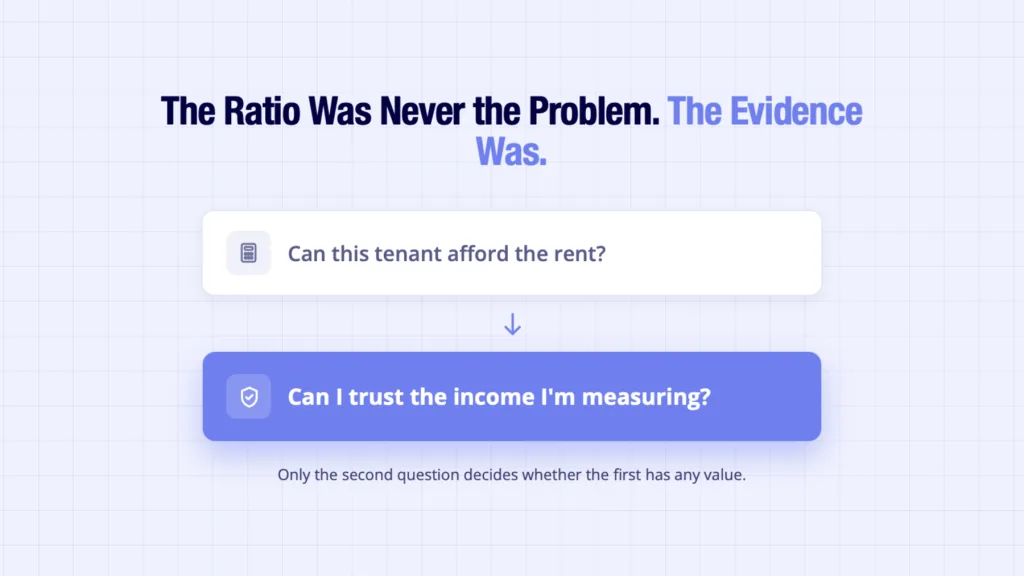
That’s why modern tenant referencing increasingly separates two questions:
- Can this tenant afford the rent?
- Can I trust the income I’m measuring?
Only the second question determines whether the first has any value.
What a Modern Rent Affordability Check Actually Requires
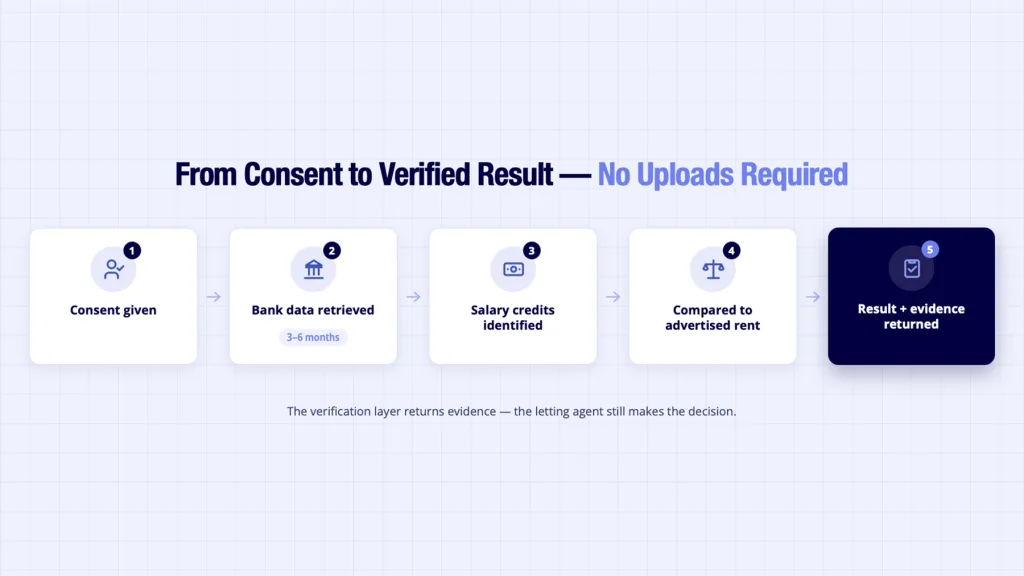
A modern rent affordability check should verify income before calculating affordability.
Instead of relying solely on uploaded documents, many PropTech platforms now use consent-based bank verification to assess income from actual banking activity.
A stronger workflow typically follows these steps:
- Tenant gives explicit Open Banking consent.
- Bank transaction history is retrieved securely.
- Salary deposits are identified across the previous three to six months.
- Regular income is distinguished from one-off credits.
- Monthly average income is calculated.
- Income is compared against advertised rent.
- The affordability assessment is returned with verified supporting evidence.
Notice what isn’t required.
No emailed payslips.
No screenshots.
No manually downloaded statements.
The calculation hasn’t changed.
The evidence has.
What to Look for in a Rent Affordability Verification Solution
Not every affordability workflow offers the same level of confidence.
When evaluating providers, look beyond headline turnaround times.
1. Verified income sources
The solution should prioritise bank-verified income over tenant-submitted documents wherever appropriate.
Verification matters more than calculation.
2. Historical income visibility
One month’s salary rarely tells the whole story.
Looking across three to six months helps identify consistent earnings, variable income and seasonal fluctuations.
3. Support for employed and self-employed applicants
Self-employed income often arrives irregularly.
A verification workflow should accommodate multiple income patterns without requiring entirely different processes.
4. Workflow automation
Income verification should integrate naturally into referencing workflows rather than creating another manual review stage.
Automation reduces operational delays while improving consistency.
5. Secure consent management
Applicants should always authorise access explicitly.
Consent-based access protects both the applicant and the organisation while maintaining compliance with UK Open Banking requirements.
Comparing Verification Approaches
| Verification Method | Income Verified | Fraud Resistance | Manual Review | Typical Processing Time |
|---|---|---|---|---|
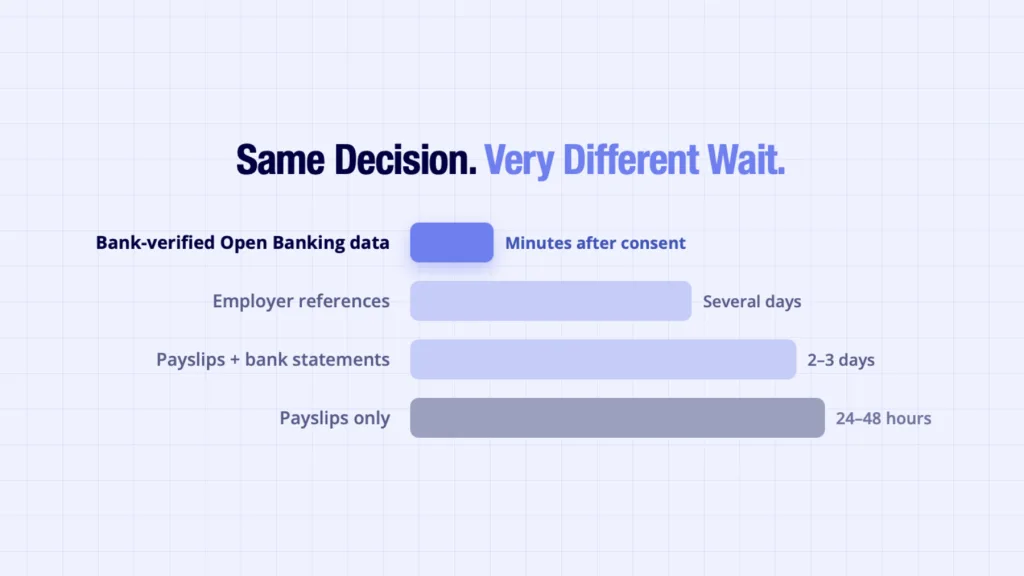
| Payslips only | Limited | Moderate | High | 24–48 hours |
| Payslips + bank statements | Better | Moderate | High | 2–3 days |
| Employer references | Partial | High | Moderate | Several days |
| Bank-verified Open Banking data | High | High | Low | Minutes after consent |
Each approach has its place.
Many organisations still combine several methods depending on applicant circumstances.
However, the trend is increasingly towards bank-verified evidence because it strengthens every subsequent affordability assessment.
The Gap: Why Document-Based Checks Still Leave Too Much Uncertainty
Traditional tenant referencing tools often calculate affordability correctly.
Their shared limitation is that they depend on documents whose authenticity must first be established.
Imagine two applicants applying for the same property.
Both submit payslips showing an annual salary of £48,000.
One document is genuine.
The other has been edited using freely available software in under ten minutes.
Visually, they may appear identical.
Operationally, they’re treated the same until someone spots an inconsistency, or doesn’t.
That’s the hidden weakness.
The affordability calculation isn’t wrong.
The underlying evidence may be.
The next generation of rent affordability check workflows therefore isn’t replacing affordability ratios.
It’s replacing uncertainty with verified financial data before the calculation even begins.
Where Finexer’s Verification Infrastructure Fits
A stronger rent affordability check starts with stronger evidence.
That’s exactly where verification infrastructure comes in.
Finexer doesn’t determine whether a tenant should be accepted, calculate affordability ratios or replace a letting agent’s judgement. Instead, it provides the verified bank data that allows PropTech platforms and referencing providers to make better-informed affordability decisions.
For organisations replacing document-heavy workflows, that distinction is critical.
How the verification workflow works
Here’s the mechanism behind a modern bank-verified affordability check:
- The tenant provides explicit consent through an Open Banking journey.
- Finexer’s Account Information Service (AIS) securely retrieves transaction data from the tenant’s bank.
- Salary credits and recurring income are identified across the selected history (typically three to six months).
- Structured transaction data is returned to the referencing platform.
- The platform applies its own affordability policy, whether that’s the 30× rule, custom ratios or additional underwriting criteria.
- The result is presented to the letting agent together with verified supporting evidence.
The verification layer provides trustworthy financial data.
The approval decision always remains with the letting agent or PropTech platform.
If you’re exploring Open Banking for Proptech, affordability verification is one of the clearest examples of how bank-verified data improves operational workflows without changing business policies.
Why verification infrastructure matters
The difference isn’t simply faster processing.
It’s greater confidence in the underlying evidence.
Relevant capabilities include:
- FCA-authorised AISP (FRN925695)
- Consent-based bank data retrieval
- Historical transaction history (subject to participating bank availability)
- Real-time webhook notifications for consent and data events
- Usage-based pricing
- 3–5 weeks onboarding support
- 99% UK bank coverage
To understand how verification fits into broader tenant referencing workflows, explore Finexer’s Verification product.
If your organisation builds solutions for landlords, agencies or property platforms, our Proptech & Real Estate use case explains where verification infrastructure delivers the greatest operational value.
What Is Affordability Check Rent?
Affordability check rent refers to the process of assessing whether a prospective tenant has sufficient income to meet ongoing rental payments.
Traditionally, that assessment relied on payslips, employer references and manually reviewed bank statements. Increasingly, letting agents and PropTech providers supplement or replace those documents with consent-based Open Banking verification that retrieves income information directly from the applicant’s bank.
This doesn’t change the affordability calculation itself.
Instead, it strengthens the quality of the data feeding that calculation.
For example, recurring salary credits can be identified across several months of transaction history, providing a more reliable picture than a single uploaded payslip. That becomes particularly valuable where applicants have multiple employers, irregular earnings or self-employed income.
Many letting agents using Open Banking now view verified bank data as an additional layer of confidence rather than a replacement for professional judgement.
Likewise, the same infrastructure increasingly supports broader Proptech apps using Open Banking, including tenant referencing, rental payments and property management workflows.
Affordability is only one part of tenant due diligence. Before approving an application, many agencies also complete identity and compliance checks that serve an entirely different purpose.
While a rent affordability check asks, “Can this tenant comfortably afford the rent?”, AML checks for estate agents ask, “Do we know who this applicant is, and are we meeting our regulatory obligations?” Together, they provide a more complete picture without duplicating one another.
What is a rent affordability check?
A rent affordability check assesses whether a prospective tenant has enough income to sustain the proposed rent. Modern verification increasingly combines affordability calculations with bank-verified income rather than relying solely on tenant-submitted documents.
Does the 30× rent rule guarantee that a tenant can afford the property?
No. The 30× annual rent guideline is a widely used benchmark, but it only measures affordability if the income figure is accurate. Verifying that income through bank data provides greater confidence than relying exclusively on uploaded payslips.
Can tenants pass an affordability check using savings instead of income?
Sometimes. Some landlords and referencing providers may consider substantial savings, guarantors or other financial circumstances where regular income alone does not satisfy affordability requirements. Acceptance policies vary between landlords and letting agents.
How does Open Banking improve a rent affordability check?
Open Banking enables applicants to consent to secure access to bank transaction data, allowing verified income to be assessed directly from banking activity. It reduces dependence on manually reviewed documents and can significantly shorten verification times while improving confidence in the underlying financial evidence.
If affordability verification forms part of a broader compliance process, our guide to AML checks for estate agents explains how identity, compliance and financial verification work together without overlapping.
Replace uncertainty with verification.
See how Finexer’s Verification product helps PropTech platforms and letting agents verify tenant income using Open Banking infrastructure, reducing manual document reviews while strengthening every rent affordability decision.
About the Author

Ravi Ranjan
Ravi Ranjan is Co founder & CEO of Finexer