
Direct Debit has run UK subscription billing for over five decades, and for most of that time nothing credible challenged it. That changed quietly. VRP payments, built on variable recurring payments open banking rails, now offer subscription and SaaS businesses something Direct Debit never could: instant settlement, bank-enforced payment limits, and failure alerts at the moment of collection.
This guide explains how VRP payments work, what launched in 2026, and what it means for recurring billing.
Key takeaways
- VRP payments are pre-authorised, flexible account-to-account payments. Amounts can vary within payment limits the customer agrees once.
- Sweeping VRP (me-to-me transfers) has been mandated at the CMA9 banks since 2022; commercial VRP for business collections entered market rollout in 2026.
- The UK Payments Initiative launched its commercial VRP scheme in June 2026, backed by major UK banks, after the FCA expected first live payments in Q1 2026.
- Subscription use cases are the next phase of commercial VRP adoption. While support is still expanding across UK banks, now is the right time for businesses to evaluate the technology and plan future billing strategies.
What is a variable recurring payment?
A variable recurring payment is an open banking payment the customer authorises once, allowing a business or their own second account to collect varying amounts within agreed limits.
The customer sets the rules, and the bank enforces them
Consent covers who can collect, the maximum amount, and how long permission lasts. The customer’s bank enforces those payment limits in real time on every collection, which is a structural difference from Direct Debit, where the biller holds the mandate and errors are corrected after the fact.
Sweeping and commercial VRP are different stages
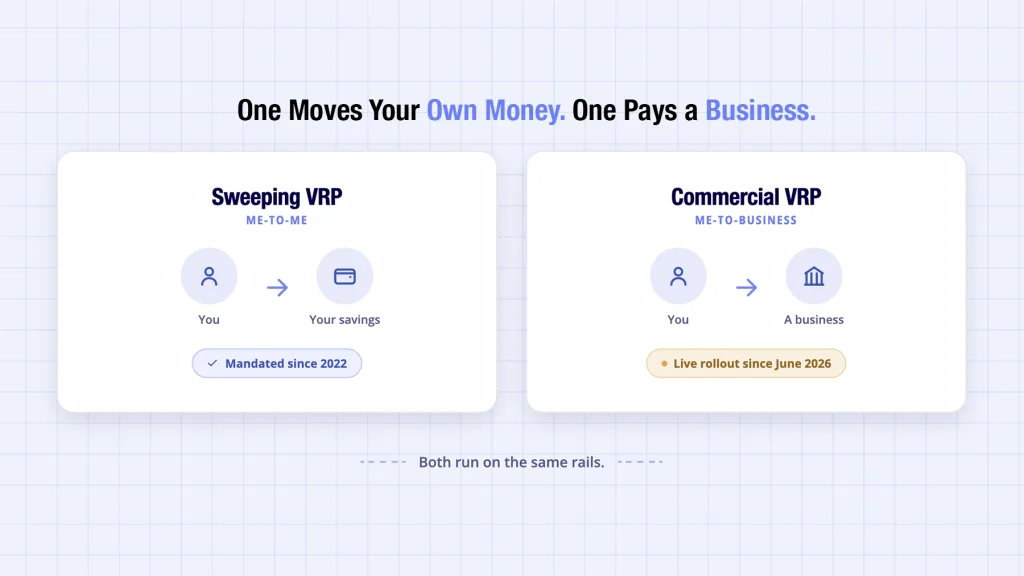
Both run on the same rails, but they serve very different jobs:
- Sweeping VRP (me-to-me): Moving money between two accounts in the same person’s name, for example current account to savings. Mandated at the nine largest UK banks (CMA9) since 2022.
- Commercial VRP (cVRP, me-to-business): Paying a company. This is the stage relevant to subscription billing, and it moved from pilots into a live scheme during 2025 and 2026.
Why are subscription businesses rethinking Direct Debit?
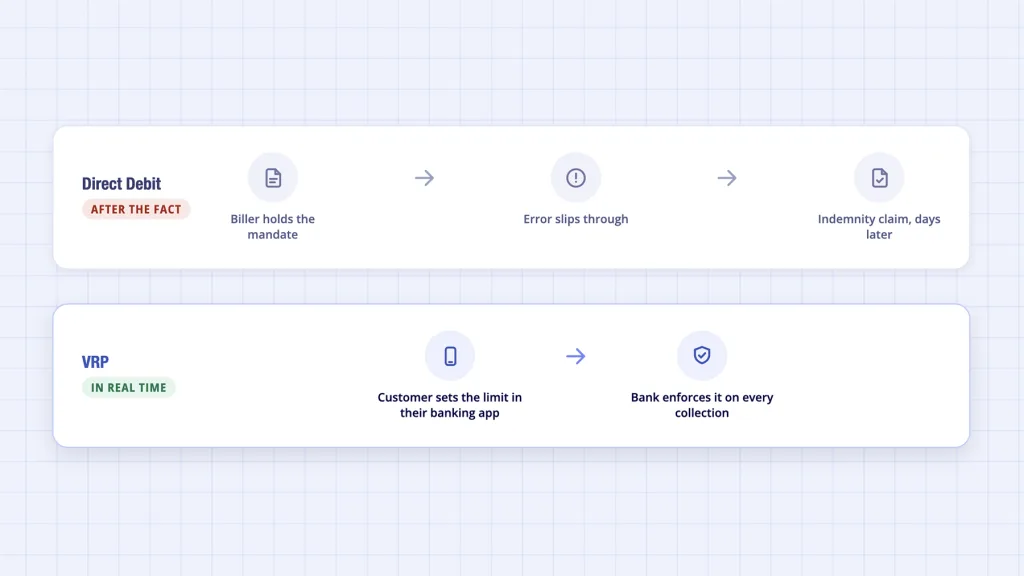
Direct Debit still works, but its mechanics show their age against instant payment initiation.
| Factor | Direct Debit | VRP payments |
|---|---|---|
| Settlement | Around 3 working days (Bacs cycle) | Near-instant via Faster Payments |
| Failure visibility | Days later, after the cycle | At the moment of collection |
| Amount flexibility | Fixed or notice-based changes | Varies freely within agreed limits |
| Refund exposure | Indemnity claims under the DD Guarantee | Bank-enforced limits reduce disputes |
| Setup | Mandate forms, lead times | In-app consent in seconds |
For a churn-focused team, the failure-visibility row matters most. A failed collection you learn about today is a dunning email today, not a cancelled customer next week.
What are the benefits of VRP for recurring billing?
The benefits of VRP payments cluster around three things subscription finance teams measure already.
- Cash flow: Instant settlement replaces the standing three-day wait, and there is no card-style chargeback process on account-to-account rails.
- Involuntary churn: Real-time failure alerts let you retry payments immediately instead of waiting days to find out a payment failed.
- Customer trust: Payment limits are visible and bank-enforced, which removes the “how much will they take” anxiety that a paper mandate or standing order never solved.
Which banks support variable recurring payments?
Support arrives in two layers, and the difference matters when you assess readiness.
Sweeping support is already broad
The CMA9 banks (including Barclays, HSBC, Lloyds, NatWest and Santander) have offered sweeping variable recurring payments since the 2022 mandate.
Commercial support is building through a scheme
The UK Payments Initiative (UKPI) launched its commercial VRP scheme on 2 June 2026 at Money2020, with a finalised rulebook and rollout underway after live proving. Its founding shareholders span major UK banks and UK payment service providers: Barclays, HSBC, Lloyds, NatWest, Nationwide, Santander, Monzo, Starling and Revolut sit alongside open banking fintechs.
So the honest answer to which banks support variable recurring payments commercially is: the largest ones are committed and live proving is done, but coverage is still expanding bank by bank.
What is the government doing about commercial VRP?
Commercial VRP is a named priority of the government’s National Payments Vision, and the 2026 milestones came from that push.
- The FCA and PSR’s December 2025 delivery update reported open banking passing 16 million active users, 53% year-on-year growth in open banking payments, and variable recurring payments already making up 16% of them.
- The FCA expected the first live UKPI scheme payments in Q1 2026, with phase 1 covering utilities, financial services, charities and government collections.
- Industry told the FCA that around 75% current account coverage is the critical mass needed for mainstream adoption.
- HM Treasury is expected to legislate in 2026 to give the FCA rule-making powers over open banking, with a Long-Term Regulatory Framework consultation before year-end, feeding the wider open finance UK roadmap.
What comes next for VRP payments?
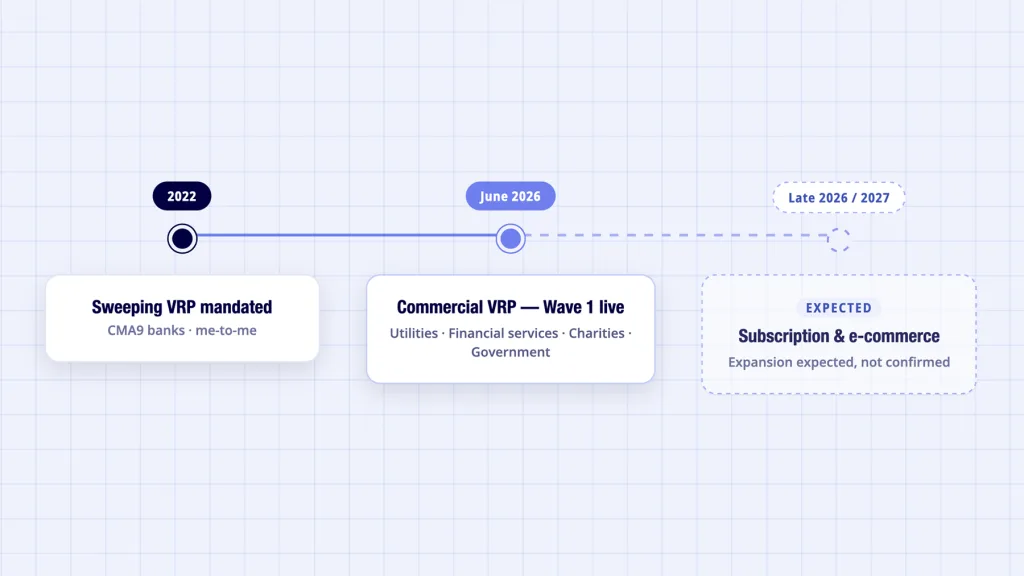
The direction is set; the sequencing is what subscription teams should watch.
Open banking payments now exceed 37 million per month, but most are one-off. UKPI’s stated next step is exactly your use case: moving from phase 1 collections to subscription models and wider e-commerce. Realistically, that makes late 2026 and 2027 the adoption window for SaaS billing, and today the right moment to understand the rails. VRP payments will not replace Direct Debit overnight, and this page will not pretend otherwise.
Where does Finexer fit for teams exploring VRP payments?
Finexer is an FCA-authorised (FRN 925695) UK open banking provider, and VRP sits inside its payment initiation stack.
- Finexer’s Payments product covers pay-by-bank collections and payouts, with Finexer’s VRP API handling variable recurring payments as the scheme rollout expands.
- 99% UK bank coverage across the CMA9 and beyond.
- Usage-based pricing, so pilots start small and scale with volume.
- AIS and PIS under one FCA authorisation and one integration.
- White-label consent screens matching your product’s branding.
- Webhooks for payment and consent events in real time.
- Free sandbox access, with 3 to 5 week onboarding for billing pilots.
For related reading, see our A2A payments provider checklist and the Ivy vs Tink vs Finexercomparison, which notes VRP support across providers.
The bottom line
Direct Debit remains a trusted option for recurring payments, but VRP payments introduce a new approach that offers greater flexibility and faster settlement. As commercial rollout expands across UK banks, now is a good time to understand the technology, evaluate where it fits, and prepare for future adoption.
What are VRPs in simple terms?
They are variable recurring payments: a customer authorises a business (or their own second account) once, then payments of varying amounts are collected automatically within bank-enforced limits. Think of what is a variable recurring payment as a smart, instant successor to the standing order and the Direct Debit mandate.
How are VRP payments different from Direct Debit?
Three ways. Settlement is near-instant rather than a three-day Bacs cycle. Failures are visible at collection, not days later. And the customer’s bank enforces the agreed payment limits on every transaction, whereas Direct Debit relies on the DD Guarantee’s after-the-fact indemnity claims.
When will commercial VRP launch for subscriptions?
The UK Payments Initiative scheme went live in June 2026 for phase 1 use cases: utilities, financial services, charities and government. Subscription and e-commerce collections are the declared next step, expected to build through late 2026 and beyond as bank coverage grows toward the 75% critical-mass level the FCA cited. What are the benefits of VRP arriving early? Teams that pilot now shape their billing stack before the rush.
No commitment needed: explore how variable recurring payments open banking rails would slot into your stack, and talk timing with our team when you are ready.
Explore with AI
About the Author

Ravi Ranjan
Ravi Ranjan is Co founder & CEO of Finexer