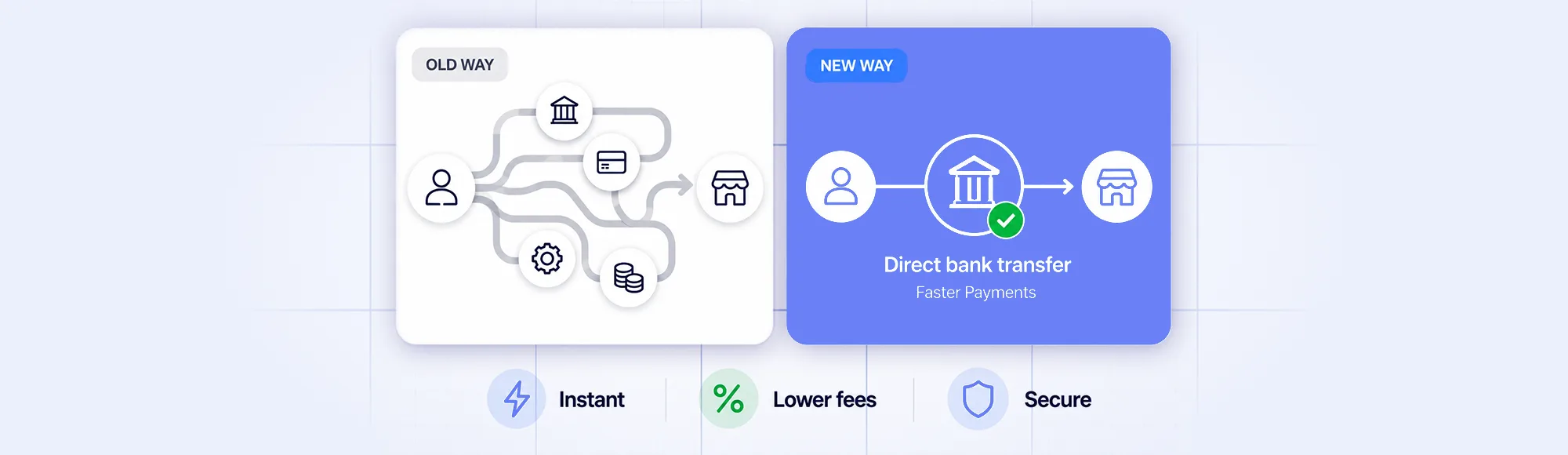
Initiate UK Bank Payments in Seconds Connect to almost all major UK banks with Finexer’s FCA-authorised PIS.
Every card payment your platform processes passes through at least four intermediaries before the money reaches you. Each one takes a cut. Card fees typically run at 1.5-3.5% per transaction. Settlement takes one to three days. Chargebacks arrive weeks later with no prior notice.
Payment initiation services are the bank-payment infrastructure designed to reduce this stack.
A payment initiation service (PIS) is a regulated mechanism that lets an FCA-authorised third party start a bank payment on behalf of a customer – with the customer’s explicit consent. Money moves directly from the customer’s bank account to the recipient’s. No card network. No acquirer. No processor. Just an account-to-account (A2A) bank transfer, settled near-instantly through Faster Payments.
At Finexer, I work with EPOS platforms, SaaS billing tools, payroll infrastructure, and fintech teams building embedded payment journeys. The shift toward payment initiation services from card-led payment flows is not a future trend for these teams. It is an active engineering decision they are making now.
UK merchants paid over £1.7 billion in card processing fees in 2024, according to the British Retail Consortium. As of March 2026, Open Banking across the UK reached 17.94 million user connections and processed 37.46 million payments via PIS, with 2.54 billion API calls – reflecting adoption at infrastructure scale, not pilot stage.
“Payment initiation services are the part of Open Banking that most platforms underestimate on first contact. The regulatory layer looks complex. In production, it is less complex than maintaining a card gateway – and the economics are a different order of magnitude.” – Yuri, Finexer
TL;DR
A payment initiation service (PIS) lets an FCA-authorised third party – a PISP – start a bank payment with the customer’s explicit consent. In the UK, PISPs connect to banks via Open Banking APIs and route funds through Faster Payments in seconds. No card networks. No interchange fees. Payment initiation services are governed by the Payment Services Regulations 2017 and authorised by the FCA.
Key Takeaways
What is a payment initiation service (PIS)?
A payment initiation service that allows an authorised third party to start a payment from a customer’s bank account with their explicit consent. The customer authenticates via their own banking app using Strong Customer Authentication (SCA). Funds transfer directly bank to bank through Faster Payments. No card network, no card fees, no settlement delay.
How do you send money with a PISP?
The customer selects their bank at checkout or payment screen. The PISP – the Payment Initiation Service Provider – connects to the customer’s bank via an Open Banking API. The customer approves the payment in their banking app using SCA (biometrics or PIN). The bank initiates the transfer through Faster Payments. The PISP confirms to the platform that the payment has been initiated. The process takes seconds from selection to confirmation.
Who needs payment initiation services?
UK platforms that collect or send money and want to remove card fees, accelerate settlement, and reduce reconciliation overhead. This includes SaaS billing platforms, EPOS and retail operators, payroll and disbursement tools, utility billing systems, and marketplace operators paying out to sellers or contractors. Any platform where the volume of transactions makes card fees a meaningful operational cost.
Why Do Card Networks Slow Down UK Platform Payments
What Is the Business Case for Moving Away From Card-Led Payment Flows?
Card payments are not cheap infrastructure. They are convenient consumer infrastructure that businesses pay for – repeatedly.
The typical UK platform processing card payments absorbs three compounding costs. Interchange fees flow to the card issuer. Scheme fees go to Visa or Mastercard. Acquirer margins sit on top. For platforms processing high volumes, these fees accumulate into a significant operational drag – often 1.5-3.5% per transaction, with no reduction at scale.
Settlement compounds the problem. Card transactions typically clear in one to three business days. For platforms that need to disburse funds or confirm payment before releasing a service, that delay is a workflow problem, not just a finance problem.
Chargebacks add a third layer. A dispute arrives weeks after the transaction. The platform bears the evidence burden, the processing fee, and the risk of elevated chargeback ratios affecting card acceptance terms.
Payment initiation services address all three of these problems. No interchange fees. Near-instant settlement via Faster Payments. And because the customer authenticates directly with their bank using SCA, the payment is bank-authorised – which removes card-style chargeback exposure from the transaction flow.
For platforms evaluating the cost and workflow difference in detail, the Pay by Bank vs card payments guide covers a direct comparison of fees, settlement timelines, and chargeback risk across both payment methods for UK EPOS and retail platforms.
How Does a Payment Initiation Service Actually Work
What Are the Steps in a PIS Payment Flow?
Understanding how payment initiation services work is easiest through the five-stage flow that every PIS transaction follows.
Stage 1 – Payment request. The customer reaches a payment screen – at checkout, on an invoice, or in a billing portal. They select their bank from the list displayed by the PISP. The platform sends a payment request to the PISP’s API.
Stage 2 – Bank connection. The PISP connects to the customer’s bank via the Open Banking API. No credentials are shared – only encrypted, permission-based access under PSR 2017. The PISP holds only the permissions required for this specific payment.
Stage 3 – Strong Customer Authentication (SCA). The customer is redirected to their banking app or bank web interface. They authenticate using their bank’s SCA method – biometrics, PIN, or one-time passcode. This step is non-negotiable for PIS transactions. Without SCA completion, no payment initiates.What Rules Govern Payment Initiation Services in the UK
Stage 4 – Payment execution. The bank initiates the transfer from the customer’s account to the receiving account. In the UK, this routes through Faster Payments. 95% of Faster Payments settle in under 15 seconds. The funds move bank to bank with no intermediary holding them.
Stage 5 – Confirmation. The PISP receives bank confirmation and fires a webhook to the platform – status, reference, amount, timestamp. No batch file. No end-of-day wait.
For a technical breakdown of how each stage interacts at the system level – including consent presentation, redirect handling, and webhook delivery – the Open Banking payment flow guide covers the full engineering view for platform and product teams.
“The SCA step is where most platform teams focus their UX attention. What they underestimate is the webhook design on the other side. Idempotent webhook handling is what separates a production-grade PIS integration from a demo that works fine until a network timeout creates a duplicate event.” – Yuri, Finexer
What Rules Govern Payment Initiation Services in the UK
What Does FCA Authorisation Mean for a PISP?
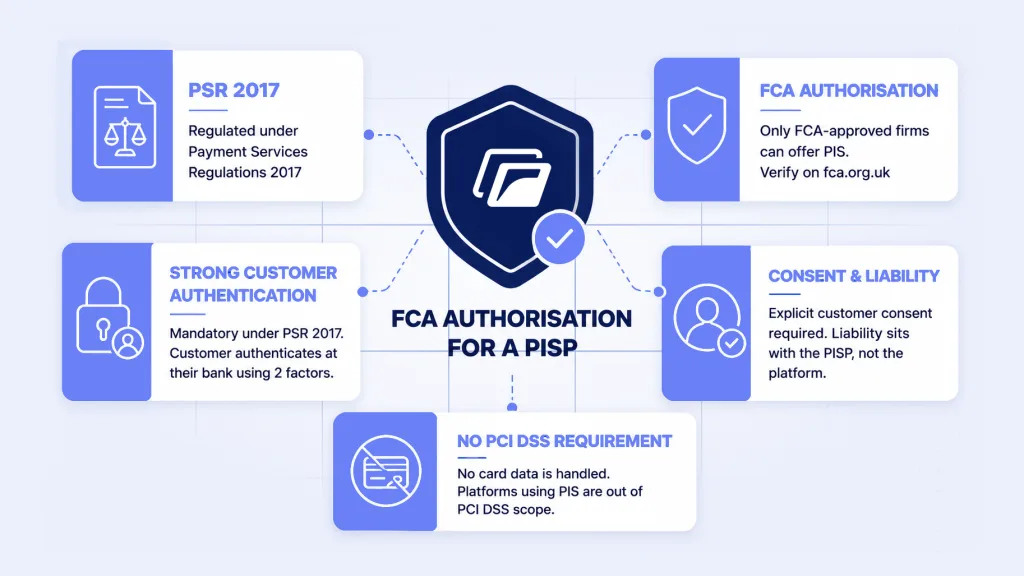
Payment initiation services operate under a specific regulatory framework in the UK. Understanding this framework matters for platform decision-makers because the compliance burden falls on the PISP – not on the platform integrating with them.
- Payment Services Regulations 2017 (PSR 2017). The UK’s primary PIS legislation. It defines the authorisation requirements, consent obligations, and liability framework for PISPs (UK Payment Services Regulations 2017, legislation.gov.uk).
- FCA authorisation. Only FCA-approved firms can offer PIS. Authorisation status is publicly verifiable on the FCA register at fca.org.uk. Check this before integrating any PISP.
- Strong Customer Authentication (SCA). Mandatory under PSR 2017. The customer authenticates via two factors – biometrics or PIN – at their bank before any payment releases. SCA is enforced by the bank, not by the platform.
- Consent and liability. Each payment requires explicit customer authorisation. If a payment initiates without proper consent, liability rests with the PISP – not the platform. This protects the platform, provided the PISP is properly authorised.
- No PCI DSS requirement. Payment initiation services involve no card data. Because no card details are ever entered or transmitted, platforms using PIS do not inherit PCI DSS scope from the payment flow. This is a meaningful compliance reduction compared to card processing – and a significant difference from Account Information Service Providers (AISPs) or card processors that do handle sensitive financial data.
For a detailed view of the regulatory framework and how Open Banking providers operate under UK FCA rules, the third-party providers for payment initiation UK guide covers the authorisation landscape, what to look for in a PISP, and how to verify FCA status before integration.
| Payment Method | Settlement Speed | Cost per Transaction | Chargeback Risk | FCA Regulated |
|---|---|---|---|---|
| Payment Initiation Service (PIS) | Near-instant via Faster Payments – typically seconds | Flat usage-based fee per transaction | Not applicable via card chargeback – payment is bank-authorised by the customer directly | Yes – PISP requires FCA authorisation under PSR 2017 |
| Card Payments | 1-3 business days | 1.5-3.5% interchange + scheme fees + acquirer margin | Yes – customer can raise a chargeback post-settlement | Acquirers regulated; card networks self-governed |
| Direct Debit (Bacs) | 3-5 business days | Low per-payment fee | Yes – Indemnity Claim available to payer | Yes – Bacs Direct Debit Scheme rules apply |
Where Are Payment Initiation Services Used Today?
Which Platform Types Use PIS in Production?
UK payment initiation services are not an emerging concept in UK platform infrastructure. They are in production across multiple verticals where card fees or settlement delays create operational problems.
- SaaS billing and subscription platforms. Variable Recurring Payments (VRP) allow pre-authorised recurring bank payments without card infrastructure. Each renewal draws from the customer’s bank with pre-agreed consent – no card expiry, no card decline, no card-on-file chargeback exposure.
- EPOS and retail checkout. In-store and online retailers offerPay by Bank checkout as an alternative to card terminals. The customer selects their bank, authenticates in their banking app, and the payment settles near-instantly. No card machine. No interchange. No end-of-day card reconciliation. Particularly relevant for high-volume, low-margin retail where card fees erode margin per transaction.
- Payroll and contractor disbursements. Payroll platforms use bulk PIS to disburse salaries and contractor payments in a single API call. Each recipient receives funds via Faster Payments with a per-payment reference. Reconciliation runs against the payment reference – not a batch file. For a comparison of providers supporting payroll-specific PIS infrastructure, the payment initiation API for payroll guide covers what bulk disbursement capability looks like at the API level.
- Utility and telecoms billing. One-time bank transfers via PIS. Customers approve in their banking app. Near-instant settlement. No direct debit mandate delay, no card expiry to manage.
How Does Finexer Deliver Payment Initiation Services?
What Does Finexer’s PIS Infrastructure Provide for UK Platforms?
Card fees and settlement delays are the operational problem. Finexer’s PIS infrastructure is the data and payment layer that addresses both.
Finexer is not a bank. It does not provide treasury management, card processing, or lending infrastructure.
Finexer provides FCA-authorised Open Banking payment initiation services – the payment initiation layer that UK platforms use to collect and disburse funds bank-to-bank, via Faster Payments, without card networks.
- 99% UK bank coverage – high street, challenger, and business accounts, through one API integration
- FCA-authorised under the Payment Services Regulations 2017 (FRN 925695) – verifiable on the FCA register
- Pay by Bank – customer authenticates in their banking app, payment settles near-instantly via Faster Payments
- Payment Links – shareable per-invoice links with pre-filled references, requiring no card details
- Bulk Payout – multiple recipients in a single API call, each with an individual payment reference
- Variable Recurring Payments (VRP) – pre-authorised recurring bank payments for subscription and billing flows
- QR code payment initiation for in-store and kiosk environments
- Webhook-based confirmation per payment – status, reference, amount, and timestamp at settlement
- White-label payment flows – embeddable under the platform’s own brand
- Usage-based pricing, no setup fees, 2-3x faster deployment than market alternatives
- 3-5 weeks onboarding support to production
For platforms choosing between PIS providers – on coverage, API quality, pricing, and integration speed – the best UK payment initiation platform guide compares the leading options across these criteria.
For platforms already familiar with Open Banking but evaluating how PIS integrates technically alongside AIS bank data, the payment API integration guide covers how PIS and AIS work together as a unified payment and data layer.
What Does a Strong Payment Initiation Service Require?
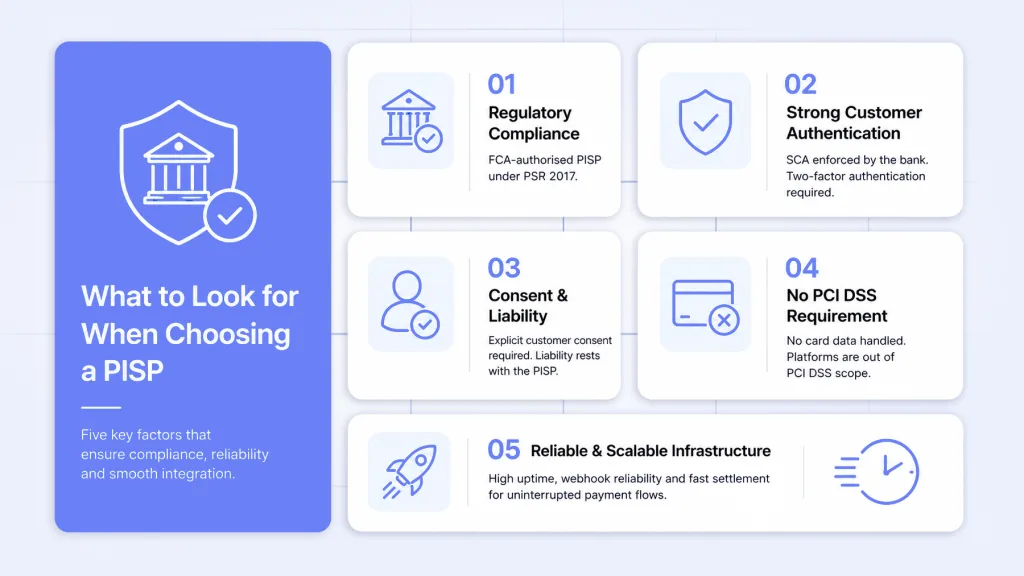
What Should UK Platforms Look for When Choosing a PISP?
Not all payment initiation services providers deliver the same production reliability. Four criteria matter most:
- Bank coverage. A PISP covering 85% of UK banks means 15% of customers cannot pay. Coverage breadth determines eligibility, not just cost.
- Webhook reliability. Webhooks must be idempotent – firing twice should not create duplicate events, and a missed webhook should trigger a retry. This should be handled at the infrastructure level, not left to the platform.
- FCA authorisation. Verify on the FCA register at fca.org.uk before any integration begins. Authorisation status, permission scope, and any regulatory actions are all visible in minutes.
- Integration speed. Structured onboarding support – not just documentation – closes the gap between sandbox and production from months to weeks.
For an evaluation framework and provider comparison, the Pay by Bank API selection guide covers the technical checklist for assessing any PIS provider before committing to integration.
For a broader view of how payment initiation services compare against card, direct debit, and alternative payment rails in the UK, the alternative payment methods UK guide covers the infrastructure tradeoffs across each method.
What I Feel
Most platform teams that contact us have already evaluated payment initiation services and found the regulatory framing off-putting. PSD2, PSR 2017, SCA, PISP – the terminology makes it sound like a compliance project rather than a product decision.
In production, it is simpler than a card gateway. There is no card data to handle, no PCI DSS scope to manage, and no chargeback dispute workflow to build. The SCA step that looks complex in documentation is handled by the customer’s own bank – not by the platform.
The part that matters most – and the part that is hardest to evaluate from documentation alone – is webhook reliability in production. A payment initiation service that fires webhooks correctly, idempotently, and with enough detail to drive automated reconciliation is the difference between infrastructure that works and infrastructure that creates manual exceptions.
That is the question worth asking any PISP before you build.
Is a payment initiation service the same as Pay by Bank?
Pay by Bank is the consumer-facing checkout experience powered by payment initiation services. PIS is the regulated mechanism underneath. When a customer sees “Pay by Bank,” they are using a PIS flow – authenticating via their banking app and sending funds bank-to-bank via Faster Payments. The PISP is the authorised provider operating the infrastructure.
Can payment initiation services handle recurring payments?
Yes, through Variable Recurring Payments (VRP). VRP is a PIS mechanism that allows pre-authorised recurring bank payments with a single consent. The customer consents to a recurring payment mandate within agreed parameters – frequency, maximum amount, duration. Each subsequent payment draws from the customer’s bank without requiring re-authentication, provided the payment stays within the consented parameters.
How long does a payment initiation service take to settle in the UK?
For domestic UK bank-to-bank payments via Faster Payments, settlement typically completes in seconds. 95% of Faster Payments settle in under 15 seconds. The PISP receives confirmation from the bank and fires a webhook to the platform at the point of payment initiation – meaning the platform knows the payment status almost immediately rather than waiting for end-of-day bank statement reconciliation.
Stop paying card fees on every transaction – initiate bank-to-bank payments via Finexer’s PIS infrastructure and settle near-instantly through Faster Payments.
About the Author

Yuri
Yuriy Yakushko is a fintech founder and software engineer with over 20 years of experience building financial technology. He’s passionate about creating scalable, secure infrastructure that helps businesses modernise how they access financial data and manage payments.