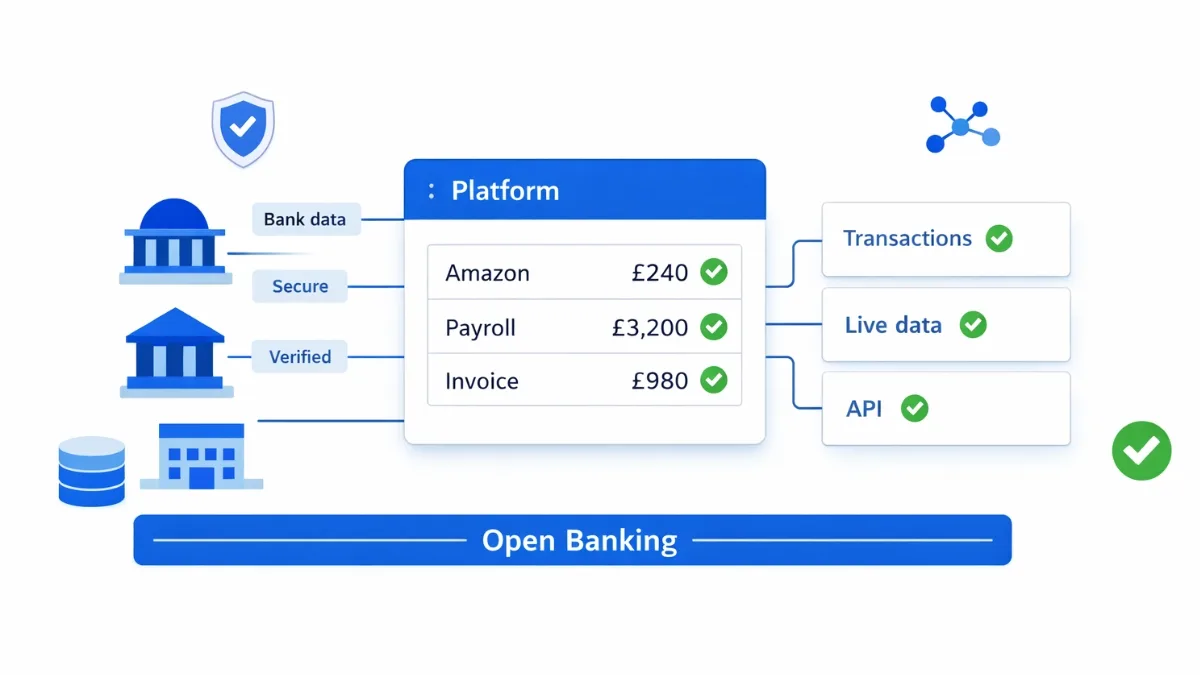
Platforms cannot build reliable features when open banking financial data access depends on manual CSV uploads or broken bank feeds. Integration evaluation requires understanding infrastructure capabilities that enable automated workflows.
Key Takeaways
What problem does this solve?
Platforms cannot access open banking financial data reliably when users must download statements manually or feeds break frequently.
Why does infrastructure quality matter?
Poor bank connectivity creates operational overhead. Platforms need verified open banking financial data without manual fallback workflows.
What breaks with unreliable providers?
Consent management fails. Bank feeds disconnect. Transaction data arrives incomplete. Platforms cannot build reliable features on unstable infrastructure.
What should platforms evaluate before integrating?
UK bank coverage percentage, data reliability metrics, consent lifecycle management, structured transaction format, historical data depth.
Where does Finexer fit operationally?
Finexer provides bank connectivity infrastructure. Platforms integrate once and receive open banking financial data through APIs. Platforms build reconciliation, verification, and reporting features on top.
Why does open banking financial data access fail operationally?
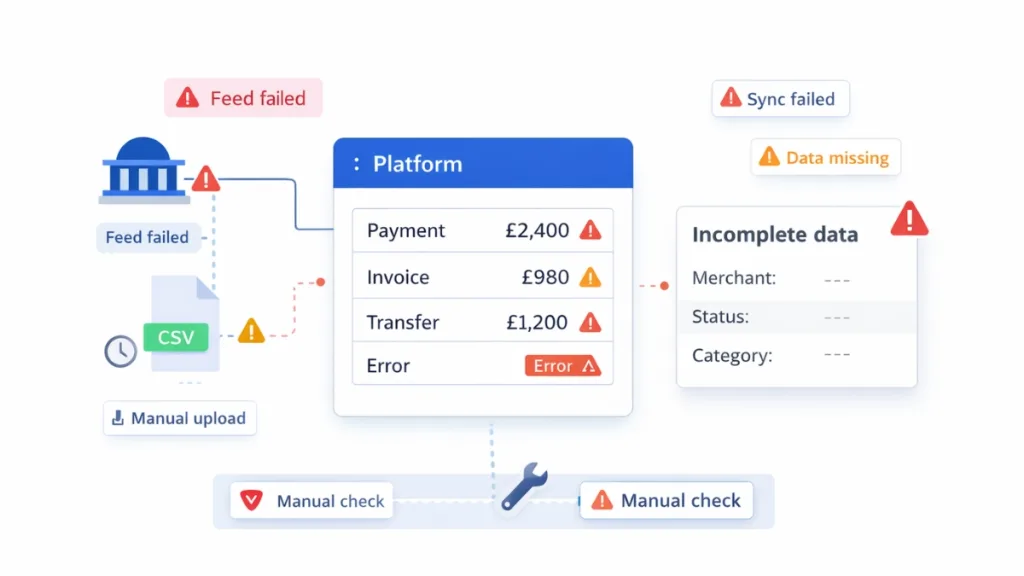
Platforms promise automated reconciliation, instant verification, and real-time reporting. These features require continuous access to open banking financial data.
Common failures include:
- Users must download bank statements manually
- Bank feed connections break frequently
- Transaction data arrives incomplete or delayed
- Verification processes require manual intervention
- Reconciliation becomes impossible without current data
When platforms rely on CSV uploads, users download bank statements manually. This creates delays between transactions occurring and data becoming available for processing.
Bank feed connections built through unreliable methods break frequently. Users report missing transactions. Support teams spend time troubleshooting connectivity instead of building features.
Manual financial data collection prevents automation. Finance teams cannot reconcile payments when transaction data requires user intervention to access.
Who faces this infrastructure problem?
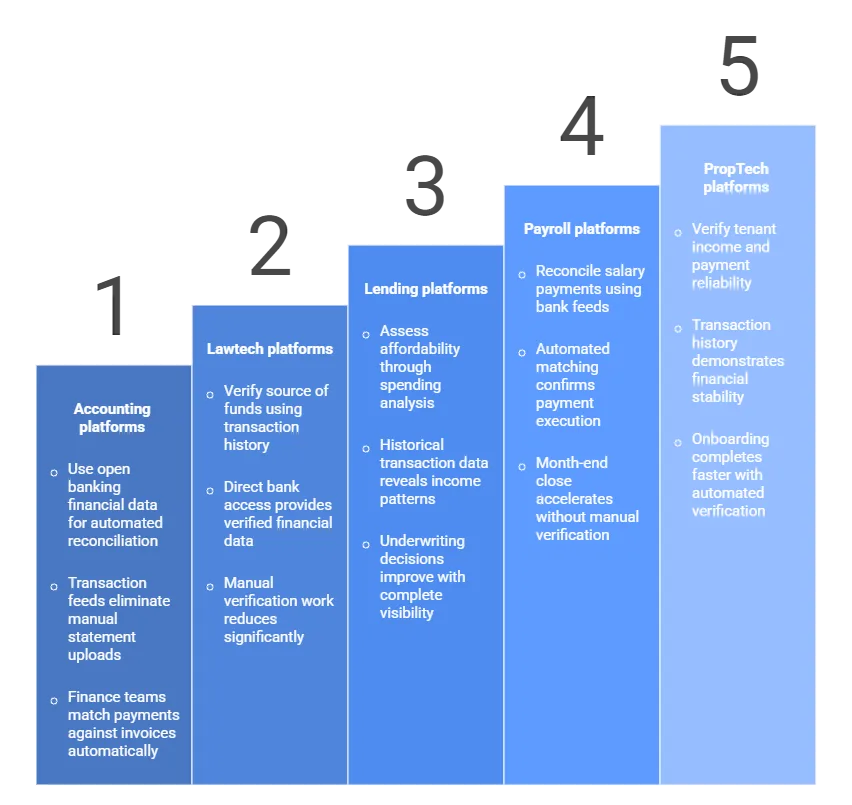
Different platform types face specific challenges:
Accounting platforms:
- Collect client financial data for automated reconciliation
- Bank feeds break and reconciliation becomes manual
- Users expect real-time transaction visibility
Lawtech platforms:
- Verify source of funds for client account compliance
- Unreliable data access creates verification delays
- Case timelines extend due to manual processes
Lending platforms:
- Assess affordability using transaction history
- Incomplete financial data prevents accurate underwriting
- Decision speed depends on data availability
Payroll platforms:
- Reconcile salary payments against bank transactions
- Manual data collection increases operational workload
- Month-end close requires automated feeds
PropTech platforms:
- Verify tenant income and payment capacity
- Delayed access slows tenant onboarding
- Financial verification requires complete history
What happens when financial data access fails?
Business impact appears across operations:
Onboarding delays:
- Platforms cannot verify financial information quickly
- Users wait for manual data collection
- Competitive advantage decreases
Operational workload:
- Finance teams spend hours matching transactions manually
- Support teams troubleshoot broken feeds constantly
- Product development slows
Compliance risks:
- Platforms managing client money lack proper audit trails
- Financial data contains gaps
- Regulatory scrutiny increases
Platform reliability:
- Users lose trust when features stop working
- Connectivity problems damage reputation
- Client retention suffers
Cost increases:
- Support overhead grows
- Manual processes require staff time
- Scaling becomes expensive
What must platforms evaluate before integration?
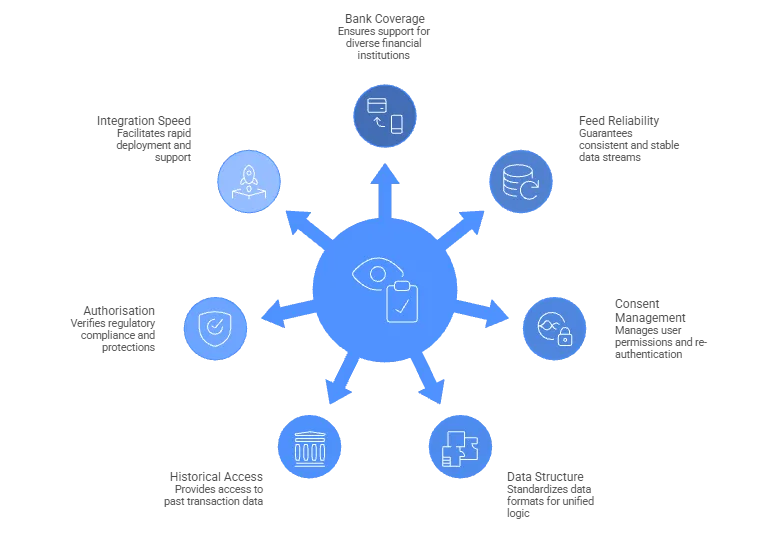
Critical evaluation criteria:
Bank coverage:
- Does the provider support all major UK banks?
- Are challengers and building societies included?
- Can users connect any account type?
Feed reliability:
- Are transaction feeds reliable or prone to disconnection?
- What uptime metrics are available?
- How quickly are issues resolved?
Consent management:
- How does consent lifecycle management work?
- Is re-authentication automated?
- Can platforms track expiry dates?
Data structure:
- Is transaction data structured consistently?
- Do formats vary by bank?
- Can platforms build unified logic?
Historical access:
- Can platforms access historical transactions?
- How far back does data extend?
- Are there retrieval limitations?
Authorisation:
- Is the provider FCA-authorised?
- What compliance protections exist?
- Are there regulatory risks?
Integration speed:
- How quickly does deployment happen?
- What support is provided?
- Are timelines realistic?
According to UK bank coverage data, comprehensive connectivity includes challengers and building societies, not just major institutions.
How does Finexer enable reliable financial data access?
Finexer provides FCA-authorised infrastructure connecting platforms to UK banks.
Key capabilities:
- 99% UK bank coverage
- FCA-authorised infrastructure
- Real-time webhooks
- Up to 7 years historical data
- Usage-based pricing
- White-label ready
- 2-3x faster integration
- 3-5 weeks onboarding support
- Saves up to 90% on transaction costs
How it works:
Platforms integrate once through standard APIs. Finexer handles bank connectivity, consent management, and data formatting.
Transaction data arrives in a consistent JSON structure regardless of source bank. Platforms write processing logic once and apply across all institutions.
Real-time webhooks notify platforms when new transactions occur. Users see current positions without manual refresh.
Consent lifecycle management is automated. Users authenticate once through banking apps. Platforms track expiry dates without requiring repeated logins.
Historical open banking financial data extends up to seven years depending on bank support. Platforms can access complete financial histories without manual statement collection.
For platforms managing data aggregation workflows, reliable infrastructure removes operational bottlenecks.
Integration Evaluation Checklist
| Evaluation Criteria | Why It Matters | What to Look For |
|---|---|---|
| UK bank coverage | Users cannot connect accounts with unsupported banks | 99% coverage including challengers and building societies |
| Feed reliability | Frequent disconnections create support overhead | Real-time webhooks with proven uptime metrics |
| Consent management | Manual re-authentication creates user friction | Automated tracking with clear expiry visibility |
| Data structure | Inconsistent formats require custom parsing per bank | Standardised JSON across all institutions |
| Historical access | Limited retention prevents past period analysis | 7-year transaction retrieval capability |
| FCA authorisation | Unauthorised access creates compliance exposure | Direct FCA-authorised infrastructure provider |
Platforms requiring real-time transaction data should confirm webhook delivery remains reliable under volume.
What we see in practice
Most platforms underestimate the operational cost of maintaining bank connectivity. Screen scraping works initially but creates constant overhead when authentication breaks.
Common implementation realities:
- Feed failures appear months after initial integration
- Consent expiry creates unexpected user friction
- Data inconsistency requires separate parsing per bank
- Support overhead increases with user volume
- Manual fallback workflows become necessary
The mistake we see most often is choosing providers based on initial integration simplicity. The maintenance burden appears months later when feeds disconnect across different banks.
Consent expiry creates user friction when platforms lack visibility into permission status. Users receive unexpected re-authentication requests that damage experience.
Data inconsistency problems emerge when providers deliver different formats per bank. Platforms must maintain separate parsing logic instead of unified processing.
Platforms serving regulated clients cannot afford connectivity failures. When verification depends on open banking financial data, infrastructure reliability becomes an operational requirement.
Common use cases
What is open banking financial data for platforms?
Open banking financial data is bank transaction information accessed through FCA-authorised APIs. Platforms receive structured feeds enabling automated reconciliation, verification, and reporting features.
Why do platforms need reliable financial data access?
Features requiring bank data fail when connectivity is unreliable. Platforms need consistent open banking financial data access to deliver automated workflows users expect.
How do platforms evaluate infrastructure providers?
Platforms should assess UK bank coverage, feed reliability, consent management, data structure consistency, historical access depth, and FCA authorisation status.
Can platforms build bank connectivity internally?
Platforms can build feature logic and workflows, but bank connectivity requires FCA authorisation. Most platforms use authorised infrastructure providers.
What makes infrastructure reliable for financial data access?
Reliable infrastructure provides consistent transaction feeds, automated consent management, standardised data formats, and comprehensive UK bank coverage without frequent disconnections.
Access reliable open banking financial data with FCA-authorised infrastructure and comprehensive UK bank coverage.
About the Author

Yuri
Yuriy Yakushko is a fintech founder and software engineer with over 20 years of experience building financial technology. He’s passionate about creating scalable, secure infrastructure that helps businesses modernise how they access financial data and manage payments.