Table of Contents
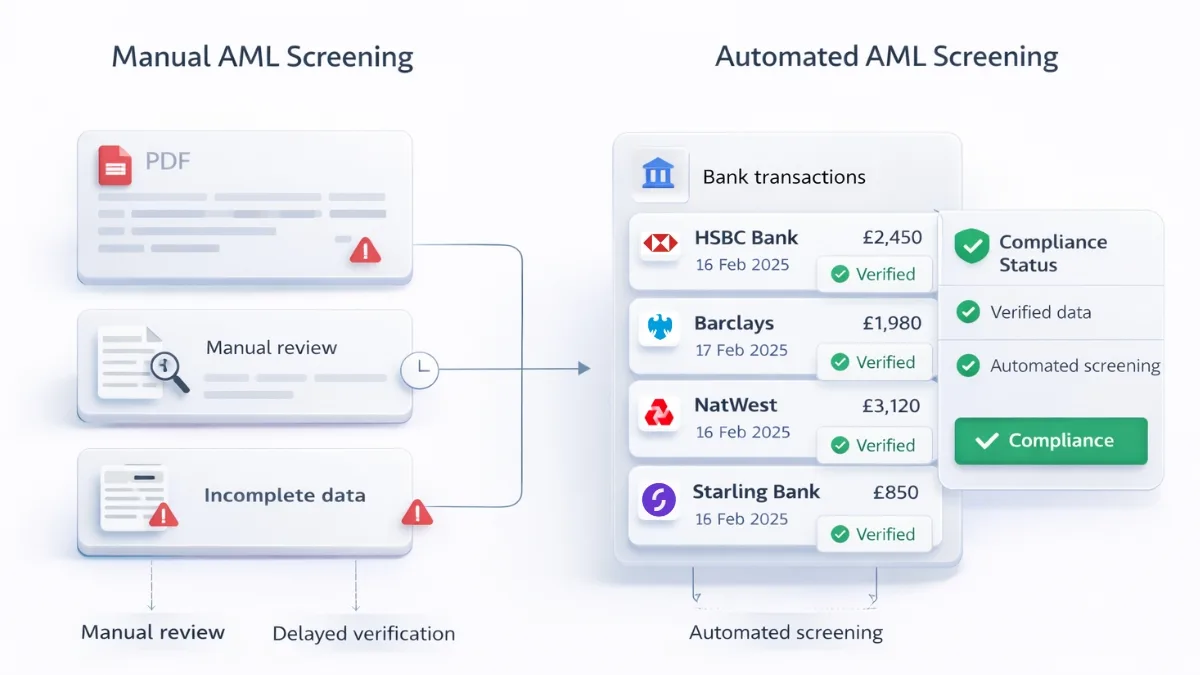
UK platforms enabling AML screening cannot verify source of funds reliably when financial data access depends on manual bank statement uploads. LawTech platforms, lending systems, and fintech products need automated verification using bank-verified transaction data without operational overhead.
Manual compliance reviews create bottlenecks. Teams collect PDFs and screenshots manually. Financial activity verification happens through document inspection. AML screening workflows cannot scale when transaction visibility requires user intervention.
This blog explains how platforms enable AML screening using verified bank transaction APIs, what infrastructure prevents compliance gaps, and how reliable connectivity eliminates verification delays that slow onboarding workflows.
Key Takeaways
What problem does this solve?
Platforms cannot verify source of funds automatically when AML screening depends on manual bank statement collection from users.
Why does infrastructure matter?
Manual verification prevents scaling. AML screening workflows need automated access to verified bank transaction data without operational overhead.
What breaks with manual processes?
delays extend. Verification becomes unreliable. Audit trails remain incomplete. Platforms cannot confirm financial activity accurately.
What should platforms evaluate before integration?
FCA authorisation status, UK bank coverage, transaction data completeness, consent management, historical access depth, API reliability.
Where does Finexer fit operationally?
Finexer provides verified bank transaction infrastructure. Platforms access financial data through secure APIs. Platforms build AML screening and monitoring workflows on top.
Why do platforms need AML screening infrastructure?
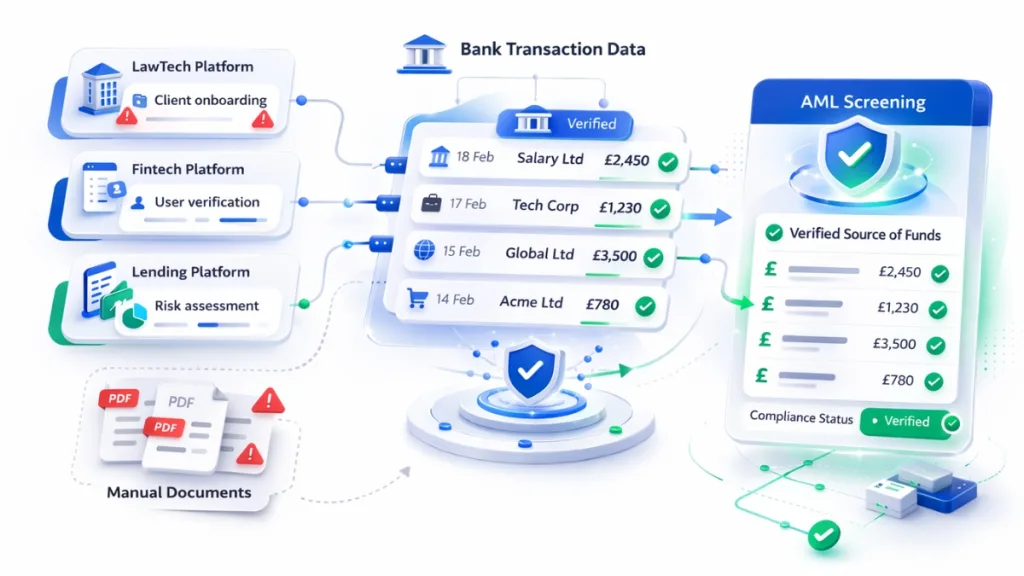
LawTech platforms cannot verify client source of funds without bank transaction access. Conveyancing workflows require financial activity confirmation. Manual statement review creates onboarding delays that damage client experience.
LawTech platforms require:
- Verified bank transaction data for source-of-funds checks
- Complete financial activity history for compliance workflows
- Automated verification replacing manual document review
- Structured transaction data supporting AML screening decisions
Fintech platforms onboarding users need:
- Customer financial activity validation using bank data
- Real-time transaction visibility for ongoing monitoring
- Verified income patterns for risk assessment
- Historical transaction access for comprehensive screening
Lending platforms depend on:
- Transaction-level financial visibility for AML checks
- Income verification using verified bank data
- Complete financial history for risk profiling
- Automated screening replacing manual processes
Manual bank statement uploads prevent automation. Users provide PDFs from different banks. File formats vary significantly. Verification becomes manual when transaction data needs document inspection rather than API access.
Who needs AML screening infrastructure?
Legal SaaS platforms process client onboarding requiring source-of-funds verification. Compliance teams cannot review documents manually at scale. Automated access to verified bank transaction data removes operational bottlenecks.
Conveyancing platforms handle property transactions where AML screening is mandatory. Financial activity verification must happen before transaction completion. Real-time bank data access enables automated compliance workflows.
Neobanks onboarding customers require ongoing AML monitoring using transaction data. Manual reviews prevent scaling when user numbers grow. Automated transaction access enables continuous compliance screening.
Investment platforms assess customer suitability using financial activity analysis. AML screening workflows need complete transaction visibility. Verified bank data provides reliable information for compliance decisions.
Consumer lending platforms verify income and assess financial patterns for AML screening. Manual statement review creates verification delays. Automated transaction retrieval enables immediate compliance checks.
What happens when AML screening fails?
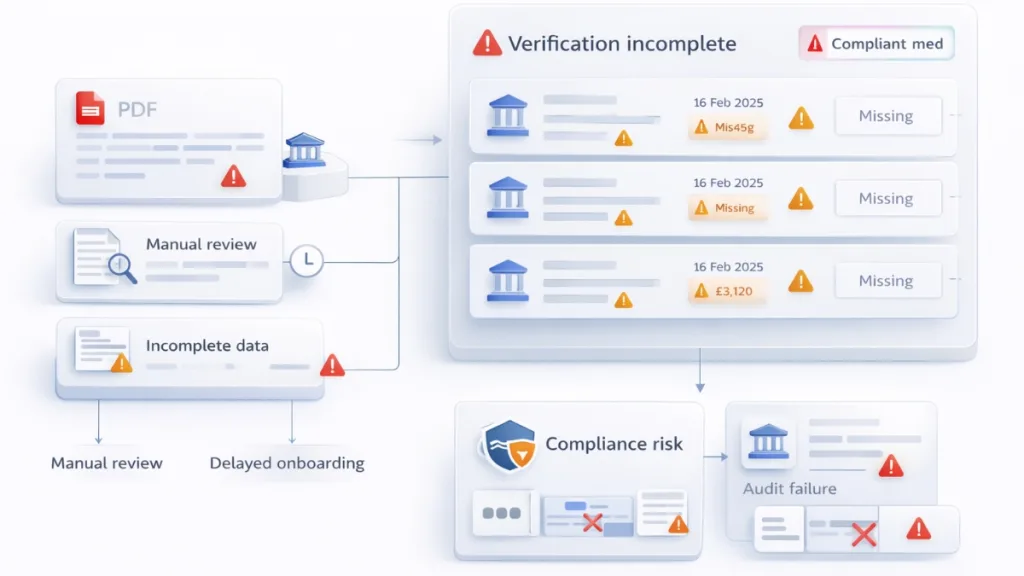
Client onboarding delays extend when source-of-funds verification requires manual document review. Compliance teams spend days collecting and inspecting bank statements. Operational costs increase when staff handle verification manually.
Compliance gaps emerge when financial activity visibility is incomplete. Manual processes miss transaction patterns that automated screening detects. Regulatory exposure increases when AML screening relies on unverified documents.
Audit preparation becomes difficult when transaction records lack structure. Compliance teams cannot demonstrate proper verification workflows. Regulatory reviews reveal gaps that manual processes cannot address at scale.
Operational scaling becomes impossible when manual AML screening prevents volume growth. Hiring additional compliance staff increases costs faster than revenue. Platforms cannot compete against alternatives offering automated verification.
Fraud risk increases when platforms accept unverified financial documents. Screenshot editing tools enable document manipulation. Verified bank transaction access eliminates tampering risk that manual review cannot prevent.
What infrastructure enables AML screening automation?
Platforms need secure bank transaction access providing verified financial activity data. Each platform user authenticates accounts once through banking apps. Platforms retrieve transaction information automatically without managing document collection.
Transaction data requirements for AML screening:
- Complete financial activity history for pattern analysis
- Transaction amounts and frequencies for risk assessment
- Merchant details and transaction types for activity verification
- Historical data extending beyond 90 days for comprehensive screening
Real-time monitoring capabilities:
- Continuous transaction feeds for ongoing AML compliance
- Immediate notification when suspicious patterns emerge
- Current account activity for real-time risk assessment
- Automated alerts replacing manual periodic reviews
Compliance workflow support:
- Structured transaction data enabling automated screening
- Audit-ready records demonstrating verification completeness
- Historical access supporting regulatory reporting requirements
- Consent logs maintaining proper authorisation documentation
Consent management must be automated. Platforms cannot ask users to re-authenticate repeatedly without destroying experience. Permission tracking needs visibility into expiry dates with proactive renewal.
How does Finexer enable AML screening infrastructure?
Finexer provides FCA-authorised infrastructure enabling secure access to verified bank transaction data for UK platforms.
Key capabilities:
- 99% UK bank coverage
- FCA-authorised infrastructure
- Real-time webhooks
- Up to 7 years historical data
- Usage-based pricing
- White-label ready
- 2-3x faster integration
- 3-5 weeks onboarding support
- Saves up to 90% on transaction costs
Platforms integrate transaction APIs through REST endpoints. Users authenticate accounts via secure open banking flows. Platforms receive structured financial data in consistent JSON format.
Real-time webhooks notify platforms when transaction activity occurs. Financial patterns become visible immediately. Transaction feeds continue automatically supporting ongoing AML monitoring.
Consent lifecycle management is automated with clear permission tracking. Users receive notifications before access expires. Re-authentication happens smoothly without disrupting compliance workflows.
Historical transaction access extends up to seven years depending on bank support. Platforms retrieve complete financial history for comprehensive AML screening without manual statement collection.
Transaction data includes structured fields enabling automated analysis. Amounts, dates, merchant details, and transaction types arrive consistently formatted across UK banks.
For platforms requiring automated AML checks, reliable infrastructure removes verification bottlenecks.
AML screening infrastructure evaluation checklist
| Evaluation Criteria | Why It Matters | What to Look For |
|---|---|---|
| FCA authorisation | Unauthorised providers create compliance exposure | Direct FCA authorisation for account information services |
| Transaction completeness | Incomplete data creates AML screening gaps | Structured fields with amounts, dates, and merchant details |
| Historical depth | Limited access prevents comprehensive screening | 7-year transaction retrieval for complete analysis |
| UK bank coverage | Users cannot verify accounts from unsupported banks | 99% coverage including challengers and building societies |
| Real-time monitoring | Batch-only feeds prevent ongoing AML compliance | Webhook notifications for continuous transaction visibility |
| Audit trail quality | Poor records create regulatory exposure | Structured consent logs and transaction documentation |
Platforms building PropTech compliance features should confirm infrastructure supports AML screening requirements.
What we see in practice
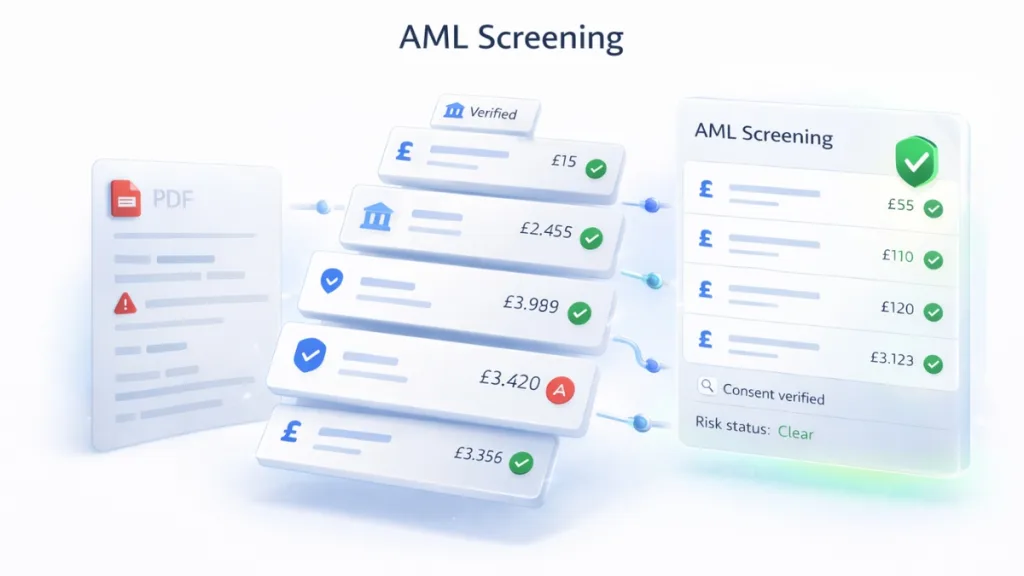
Most platforms underestimate the operational cost of manual AML screening. Initial document review processes appear manageable but scaling becomes impossible when client numbers grow.
Source-of-funds verification delays compounds during high-volume onboarding periods. Compliance teams spend days reviewing bank statements manually. Support costs increase faster than revenue when staff handle verification inquiries.
Verified bank transaction access transforms compliance workflows. Automated screening replaces manual document inspection. Platforms detect suspicious patterns that manual review misses consistently.
Consent expiry creates unexpected disruption when platforms lack proper tracking. Financial data access stops working without warning. Compliance workflows discover issues during critical onboarding rather than receiving proactive notifications.
Transaction data quality determines screening accuracy. Incomplete financial information prevents comprehensive analysis. Manual intervention becomes necessary when structured fields are missing from data feeds.
For platforms requiring estate agent AML checks, reliable connectivity determines compliance quality.
Common use cases
LawTech platforms:
- Retrieve verified bank transaction data for source-of-funds verification
- Automate client financial screening using structured transaction history
- Access complete financial activity records for compliance workflows
- Enable audit-ready documentation using bank-verified data
Fintech platforms:
- Verify customer financial activity using real-time transaction access
- Support ongoing AML monitoring with continuous transaction feeds
- Analyse income patterns and spending behaviour for risk assessment
- Access historical financial data for comprehensive customer screening
Lending platforms:
- Retrieve transaction-level data for financial activity validation
- Verify income sources using structured bank transaction information
- Access complete financial history for underwriting risk profiles
- Enable automated compliance checks replacing manual processes
Accounting platforms:
- Verify client financial information using bank transaction data
- Support compliance workflows with structured financial records
- Access transaction history for client onboarding verification
- Enable automated screening for regulatory requirements
PropTech platforms:
- Verify tenant financial activity using transaction pattern analysis
- Validate source of funds for rental deposit verification
- Access complete financial history for affordability screening
- Enable automated compliance workflows for letting agents
What are AML checks in the UK?
AML checks verify customer identity and financial activity to prevent money laundering. UK platforms use bank transaction data to verify source of funds and assess financial patterns for compliance.
What is an AML screening?
AML screening analyses customer financial activity to identify suspicious patterns. Platforms retrieve verified bank transaction data through APIs to automate compliance verification workflows.
How long do AML checks take in the UK?
Manual AML screening takes days when requiring document collection. Automated screening using bank transaction APIs completes immediately by accessing verified financial data directly.
What is AML in the UK?
AML (Anti-Money Laundering) refers to UK regulations requiring financial activity verification. Platforms use bank transaction infrastructure to comply with screening and monitoring requirements.
Why do platforms need AML screening infrastructure?
Manual verification prevents scaling compliance workflows. Platforms need automated access to verified bank transaction data for reliable AML screening without operational overhead.
Enable reliable AML screening with verified bank transaction infrastructure and automated compliance workflows.
About the Author

Ravi Ranjan
Ravi Ranjan is Co founder & CEO of Finexer