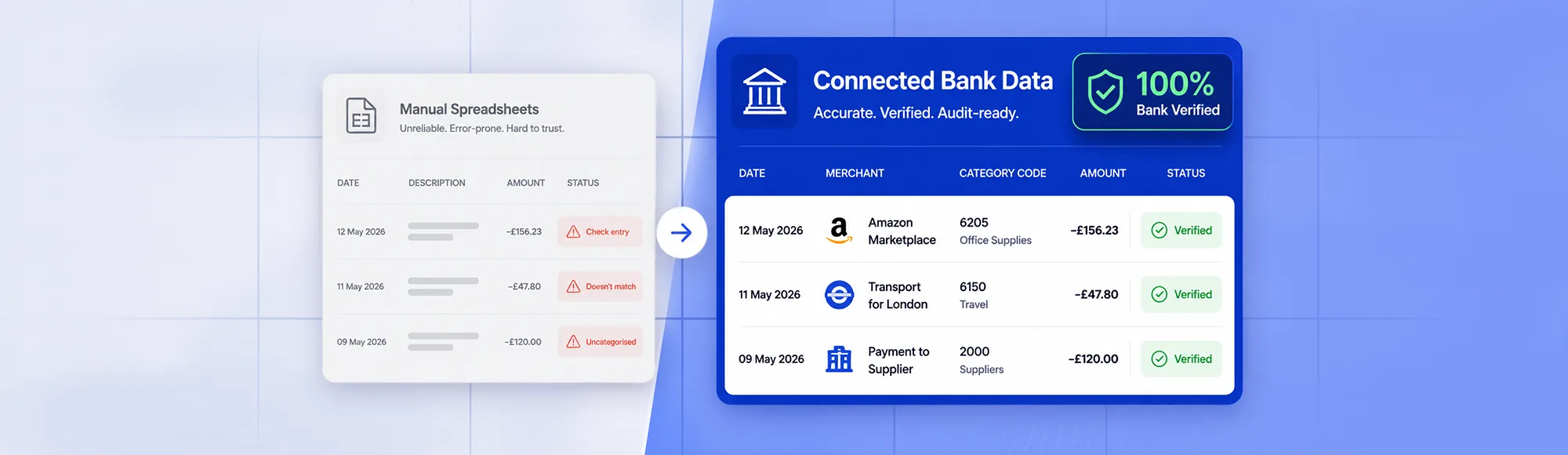
Bank data. Structured records. Audit-ready workflows.
Open Banking AIS for accounting and ERP platforms that need reliable financial data.
The tax return is filed. The audit passes. The CFO signs off.
Why is accurate record keeping important if the audit passes? Because passing an audit is not the same as having accurate records. It means nobody found the errors yet.
The finance team that spent three days last month reconciling – a direct accurate record keeping failure – knows this. The accountant who found a £4,200 VAT discrepancy in February – six weeks after the transaction – knows this.
The business that discovered its cash position was overstated by £18,000 because two payments were recorded in the wrong period knows this.
They didn’t have a compliance problem. They had a data connectivity failure dressed up as paperwork.
“Most record keeping problems I see aren’t about what was stored. They’re about what was never connected. Bank data that didn’t flow into the accounting system. Transactions entered manually three weeks late. References that didn’t match. The record exists. The accuracy doesn’t.” – Clare, Finexer
TL;DR
Why is accurate record keeping important? Because every financial decision – tax, payroll, investment, audit – runs on the data underneath. When that data is delayed, manually entered, or disconnected from live bank transactions, the record becomes a reconstruction rather than a reflection of reality. Keeping financial records accurately requires connected, structured bank transaction data – not just diligent data entry.
Key Takeaways
Why is accurate record keeping important for businesses?
Because every downstream financial decision depends on it. Tax calculations, payroll runs, cash flow forecasts, audit responses – all of these run on the accuracy of the underlying transaction records. An inaccurate record does not just affect compliance. It affects every financial decision made from that record onwards.
What makes financial records inaccurate in practice?
Three things undermine accurate record keeping: manual data entry that introduces errors or delays, fragmented systems where bank data and accounting records do not connect automatically, and batch reconciliation that means the financial picture reflects yesterday rather than today. Accurate record keeping is not a data storage problem. It’s a data connectivity problem.
How does Open Banking improve record keeping accuracy?
Open Banking AIS delivers bank transaction data directly to accounting and ERP systems with structured fields – merchant ID, category code, counterparty, amount, date. No manual re-entry. No formatting inconsistency. The transaction record in the accounting system reflects what the bank confirmed, not what someone typed from a PDF statement.
Why Is Accurate Record Keeping Important Beyond Compliance?
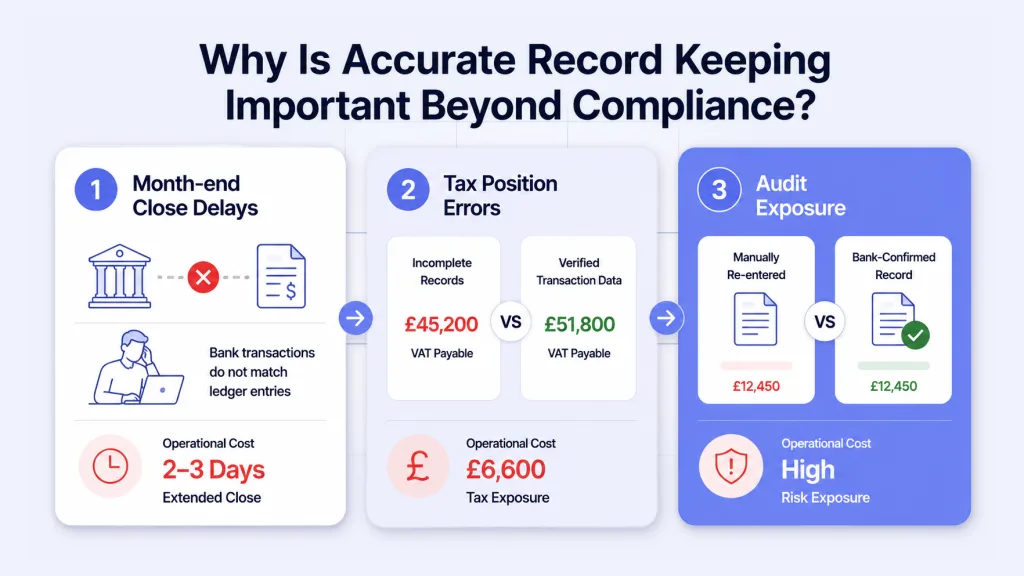
What Does Poor Record Keeping Actually Cost?
HMRC compliance is the minimum. Ask why is accurate record keeping important in any finance team and compliance comes first. It shouldn’t.
The real cost of poor accurate record keeping is operational.
A finance team that cannot trust its own transaction data spends time investigating rather than reporting. A CFO making cash flow decisions on records that are three days behind is working with stale information – and doesn’t know it.
An accounting platform that delivers reconciled data to clients by T+2 instead of same-day is delivering a service that feels manual even if it is digital.
Three operational failures appear consistently in businesses where keeping financial records is not connected to live bank data:
Month-end close delays. An accounting platform managing 200 client accounts closes its books on the last working day of the month. In a fragmented workflow, the finance team spends the first three days of the following month chasing unmatched entries – transactions the bank confirmed but the ledger never received. That’s three days of investigation for every single month. Accurate record keeping, connected at source, doesn’t prevent all of this. But it removes the largest single cause.
Tax position errors. A retailer miscategorises £12,000 of supplier payments in Q3 because the bank descriptions are generic and the manual entry was done by a different staff member each time. The VAT reclaim comes back £2,100 short. HMRC doesn’t flag it as fraud. They flag it as a record keeping failure – which it is.
Audit exposure. An HMRC compliance check doesn’t ask to see the totals. It asks how each number was produced. A manually re-entered transaction from a PDF bank statement has no source trail – the number exists, but the evidence that produced it can’t be verified. Bank-confirmed AIS data can be. That distinction matters when an auditor is in the room.
For platforms managing MTD compliance workflows and needing to understand what digital record keeping standards actually require, the MTD record keeping compliance guide covers what HMRC expects at the transaction level and how digital links work in practice.
What Makes Keeping Financial Records Accurate at Scale?
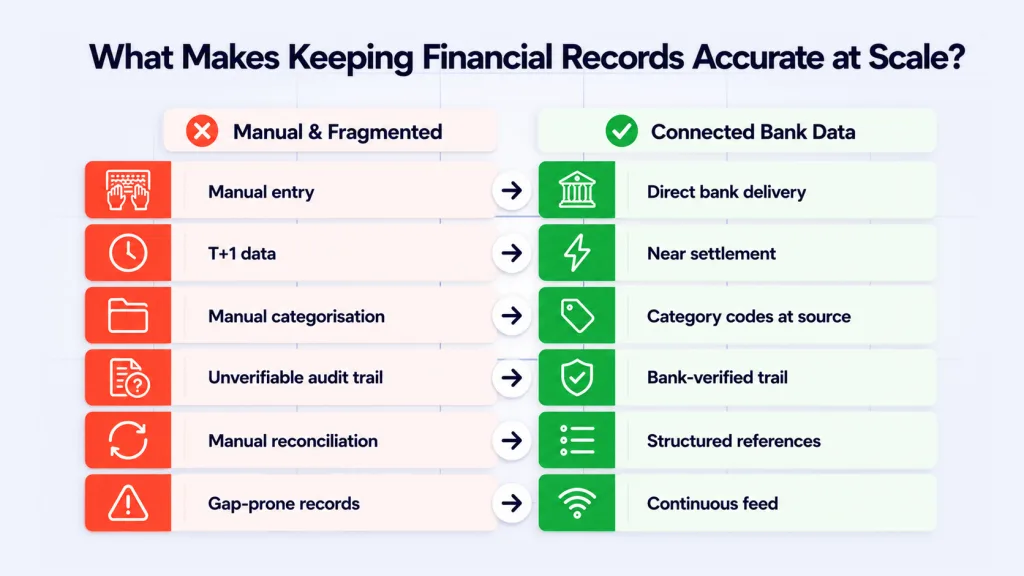
Why Do Financial Records Become Inaccurate in the First Place?
| Record Keeping Issue | Manual / Fragmented Approach | Connected Bank Data Approach |
|---|---|---|
| Transaction entry | Manually entered from bank statements – prone to delay and error | Bank transaction data delivered directly to accounting system |
| Data timing | T+1 or later – records reflect yesterday, not today | Near settlement – records reflect current bank-confirmed position |
| Transaction classification | Manual categorisation – inconsistent across entries and staff | Category codes applied at source – consistent across all transactions |
| Audit trail | Based on re-entered data – cannot be verified at source | Bank-verified transaction record – traceable to source |
| Reconciliation | Manual matching – reference inconsistencies create exceptions | Structured references from bank data reduce manual matching overhead |
| Record completeness | Dependent on manual download frequency – gaps if delayed | Continuous bank feed – records stay current without manual action |
Inaccurate records and poor accurate record keeping are not usually the result of negligence. They’re the result of systems that were not designed to stay connected.
A transaction happens in the bank at 2:47pm on a Tuesday. Three days later, a staff member downloads the bank statement, opens a spreadsheet, and types the description into the accounting system. They’re working from memory on what “FP MKT LTD” means. They get it right this time. They don’t next time.
At low transaction volumes, keeping financial records and maintaining accurate record keeping this way is manageable. At scale, poor accurate record keeping becomes the operational bottleneck that determines how long a month-end takes, how confident the finance team is in its own numbers, and how exposed the business is during an audit.
The question of why is accurate record keeping important has a different answer at 40 transactions a month versus 4,000. The obvious counter-argument is that most businesses manage perfectly well without automated bank feeds – and for small operations, that’s true. A sole trader with 40 transactions a month can maintain accurate records manually without structural risk. The connectivity problem surfaces at scale.
When transaction volumes grow, when multiple staff members enter data, when the same bank description covers five different suppliers – that’s when manual workflows start producing errors the business doesn’t find until month-end, or an audit, or a cash flow crisis. The argument for connected bank data isn’t that manual entry is careless. It’s that at volume, manual entry introduces errors that no amount of care prevents.
For accounting platforms evaluating how to improve data accuracy for clients in regulated industries, the compliance data for regulated platforms guide covers what bank-verified transaction records mean in practice for audit trails and compliance evidence.
How Does Finexer Support Accurate Financial Record Keeping?
What Does Finexer’s AIS Provide for Financial Records?
Finexer is not accounting software. It doesn’t replace ERP systems, manage ledgers, or provide bookkeeping services.
Finexer provides FCA-authorised Open Banking AIS – the bank data infrastructure layer that accounts for SaaS platforms, ERP systems, and compliance tools used to keep financial records accurate at source.
When transaction data flows directly from the bank into the accounting system – structured, categorised, and referenced – the keeping financial records problem changes. The question for anyone serious about keeping financial records accurately shifts from “is this correct?” to “is this connected?”
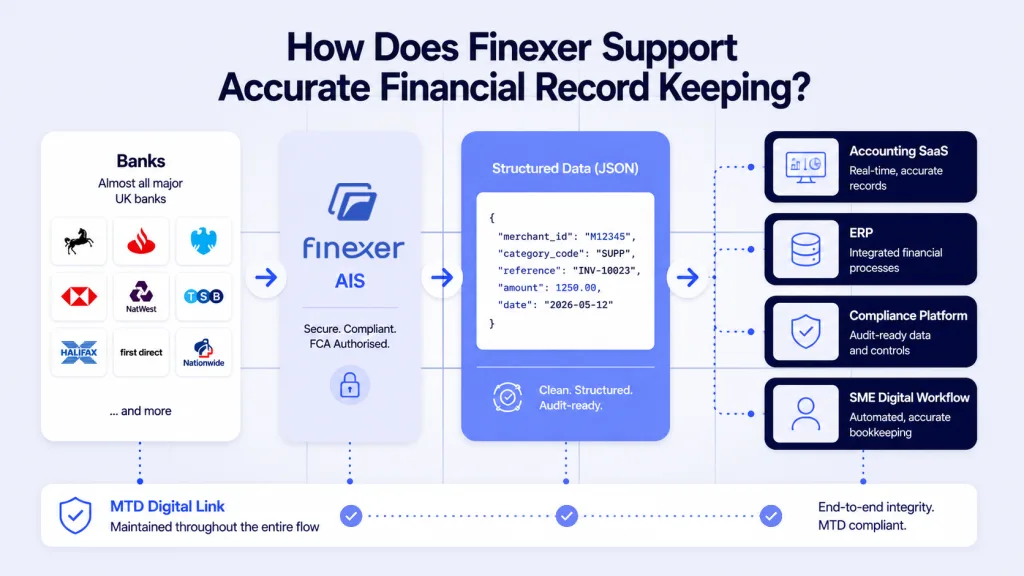
AIS – Transaction and Invoice Tracker for record keeping:
- Bank transaction data delivered per payment with merchant IDs and counterparty information
- Category codes applied at source – consistent classification across transactions
- Consistent JSON format across almost all major UK banks – one integration, full coverage
- Up to 7 years of transaction history for retrospective record reconstruction and audit support
- Balance data and account information across connected accounts
- MTD-relevant transaction fields structured for digital record keeping requirements
The transaction that appears in Finexer’s AIS feed is the same transaction the bank confirmed – this is what accurate record keeping at the source level looks like. Not a re-entry. Not a categorisation guess. The bank-verified record.
- Usage-based pricing, no setup fees, deployment measured in weeks
- FCA-authorised (FRN 925695)
For accounting platforms building connected record keeping workflows for clients, the accounting software security and financial records guide covers how structured bank data affects the security and audit-readiness of financial records in regulated environments.
What I Feel
The standard answer to why is accurate record keeping important is compliance. That answer isn’t wrong. It is incomplete, and the incompleteness costs businesses more than most compliance failures.
The businesses that struggle most with accurate record keeping are not ignoring compliance. They are managing it. They file on time, they keep the documentation, they pass the audits.
What they lack is confidence – which is exactly why accurate record keeping matters beyond the compliance minimum. They know the records are probably right. They spend time during the month-end making sure.
That “making sure” is the cost.
Not a penalty. Not a failed audit. The hours. The uncertainty. The decisions made on data that is two days old and presented as current.
Open Banking AIS doesn’t solve all of this. But it removes the largest single source of inaccuracy in accurate record keeping: the gap between what the bank recorded and what the accounting system shows.
“The most common record keeping problem is not that businesses do not keep records. It’s that the records they keep are not connected to the transaction data that would make them verifiable. That gap is the accurate record keeping failure auditors look for first.” – Clare, Finexer
Common Use Cases
Accounting SaaS Platforms
Accounting platforms using Finexer’s AIS deliver bank transaction data to clients with category codes and merchant identifiers already applied. Client records that reflect bank-confirmed transactions rather than manually entered data change the quality of every report an accounting platform produces. Reconciliation time reduces significantly when the source data is structured and consistent.
ERP and Finance Operations Systems
Finance ops teams managing large transaction volumes benefit from AIS transaction data with consistent references and categorisation. The Transaction and Invoice Tracker provides per-payment bank data that connects directly to open payables and receivables – reducing the manual matching overhead that extends month-end close timelines.
Compliance Platforms
Compliance tools handling financial evidence for regulated industries need bank-verified transaction records to support accurate record keeping requirements rather than document uploads. AIS provides a structured, consent-based transaction history that compliance platforms cannot replicate from manually submitted statements.
SMEs Using Digital Finance Workflows
Small businesses moving to digital record keeping under MTD requirements benefit from bank transaction data that flows directly into their accounting tools. No manual downloads. No CSV formatting. The bank feed keeps records current without requiring manual action between transactions and accounting entries.
How long do financial records need to be kept in the UK?
For most businesses, HMRC requires financial records to be kept for at least six years from the end of the accounting period they relate to. For self-assessment taxpayers, the minimum is five years after the 31 January submission deadline for the relevant tax year. Finexer’s AIS provides up to seven years of transaction history, covering standard UK retention requirements.
What records need to be kept for HMRC?
HMRC requires records of all income and expenses, bank statements, VAT records (for VAT-registered businesses), payroll records, and documentation supporting tax deductions. Under Making Tax Digital, records must be in digital format with digital links between systems – manual re-entry breaks compliance. Structured bank transaction data from AIS supports these requirements at the transaction level.
Why do financial records become inaccurate over time?
Primarily because of disconnection between systems. This is an infrastructure problem, not a process one. Bank transactions aren’t automatically reflected in accounting records when data is entered manually or imported in batches. Categorisation inconsistencies accumulate. References break between payment and ledger entry. The longer the gap between bank confirmation and accounting entry, the greater the risk of error. Connected bank data feeds reduce this gap significantly.
Structured bank data. Accurate records. Audit-ready workflows.
About the Author

Clare Pearson
Clare Pearson is a senior payments professional with extensive experience across the global financial services and payments industry. She specialises in Open Banking, payment infrastructure, and financial technology transformation, with expertise spanning product delivery, operational strategy, regulatory compliance, and large-scale payments programmes. Clare currently serves as a Non-Executive Director at Finexer and a panel member for the Payment Systems Regulator (PSR), advising on the development of payment systems policy and innovation