Stop reading definitions. See the API calls.
See how Finexer’s AIS infrastructure powers accounting, LawTech, Proptech, and KYC workflows across the UK.
At Finexer, we work with UK software platforms embedding Open Banking Account Information Services (AIS) into production workflows across accounting, LawTech, Proptech, KYC and other regulated sectors. During those evaluations, we find that most teams already understand what an Account Information Service Provider is in theory.
What they’re trying to determine is far more practical: what data becomes available after customer consent, how that data fits into an existing workflow, and whether it replaces manual document collection or simply adds another integration to maintain.
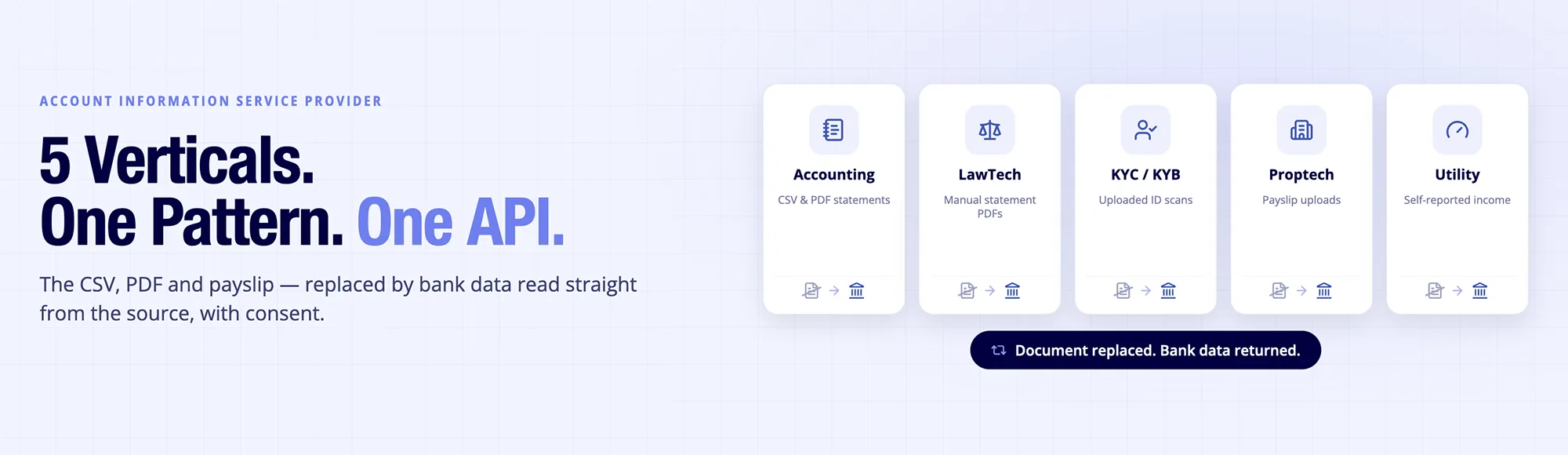
This guide answers those questions through five real account information service provider examples, showing where AIS fits into modern platform workflows and what it delivers in practice.
TL;DR: An account information service provider example that only defines “read-only, FCA-authorised, PSD2” tells you nothing about what data actually lands in your platform. This guide shows five in production: accounting reconciliation, LawTech source-of-funds, KYC onboarding, Proptech affordability, and utility billing. In my work integrating Open Banking into UK platforms, the implementation details are what separate a real evaluation from a compliance-page skim.
Every account information service provider example on the first page of search results says the same three things: FCA-authorised, read-only, PSD2. None of them show what actually lands in your platform once a client hits consent.
By Yuri, Technical Lead at Finexer
“When I work with engineering teams evaluating an account information service provider, the first question is never: ‘Is it FCA-authorised?’. It’s ‘what JSON comes back, and how fast?’. Everything else is due diligence they’ve usually already done.”
Why Every Account Information Service Provider Example You’ve Read Stops Short?
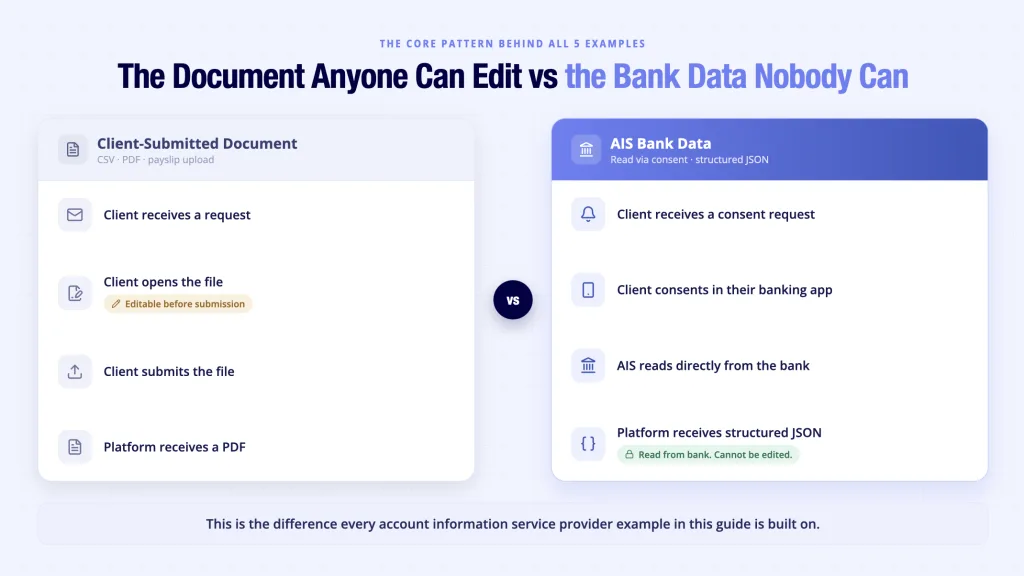
Search “account information service provider,” and every result gives you the same three facts: it’s FCA-authorised, it’s read-only and it operates under PSD2. An account information service provider, or AISP, retrieves bank account data with the user’s consent, and never moves money. That’s the definition covered in full in our AISP Open Banking guide, so this piece won’t repeat it.
What that definition never shows is what happens after the consent screen. A Product Manager evaluating AIS for their platform doesn’t need the regulation restated. They need to see what an accounting platform actually retrieves, what a LawTech tool actually checks and what the API response looks like in a real workflow.
That’s the gap five real account information service provider examples close.
What to Look for When Evaluating an Account Information Service Provider
Before the examples, five criteria separate a provider that fits a real platform workflow from one that only fits a compliance checklist.
- UK bank coverage – Does the provider connect to the high-street banks and the challengers your actual client base uses, not just the largest three or four?
- Data structure – Does transaction data arrive normalised and categorised, or does your engineering team build a parsing layer per bank?
- Historical depth – Can the provider retrieve enough transaction history for the specific workflow, whether that’s 90 days or several years for source-of-funds checks?
- Consent and revocation handling – Does the platform manage renewal and revocation automatically, or does your team build that logic?
- Integration timeline – Is onboarding measured in weeks with hands-on support, or does it require months of back-and-forth?
Five Account Information Service Provider Examples in Production
1. Accounting & ERP: Automated Client Reconciliation
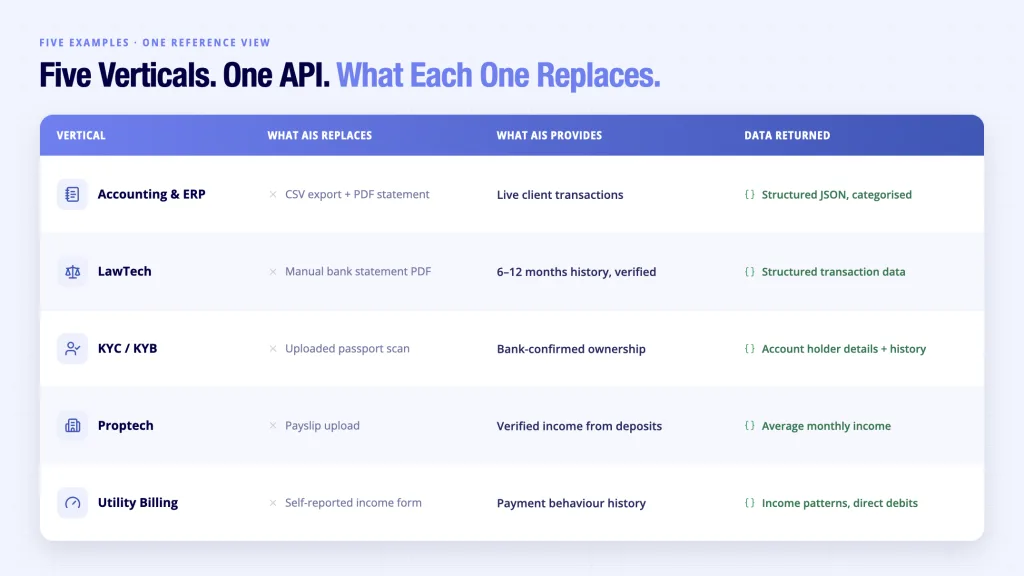
An accounting SaaS platform integrates AIS to retrieve client bank transaction data automatically, replacing the CSV export and PDF statement request that used to open every reconciliation cycle. The client connects their bank account once through consent, and transactions arrive structured and categorised going forward.
Reconciliation runs against verified bank data rather than manually uploaded files, and month-end processing time drops for practices managing multiple client accounts at once. This is the account information service provider example most accounting platforms recognise first, because it replaces a task every bookkeeper has done by hand.
Firms running this at scale often extend it into multi-client accounting workflows, and the broader Accounting & ERP use case covers how this fits alongside invoicing and payroll.
2. LawTech: Source-of-Funds Verification
A LawTech platform handling client onboarding uses AIS to retrieve six to twelve months of transaction history directly from a client’s bank account, replacing the manual bank statement request that source-of-funds checks have always relied on.
Compliance teams review structured transaction data instead of PDF documents, and the audit trail is cleaner because the data comes from a verified bank source rather than a client-submitted file.
Insolvency practices apply the same mechanism to verify a client’s financial history during case opening, checking account activity against the claims made during intake. For the deeper technical walkthrough, how solicitors use this for source-of-funds checks and the LawTech use case cover the full workflow.
3. KYC and Identity Verification: Bank-Confirmed Onboarding
A KYC and KYB workflow integrates AIS to confirm bank account ownership during onboarding, retrieving account holder details and transaction history directly from the bank rather than relying on a submitted ID document alone.
This gives the platform a bank-verified identity signal that’s harder to falsify than an uploaded passport scan, because the data ties directly to an account the person controls. LawTech platforms and accounting tools performing client due diligence use this account information service provider example to strengthen onboarding without adding friction to the journey.
4. Proptech: Tenant Affordability Checks
A property management platform integrates AIS to verify a prospective tenant’s income directly from their bank account, replacing the payslip upload that letting agents have historically relied on and that’s straightforward to edit.
Average monthly income is calculated from real transaction data rather than a self-reported figure, and the affordability decision runs on verified deposits rather than a document nobody has checked against a bank. Proptech affordability checks cover how this connects to the wider rent collection and referencing workflow.
5. Utility Billing: Payment Behaviour Analysis
A utility billing platform integrates AIS to analyse a customer’s payment behaviour before onboarding, retrieving transaction history that reveals income patterns, existing direct debits, and financial stability signals.
This replaces manual affordability checks based on self-reported income, giving the platform a verified financial picture at the point of account setup rather than a form the customer filled in themselves.
Where Generic AIS Coverage Falls Short of These Workflows
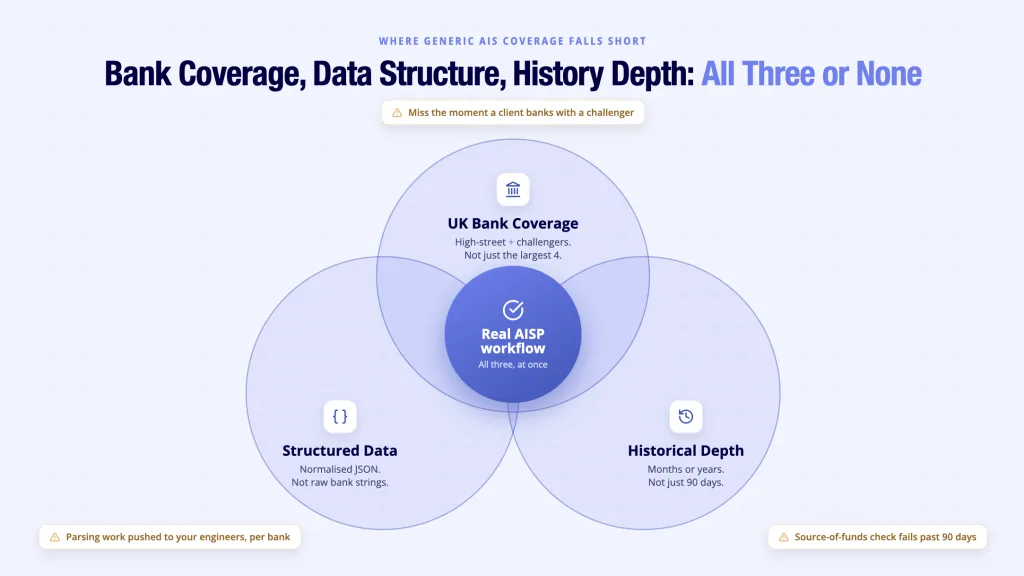
Every example above depends on the same three things working reliably: broad UK bank coverage, structured data rather than raw bank strings, and enough historical depth for the specific check being run.
A provider that covers only the largest UK banks fails the moment a client banks with a challenger. A provider that returns unstructured transaction descriptions pushes the parsing work back onto the platform’s engineering team, for every bank, indefinitely. A source-of-funds check that only reaches back 90 days can’t answer a compliance question that needs a year of history.
Real account information service provider examples only work end to end when the underlying infrastructure clears all three bars at once.
Finexer’s Data (AIS): Built for These Five Workflows
Every example above depends on the same infrastructure question: does the AISP return enough coverage, structure, and history to actually run the workflow, not just pass a compliance check.
Finexer’s Data product retrieves transaction history, account balances, and account details directly from a UK bank once the customer authenticates and consents, delivering structured JSON per transaction rather than raw bank descriptions.
For the accounting reconciliation example, that means categorised transactions arrive without a parsing layer. For the LawTech and insolvency examples, up to seven years of history covers source-of-funds checks that need to look back further than 90 days.
- Structured JSON transaction data, so reconciliation and matching logic doesn’t break per bank
- Up to 7 years of transaction history for source-of-funds and audit workflows
- Real-time webhooks when new transactions post
- Multi-account access for clients banking across several institutions
- 99% UK bank coverage
- FCA-authorised AISP and PISP (FRN925695)
- 3–5 weeks onboarding support
What Is an Account Information Services Provider?
An account information services provider is the FCA-authorised entity that retrieves bank account data on a platform’s behalf, with the customer’s explicit consent, and returns it via API.
It never initiates payments – that’s a Payment Initiation Service Provider’s (PISP) role under the same PSD2 framework. The distinction matters in the examples above: every one of them reads data (transactions, balances, ownership) and none of them moves money.
A platform needing both, say Proptech rent collection alongside affordability checks, uses an AISP and PISP together rather than picking one.
What is the difference between AISP and PISP?
An AISP retrieves bank account data such as transactions and balances, while a PISP initiates payments directly from a bank account after the customer authorises it. A platform like a Proptech tool checking tenant affordability (AISP) and then collecting rent (PISP) typically needs both.
Which platforms use account information service providers?
Accounting and ERP platforms, LawTech and insolvency tools, KYC and KYB verification workflows, Proptech and letting agent platforms, and utility billing systems all use AISPs, typically to replace a manual document collection step with verified bank data.
Is an account information service provider read-only?
Yes, an AISP’s access to bank data is strictly read-only under FCA regulation, covering transaction history, balances and account details. It cannot initiate or move funds under any circumstances, regardless of what the platform built on top of it does.
How much transaction history can an AISP retrieve?
This depends on the provider and the bank, but Finexer’s AIS can retrieve up to 7 years of transaction history with consent, which matters for source-of-funds checks that need to look back further than a typical 90-day window.
Do these examples require separate FCA authorisation for the platform?
No, a platform can integrate with an already-authorised AISP like Finexer without holding its own FCA authorisation, since the provider carries the regulatory permission for data access.
See exactly what Finexer’s Data (AIS) returns for your specific workflow, before you commit to an integration.
Explore with AI
About the Author

Yuri
Yuriy Yakushko is a fintech founder and software engineer with over 20 years of experience building financial technology. He’s passionate about creating scalable, secure infrastructure that helps businesses modernise how they access financial data and manage payments.