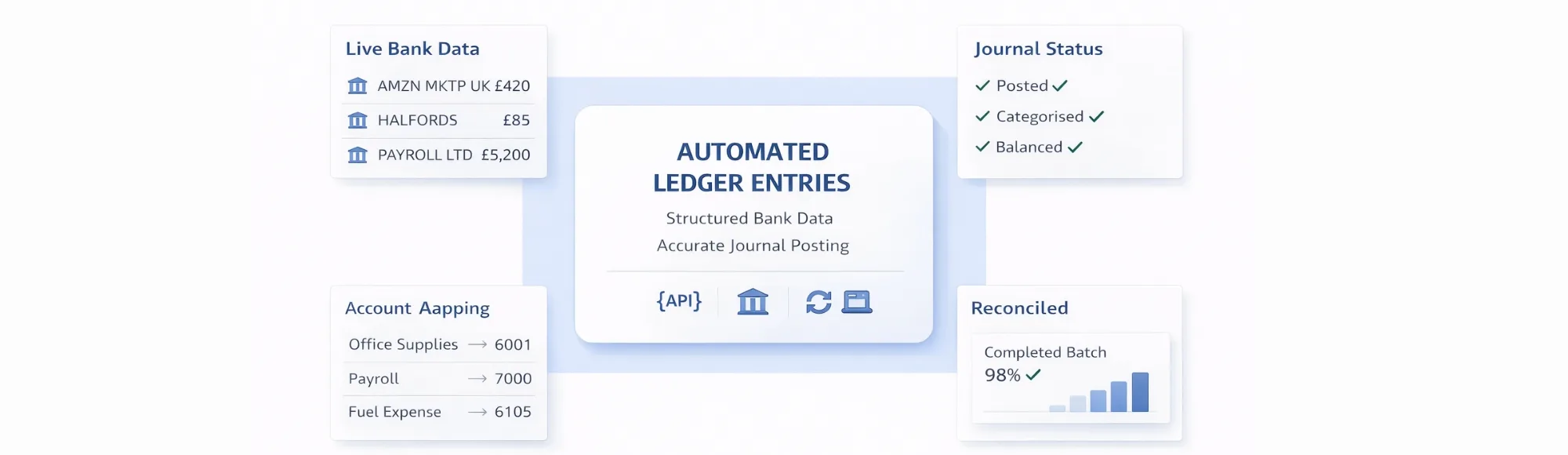
Manual ledger posting creating errors?
Access structured transaction data for automated journal entries.
UK accounting platforms cannot generate accurate ledger entries when transaction data lacks structure and merchant clarity. Bookkeeping automation, reconciliation features, and compliance workflows depend on structured bank data enabling automated journal entries without manual intervention.
Ledger entries record financial transactions in accounting systems. Accuracy depends fundamentally on transaction data quality. Broken bank connectivity causes ledger mismatches. Inconsistent merchant descriptions prevent proper categorisation. Manual posting introduces errors.
This explains how structured Open Banking data enables accurate ledger entries, what causes posting errors, and why reliable bank connectivity determines automation success.
Key Takeaways
Why does transaction data quality matter for ledgers?
Ledger accuracy depends on structured transaction data. Platforms need clean merchant names, accurate categorisation, and verified amounts enabling automated journal entries without manual cleanup.
What causes ledger posting errors?
Inconsistent transaction descriptors prevent accurate mapping. Missing merchant clarity breaks categorisation. Broken bank connectivity creates sync gaps. Duplicate imports require manual reconciliation. Delayed updates cause timing mismatches.
How do automated journal entries work?
Platforms ingest transactions, apply categorisation rules, map to chart of accounts, and post to ledgers automatically. Automation requires structured input from reliable bank connectivity.
What breaks traditional automation?
Screen scraping instability creates sync failures. Token expiry disrupts data flows. Manual CSV imports introduce inconsistency. Unstructured field formats prevent automated mapping.
Where does Finexer enable automation?
Finexer operates Open Banking connectivity using FCA-authorised infrastructure. Platforms access structured transaction data enabling accurate ledger entries through automated workflows.
Why ledger accuracy depends on bank data quality
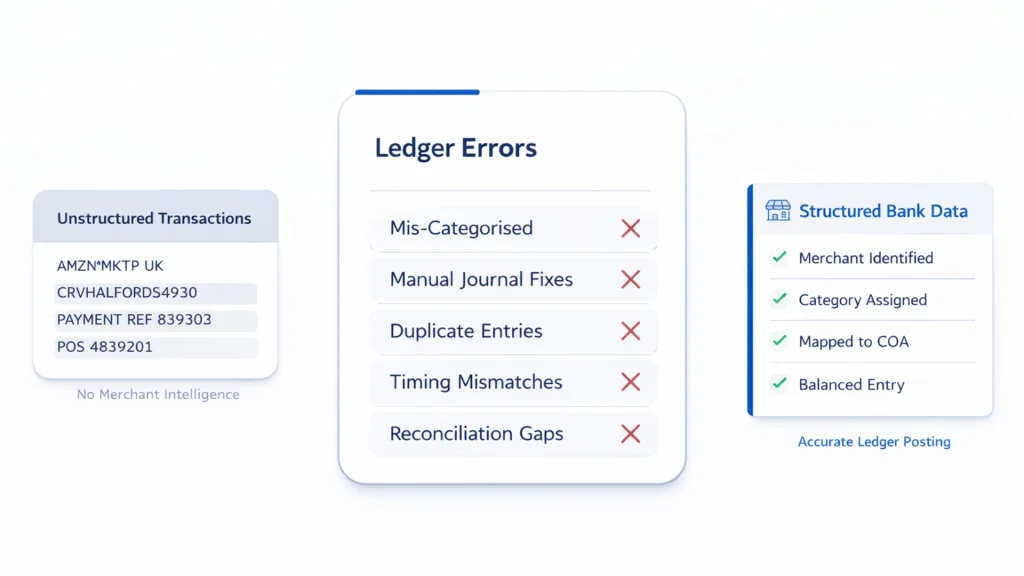
Accounting platforms building automated posting cannot function when transaction data arrives unstructured. “AMZN*MKTP UK” requires merchant identification. Category assignment needs merchant intelligence. Ledger mapping depends on structured fields.
Operational problems from poor data quality:
- Inconsistent transaction descriptors prevent accurate categorisation
- Missing merchant clarity requires manual intervention
- Broken bank connectivity creates ledger gaps
- Duplicate transaction imports require cleanup
- Delayed updates cause timing mismatches
- Reconciliation errors multiply across periods
ERP systems integrating bank connectivity discover ledger accuracy problems originate from unreliable data infrastructure. Manual journal entries compensate for automated posting failures. Staff time consumed correcting errors that proper infrastructure prevents.
How automated journal entries work
Modern accounting platforms automate posting through systematic workflows eliminating manual intervention.
- Transaction ingestion: Bank connectivity provides transaction data. Platforms receive amounts, dates, counterparties, and merchant details. Structured fields enable automated processing.
- Categorisation: Rules engines assign spending categories. Merchant intelligence improves accuracy. Machine learning refines classifications. Confidence scores flag exceptions.
- Chart of accounts mapping: Categories map to ledger accounts. Custom rules handle business-specific logic. Multi-dimensional coding supported. Department and project allocation automated.
- Ledger posting: Automated journal entries generated. Double-entry rules enforced. Posting dates determined. Audit trails maintained automatically.
Automation requires structured input from reliable bank connectivity. Poor data quality breaks workflows requiring manual intervention.
For platforms requiring automated bookkeeping, data quality determines success.
Where traditional connectivity breaks
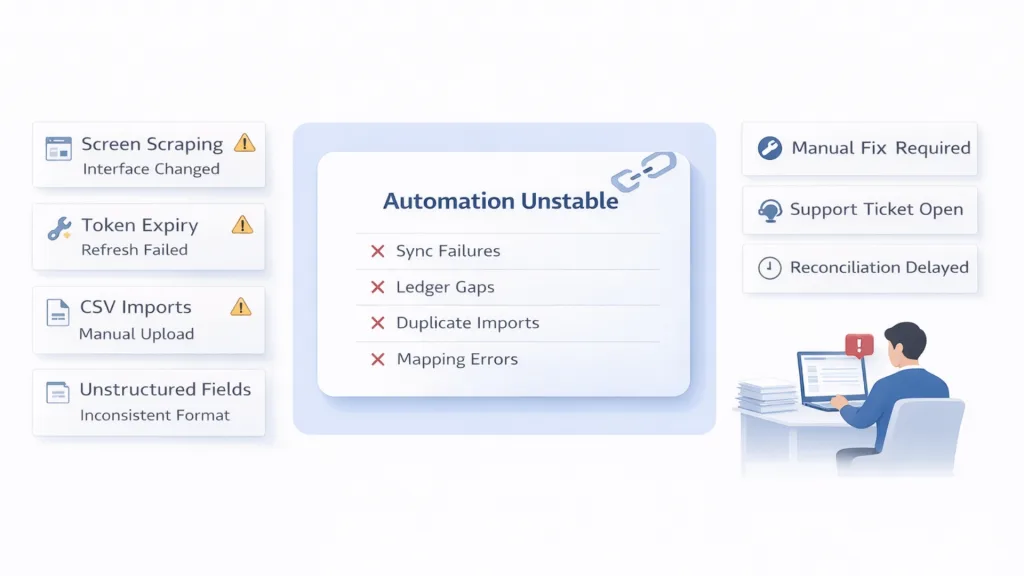
- Screen scraping instability: Legacy systems access banking websites programmatically. Banks update interfaces regularly. Scrapers break without notice. Transaction flows stop unexpectedly.
- Token expiry: API tokens require periodic refresh. Refresh mechanisms fail silently. Data gaps emerge. Ledger completeness compromised.
- Manual CSV imports: Users download bank statements manually. File formats vary by institution. Import mapping requires configuration. Consistency across periods impossible.
- Unstructured field formats: Transaction descriptions lack standardisation. Merchant names vary unpredictably. Categorisation rules fail frequently. Manual cleanup required constantly.
Traditional bank connectivity cannot provide data quality required for reliable automated journal entries at scale.
How Open Banking improves ledger automation
Open Banking infrastructure provides structured transaction data enabling accurate ledger entries through consent-based architecture.
- Consent-based access: Users authenticate through banking apps. No credential storage required. Banks manage authentication securely. Platforms receive tokenised access eliminating traditional vulnerabilities.
- Structured API outputs: Consistent JSON format across banks. Standardised transaction fields. Merchant enrichment included. Category intelligence embedded.
- Continuous data streams: Real-time transaction updates via webhooks. No polling delays. Immediate ledger visibility. Reconciliation workflows trigger instantly.
- Reduced sync failures: Direct API connectivity eliminates scraping. Banks maintain backward compatibility. Updates happen without breaking connections. Data reliability improved significantly.
- Historical transaction access: Complete transaction history up to 7 years (bank dependent). New connections include historical data. Ledger backfill automated. Compliance reporting supported.
Platforms using Open Banking for automation eliminate posting errors.
Ledger automation evaluation
| Criteria | Why It Matters | What to Look For |
|---|---|---|
| Merchant identification | Unclear names prevent accurate categorisation | Clean merchant data from comprehensive database |
| Categorisation accuracy | Incorrect categories break ledger mapping | 95%+ accuracy with confidence scoring |
| Structured outputs | Inconsistent formats prevent automation | Consistent JSON with standardised fields |
| Real-time capability | Delays prevent timely ledger updates | Webhook notifications for immediate posting |
| Historical completeness | Gaps compromise compliance reporting | Multi-year transaction retrieval |
How Finexer supports automated ledger workflows
Finexer operates Open Banking connectivity using FCA-authorised infrastructure enabling platforms to access structured transaction data.
Key capabilities:
- 99% UK bank coverage
- FCA-authorised infrastructure
- Merchant identification (100M+ database)
- Transaction categorisation (95%+ accuracy)
- Real-time webhooks
- Up to 7 years historical data
- Usage-based pricing
- White-label ready
- 2-3x faster integration
- 3-5 weeks onboarding support
Platforms integrate connectivity through REST endpoints. Users authenticate via secure Open Banking flows. Structured transaction data flows continuously enabling automated journal entries.
Real-time webhooks deliver transactions immediately. Merchant enrichment provides clean names. Categorisation intelligence enables accurate mapping. Automated workflows post ledger entries without manual intervention.
Critical positioning:
Finexer does not provide accounting software, ledger logic, or posting rules. Platforms control chart of accounts mapping and journal entry workflows.
Finexer provides structured, verified bank transaction data enabling accounting platforms to generate accurate ledger entries through automated workflows.
Common use cases
Accounting SaaS platforms:
- Generate automated journal entries from bank transactions
- Eliminate manual posting reducing staff overhead
- Improve ledger accuracy with structured merchant data
- Support multi-entity accounting workflows
ERP systems:
- Integrate bank connectivity for automated posting
- Map transactions to chart of accounts automatically
- Enable real-time ledger visibility
- Support complex allocation rules
Bookkeeping automation:
- Replace manual transaction entry with automated flows
- Categorise spending using merchant intelligence
- Generate journal entries automatically
- Maintain audit-ready transaction logs
Business management platforms:
- Enable live bank connectivity
- Automate financial record keeping
- Support compliance reporting requirements
- Reduce reconciliation effort
What I Feel About Automated Ledger Entries
Most accounting platforms treat bank connectivity as an afterthought. That’s why their ledger automation keeps breaking. I’ve seen platforms spend months building beautiful UIs and smart categorisation logic. Then everything falls apart because they’re using screen scrapers that break every few weeks. They blame “automation complexity” when the real issue is bad infrastructure.
What really matters isn’t how sophisticated your posting rules are. It’s whether your transaction data arrives structured, complete, and on time. I’ve watched platforms try to fix ledger errors with better reconciliation tools. More ML models. Smarter matching algorithms. None of that works if the underlying bank data is inconsistent garbage. Clean merchant names, accurate timestamps, verified amounts – that’s what determines whether automated journal entries actually work.
The shift to Open Banking infrastructure isn’t just about compliance or modern APIs. It’s about finally having transaction data reliable enough that automation actually works. Platforms building ledger workflows today shouldn’t ask “how do we handle posting errors better.” They should ask “why do we have posting errors in the first place.” Most of the time, it’s because the data layer is broken.
What are ledger entries?
Ledger entries record financial transactions in accounting systems. Automated ledger entries use structured bank transaction data for posting without manual intervention. Open Banking infrastructure provides verified transaction data enabling accurate automated journal entries.
How do automated journal entries work?
Automated journal entries process bank transactions through categorisation rules, map to chart of accounts, and post to ledgers automatically. Platforms require structured transaction data from reliable bank connectivity enabling automation without manual posting.
Why do ledger posting errors occur?
Ledger posting errors occur when transaction data lacks structure. Inconsistent merchant descriptions prevent accurate categorisation. Broken bank connectivity creates sync gaps. Manual CSV imports introduce inconsistency. Open Banking infrastructure eliminates these problems with structured outputs.
Enable automated ledger entries with structured transaction data and reliable bank connectivity.