
Stop fraud before money moves.
Verify bank account ownership at onboarding, not after a payment has already been authorised. See how Open Banking complements Confirmation of Payee to reduce misdirected payments and APP fraud.
A payment can be perfectly formatted, perfectly authorised and perfectly settled and still end up in the wrong account. That’s because payment systems have always been good at validating numbers. Fraudsters know they only need to exploit everything those numbers don’t prove: who actually owns the account. The difference between “valid” and “verified” is where many costly payment mistakes begin.
TL;DR: Bank account verification confirms more than whether a sort code and account number are valid. It helps establish whether you’re paying the right person. This guide compares micro-deposits, Confirmation of Payee (CoP) and instant bank account verification through Open Banking, explaining what each method verifies, where each fits, and why onboarding checks increasingly matter before the first payment is ever sent.
By Ravi Ranjan, Head of Platform Partnerships at Finexer
“Bank account verification isn’t about whether the account details look right. It’s about establishing trust before money moves. The strongest payment controls don’t wait until the payment journey; they begin when a customer, supplier or contractor is first onboarded.”
At Finexer, we work with UK businesses integrating Open Banking verification into supplier onboarding, customer onboarding and payment workflows. That practical experience, combined with the UK’s evolving fraud landscape and payment regulations, informs this comparison of bank account verification, Confirmation of Payee, and instant bank account verification, thereby helping you understand not simply how each method works, but when each should be used.
Why UK Payment Fraud Keeps Finding the Same Gap
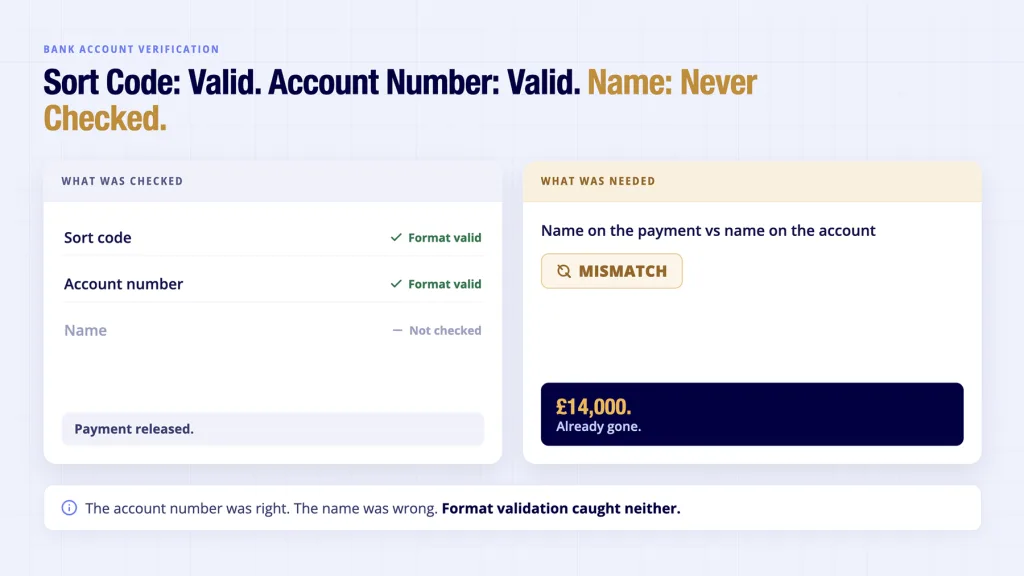
UK payment fraud cost businesses more than £1.2 billion in 2023, and a meaningful share of that traces to authorised push payment fraud, where the payer approves a transfer to an account that looks correct but isn’t.
Sort codes and account numbers pass format validation every time. What they don’t confirm is whether the name on that account matches the supplier, landlord, or contractor the business believes it’s paying. That single gap, between “the numbers are valid” and “the account belongs to who I think it does,” is where bank account verification either does its job or doesn’t.
Three Ways to Verify a Bank Account, and What Each One Actually Confirms
Bank account verification in the UK has moved through three distinct approaches, and they are not interchangeable in what they check or how long they take.
Micro-deposits send one or two small test payments to an account and ask the recipient to confirm the amounts received. It works, but it takes one to three business days, and it confirms the account can receive money, not that the name attached to it is correct.
Confirmation of Payee (CoP) checks the name on a payment against the name registered to the account, in real time, before a transfer completes. It has processed more than 2 billion checks since launch, and it’s the standard most UK banks now run automatically at the point of payment.
Open Banking bank account verification confirms account ownership directly through the account holder’s own bank login, with their consent, rather than relying on a name-matching database. It runs in seconds and ties the verification to an account the person is actively authenticating into, not a static name record.
Micro-Deposits vs Confirmation of Payee vs Instant Bank Account Verification
| Verification Method | Speed | What It Confirms | Fraud Coverage |
|---|---|---|---|
| Micro-deposits | 1-3 business days | Account can receive payments | Does not confirm name match |
| Confirmation of Payee | Instant, at point of payment | Payee name matches account | Reduces misdirected payments, name-based fraud |
| Open Banking verification | Instant, via bank login | Account ownership, direct from bank | Reduces misdirected payments and impersonation via unverified documents |
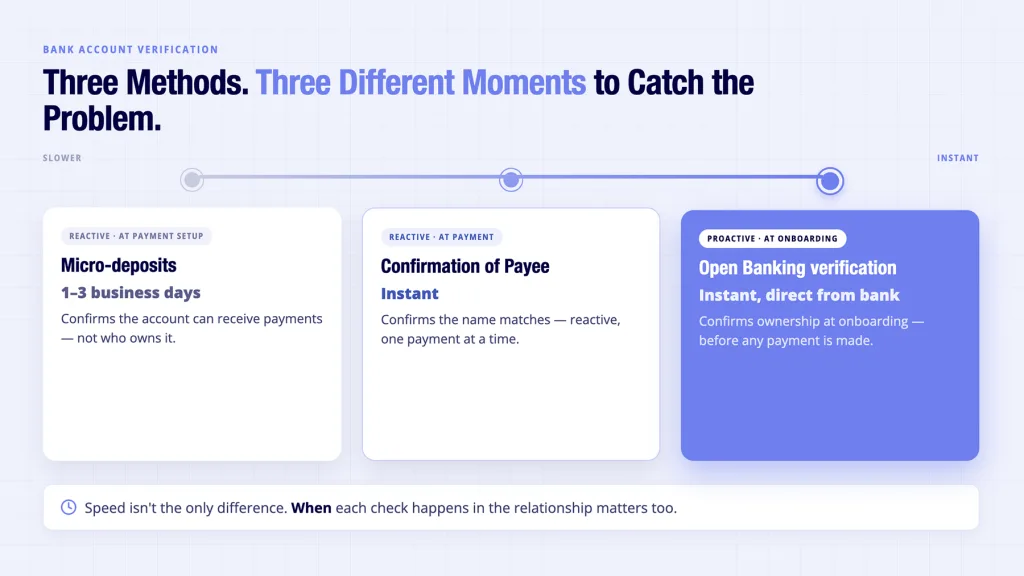
Confirmation of Payee closes the name-matching gap that sort codes and account numbers alone leave open. Open Banking bank account verification goes a step further for onboarding contexts: instead of checking a name against a database, it confirms the account holder is authenticating directly with their own bank, in real time, which matters most when a business is verifying a new customer or supplier rather than checking an existing payee.
Where This Matters Beyond a Single Payment
A bank account verification service isn’t only relevant at the moment of payment. It matters anywhere a business is taking someone’s word for whose account it actually is.
Solicitors handling client money have historically relied on submitted bank statements to confirm ownership, a document that can be edited before it ever reaches the compliance team. Verified data over uploaded documents covers how instant bank account verification replaces that submitted-document step with a direct bank confirmation for regulated firms.
Property platforms face the same exposure with tenants and landlords, and tenant and landlord verification covers how the same mechanism applies to rent collection and referencing. Small merchants processing supplier and customer payments face the exact APP fraud pattern described above, and how this reduces fraud for small businesses covers that use case directly.
Why “Format Valid” Isn’t the Same as “Verified”
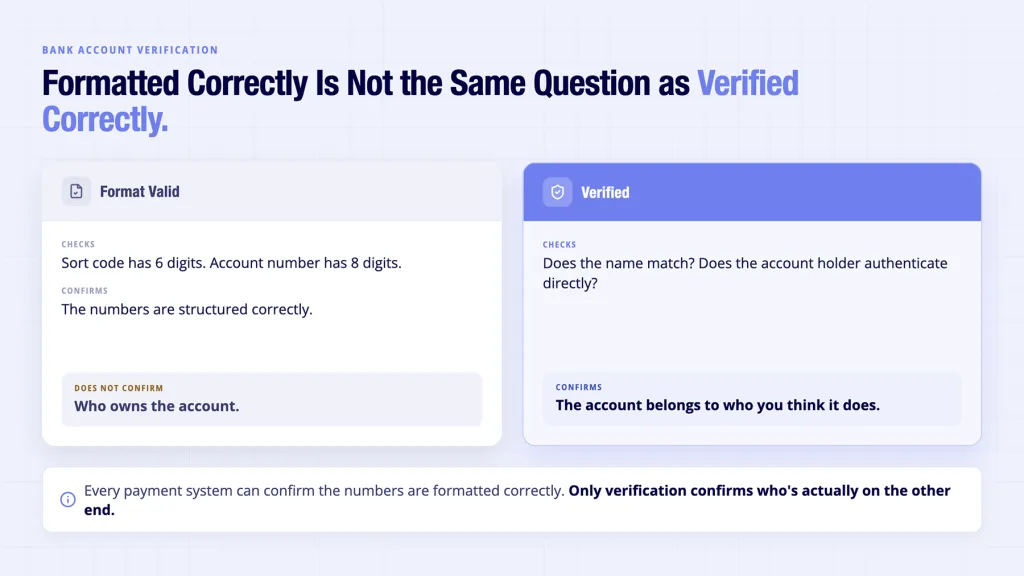
Every payment system on earth can confirm that a sort code and account number are correctly formatted. None of that confirms who actually holds the account, and that distinction is the entire fraud exposure.
A business onboarding a new supplier via emailed bank details, with no verification beyond the numbers looking right, is trusting a static piece of text with zero connection to the actual bank. Confirmation of Payee closes part of that gap for payments already in flight. Instant bank account verification via Open Banking closes it at the onboarding stage, before a business has committed to paying anyone at all.
Finexer’s Verification: Bank Account Verification at the Point of Onboarding
Businesses choosing a bank account verification service need onboarding-stage confirmation, not just a payment-time name check, particularly when a new supplier, contractor or customer is being added to the system for the first time.
Finexer’s Verification product confirms bank account ownership by having the account holder authenticate directly with their own bank: the platform requests consent, the person logs into their banking app and Finexer returns a real-time match against bank records, along with facial recognition against a passport or driving licence where identity verification is also needed. This happens before a single payment is scheduled, not as a check bolted onto the payment itself.
- Bank-based name verification: real-time match against bank records, not a submitted form
- Facial recognition with similarity score: selfie checked against passport or driving licence
- Document data extraction: structured data pulled directly from the ID document
- Almost all UK banks covered
- FCA-authorised AISP and PISP (FRN925695)
- Usage-based pricing
Is Instant Bank Account Verification the Same as Confirmation of Payee?
No, instant bank account verification and Confirmation of Payee solve related but distinct problems, and the difference matters when choosing which one to build a workflow around.
Confirmation of Payee runs a name check against a payment already being made, confirming that the payee’s name matches the account before the transfer completes.
Instant bank account verification via Open Banking confirms account ownership directly through the account holder’s own bank authentication, independent of any specific payment, which makes it suited to onboarding and identity checks rather than only payment-time confirmation.
A business processing regular supplier payments typically benefits from CoP at the payment layer and Open Banking verification at the onboarding layer, not one instead of the other.
What is bank account verification?
Bank account verification is the process of confirming that a bank account is genuine, active and belongs to the person or business claiming ownership of it, rather than just checking the sort code and account number are correctly formatted. It’s used at onboarding, before payments and during compliance checks to prevent misdirected or fraudulent transfers.
How does instant bank account verification work?
Instant bank account verification connects directly to the account holder’s bank through Open Banking, with their consent, confirming ownership in seconds rather than the 1–3 business days micro-deposits typically take. The account holder authenticates using their existing bank login, and the verification result returns immediately without documents or waiting periods.
How long does bank account verification take?
Micro-deposit verification takes 1–3 business days because it waits for the recipient to confirm the amounts received, while Confirmation of Payee and Open Banking verification both return a result instantly, at the point of payment and onboarding respectively. The method a business chooses should match how quickly a decision is actually needed.
Does a bank account verification service prevent all fraud?
No, verification confirms an account is genuine and correctly owned, which closes a specific and significant fraud gap, but it should be combined with broader fraud prevention measures rather than treated as a complete solution on its own. It’s most effective as one layer in a wider due diligence process, alongside identity checks and ongoing monitoring where relevant.
Do customers need to share their bank login details to be verified?
No, both Confirmation of Payee and Open Banking verification confirm account details without the verification provider ever seeing the customer’s banking password or login credentials. The customer authenticates directly with their own bank, using their own existing security, not a third-party form.
See how Finexer’s Verification confirms bank account ownership at onboarding, before a single misdirected payment can happen.
Explore with AI
About the Author

Ravi Ranjan
Ravi Ranjan is Co founder & CEO of Finexer