GBP payouts. Per-payment tracking. Reconciliation-ready data.
API infrastructure for UK-origin international payouts, for B2B platforms, finance ops teams, and payroll infrastructure.
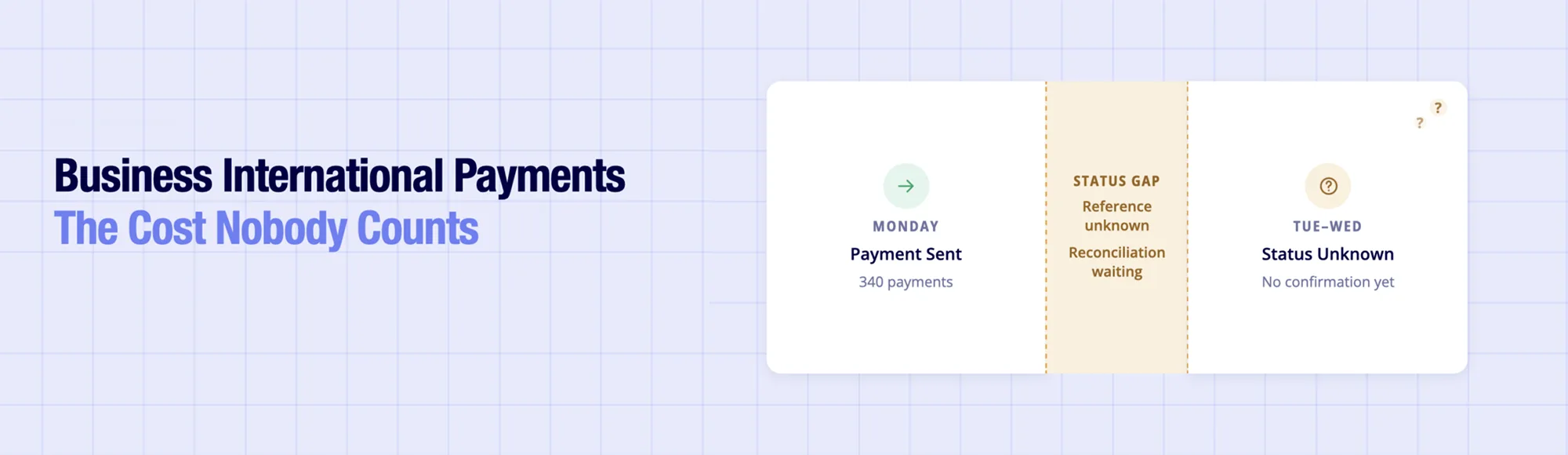
Tuesday afternoon. The payroll run goes out – 340 payments to contractors across six countries. By Wednesday morning, three had not confirmed. Nobody knows which three until recipients start emailing.
That is not a transfer problem. The money moved. The problem is that nothing on the platform side knew the payment had stalled until someone outside the business flagged it.
Finance teams describe business international payments the same way regardless of sector or size. The pattern holds whether the platform processes 50 or 5,000 business international payments a month. The sending is solved. The confirmation, the reference matching, the reconciliation – that is where the hours go. Not in the payment itself. In chasing what happened after it.
The hidden cost of business international payments rarely appears on a transaction fee report. It shows up in finance headcount, in month-end close timelines, in the spreadsheets that exist to compensate for what business international payments infrastructure did not surface automatically.
“The businesses that have fixed their international payment workflow have not found a faster payment rail. They have found infrastructure that tells them what happened after the payment left.” – Ravi, Finexer
TL;DR
Business international payments slow down operationally when payment status, settlement confirmation, and reconciliation data are disconnected from each other. The payment may move quickly. The information about the payment – reference, confirmation, matching data – often does not. Modern business international payment infrastructure should deliver per-payment status updates, embedded references, and reconciliation-ready transaction data as part of the payment flow itself, reducing the manual overhead that accumulates on the other side of every outgoing transfer.
Key Takeaways
What are business international payments?
Business international payments are B2B transfers across borders – supplier payments, payroll disbursements, marketplace payouts, or intercompany settlements. The transfer itself has improved significantly. The operational overhead around it – status confirmation, reference matching, reconciliation – has not kept pace.
Why do business international payments take longer than expected?
Settlement timelines vary by corridor, payment method, and banking partner routing. But most delays are not in transit. They are in confirmation. A payment sent Monday may not appear as a matched, referenced credit in the finance team’s records until Wednesday. That gap is operational, not technical.
What does modern international payment infrastructure need?
Per-payment status updates via webhook – not batch summaries. References embedded at initiation and consistent through to bank confirmation. Reconciliation-ready transaction data delivered near settlement. When these three elements connect, the manual overhead that follows every outgoing transfer reduces significantly.
How does Open Banking support international business payment workflows?
Finexer provides API infrastructure for UK-origin international payouts – covering UK-side funding, payout initiation, status tracking and reconciliation. The AIS Transaction and Invoice Tracker delivers per-payment bank data with the same reference at confirmation, so payment initiation and matched reconciliation data connect without a manual gap.
Why Do Business International Payments Break at the Workflow Level?
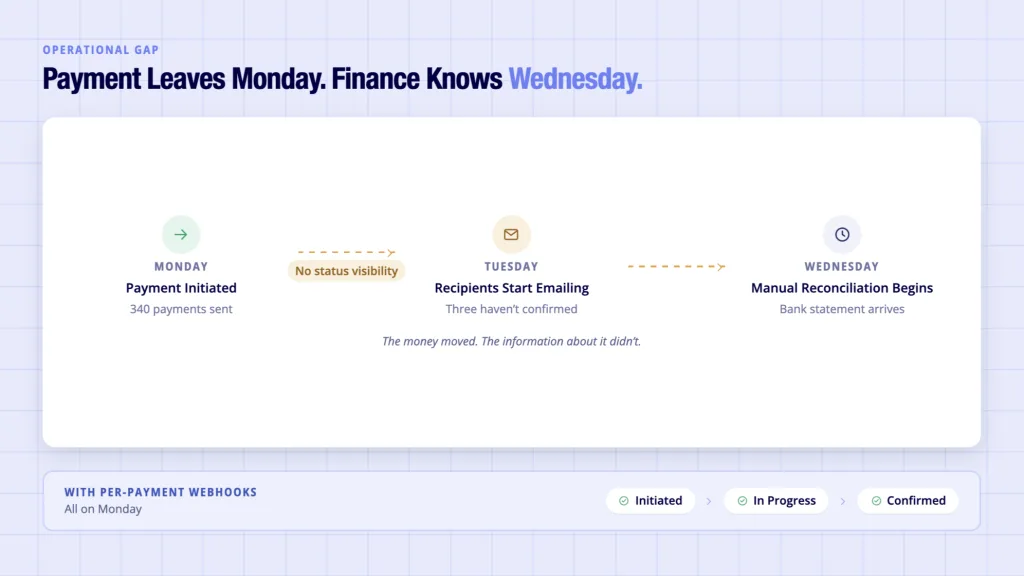
What Creates Operational Friction in International Business Payment Flows International payment infrastructure has improved considerably. SWIFT has invested in tracking standards. ISO 20022 is rolling out richer data fields across major corridors. Faster Payments handles UK domestic transfers in seconds. EU instant payments are growing.
And yet finance teams are still doing manual reconciliation runs at month-end.
The issue is not the rail. It is what the rail communicates back to the finance team – and when. That is the core business international payments challenge.
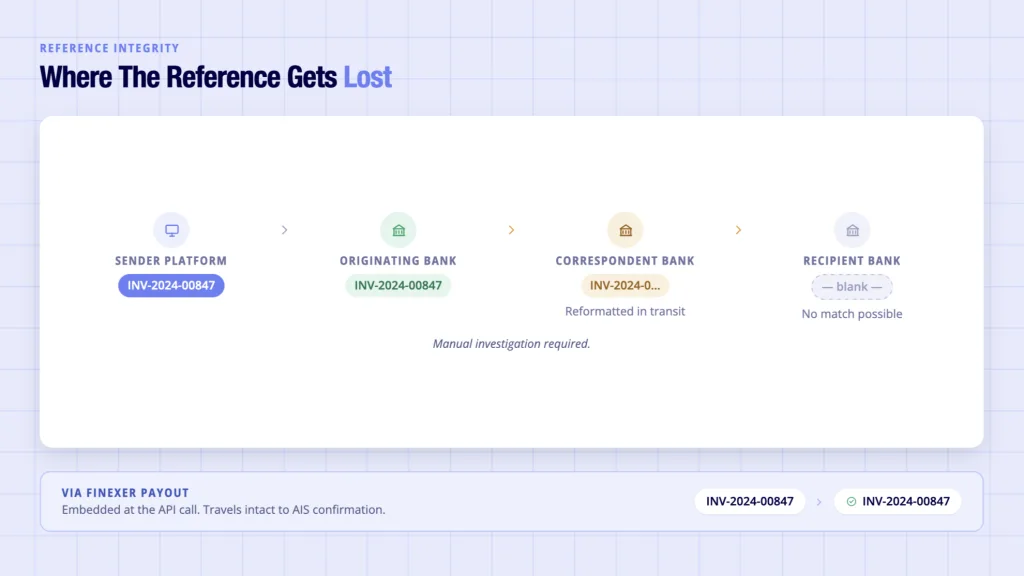
Three operational problems appear consistently in business international payment workflows:
- Status confirmation arrives too late or not at all. A payment leaves the platform. The bank shows it as sent. The recipient’s bank has not confirmed receipt. The platform has no mechanism to know which stage the payment is at without calling the bank or checking a portal. At ten payments a month, this is manageable. At two hundred, it is a role.
- References break in transit. A payment reference entered at initiation does not always survive the journey through correspondent banks. By the time the credit appears in the recipient’s account, the reference may be truncated, modified, or absent. The receiving finance team cannot match the credit to the invoice without manual investigation.
- Reconciliation data arrives separately and late. The bank statement for Monday’s international business payments arrives Wednesday morning. The finance team reconciles two days behind. Any discrepancy – a failed payment, a routing delay, a reference mismatch – surfaces in retrospect rather than in real time.
These problems are not unique to any one payment type or corridor. They are structural features of international payment infrastructure that was built for execution, not operational visibility.
For B2B platforms evaluating how API-driven payments change this dynamic, the payment integration via API guide covers how payment initiation infrastructure differs from traditional payment methods in terms of confirmation behaviour and data flow.
What Does the Operational Cost of Poor Payment Visibility Actually Look Like?
| Workflow Problem | Traditional International Payment | API-Driven Payment Infrastructure |
|---|---|---|
| Payment status | Portal login or bank call to check – no per-payment update | Webhook status update per payment: initiated, in progress, confirmed |
| Payment reference | Entered manually, may be truncated or lost through correspondent banks | Embedded at initiation, carried through to confirmation |
| Reconciliation data | Arrives in bank statement T+1 or later – manual matching required | Per-payment transaction data delivered at confirmation – structured and reference-matched |
| Failed payment visibility | Discovered in next-day statement review or recipient complaint | Webhook failure notification near-immediately – reason code included |
| Settlement timeline clarity | Varies by corridor, unclear at point of initiation | Varies by network and recipient location – communicated per payment |
| Operational overhead | Scales with payment volume – more payments, more manual checks | Structured data layer reduces overhead relative to volume |
The difference in business international payments infrastructure is not speed. Both approaches move money. The difference is what the platform knows after the payment leaves – and when.
A finance operations team processing 50 business international payments a month can manage the manual overhead. At 500, the overhead becomes a budgeted cost. At 5,000, it becomes a constraint on scaling.
For platforms building B2B payment workflows that need operational visibility alongside payment execution, the B2B payments Open Banking APIs guide covers how payment initiation changes the confirmation and data layer for B2B payment flows.
How Does Finexer Support Business International Payment Workflows?
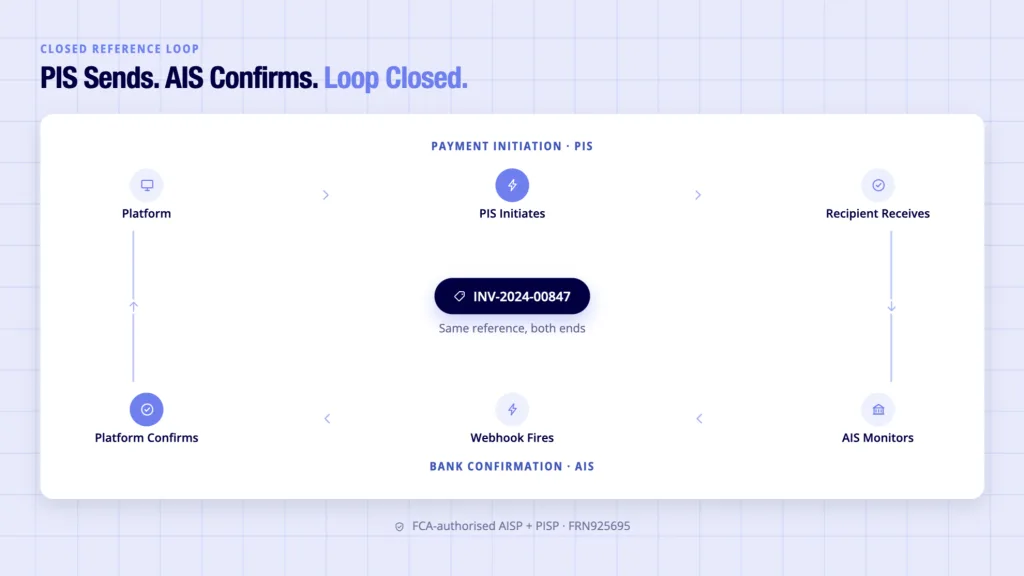
Fragmented visibility and delayed reconciliation are the operational problems. Finexer provides the payout and bank data infrastructure that reduces this overhead for UK businesses sending GBP-denominated international payments.
Finexer is not a bank. It does not operate SWIFT, provide foreign exchange (FX) conversion, or act as a treasury platform.
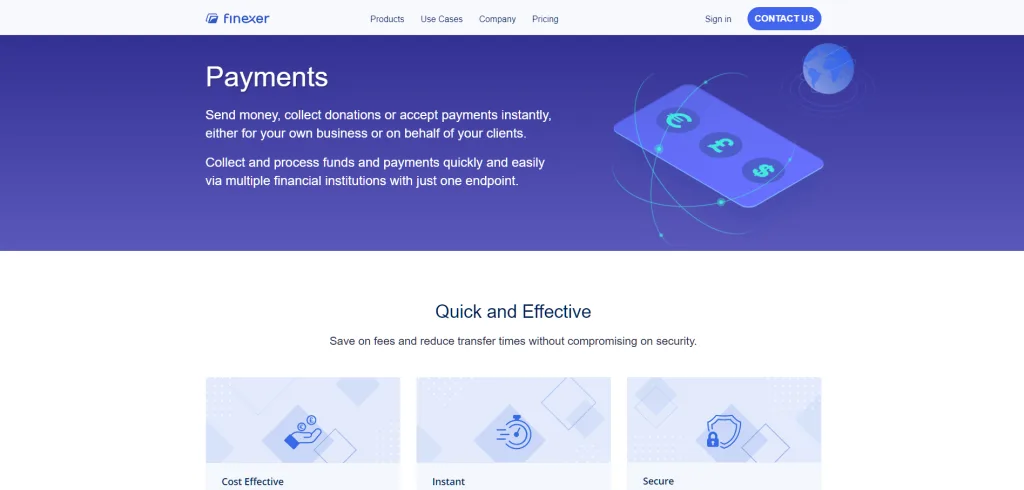
Finexer provides API infrastructure for UK-origin international payouts – covering UK-side funding, payout initiation, status tracking and reconciliation. International recipients are paid via IBAN or supported account details through supported payout routes, giving B2B platforms, payroll infrastructure, and finance operations teams per-payment visibility and reconciliation-ready data.
Payouts – initiation with reference and status tracking:
- UK-side funding and payout initiation to supported international recipients via IBAN or supported payout routes
- Payment reference embedded at initiation – consistent through to bank confirmation
- Per-payment webhook status updates – initiated, in progress, confirmed, or failed – with reason codes on failure
- Bulk Payout – multiple recipients in a single API call, each with individual payment references
- Payment Links – per-invoice shareable links with pre-filled references for inbound collection
- Pre-payment validation before funds move
- Settlement timelines and coverage depend on recipient location, payout network, and banking partner routing
AIS – Transaction and Invoice Tracker:
- Bank transaction data per payment with merchant IDs and counterparty data
- Invoice and payment references carried from initiation to bank confirmation
- Consistent JSON format across almost all major UK banks
- Up to 7 years of transaction history for reconciliation and exception resolution
- Per-payment data delivered near settlement – not overnight batch
Together, the payout and AIS layers provide the reference thread that connects the outgoing payment to the incoming bank confirmation. Business international payments that initiate with a reference and confirm with the same reference reduce manual reconciliation overhead significantly compared to workflows where reference and confirmation data arrive separately.
- Usage-based pricing, no setup fees, deployment measured in weeks
- FCA-authorised (FRN925695)
For a broader view of the payment infrastructure options available for international business payments, the fintech infrastructure API platforms guide covers how API-driven infrastructure compares to traditional banking infrastructure for cross-border payment workflows.
“Business international payments have a cost that never appears on a transaction fee report. It is the hours spent chasing status, reconciling batches, and explaining to suppliers why the payment they received does not match the reference on the invoice.” – Ravi, Finexer
The Real Question
Most conversations about business international payments focus on cost. Transfer fees, FX spreads, correspondent bank charges. Those matter.
But the operational cost of poor payment visibility often exceeds the transaction fee cost at scale. The hours spent chasing confirmations, reconciling batches, and investigating failed payments are not itemised on any invoice. They show up in headcount.
The infrastructure question for business international payments is not “what does this payment cost to send?” It is “what does this payment workflow cost to operate?”
That is where the gap between traditional international payment methods and API-driven infrastructure is most visible.
Common Use Cases
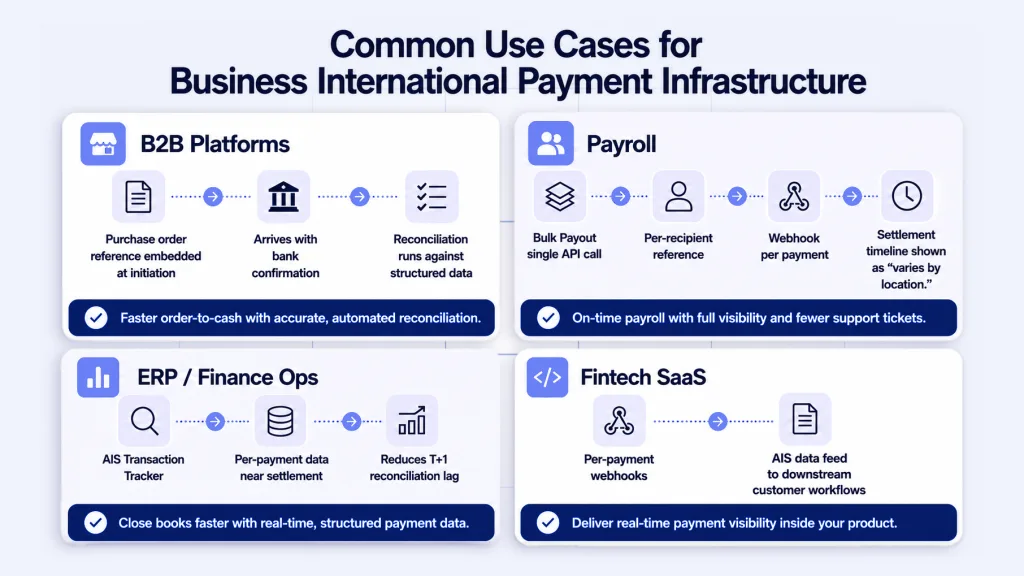
B2B Platforms and Marketplaces B2B platforms disbursing to international suppliers benefit from per-payment references embedded at initiation. Each supplier payment carries a reference that matches the purchase order or invoice. Reconciliation at the platform’s accounting layer runs against structured data rather than a manual bank statement review.
Payroll and Contractor Disbursements Payroll platforms disbursing salaries and contractor payments to supported international recipients via UK-origin payouts use Bulk Payout to initiate multiple payments in a single API call. Each recipient receives a payment with an individual reference. Settlement timelines vary by recipient location and network routing – per-payment webhook status updates reduce the support overhead from recipients asking about payment status.
ERP and Finance Operations Systems Finance ops teams managing international supplier payments and multi-currency disbursements benefit from AIS transaction data with consistent references. The Transaction and Invoice Tracker provides per-payment bank data at near settlement, reducing the T+1 data lag that creates reconciliation overhead in traditional bank statement workflows.
Fintech SaaS Platforms Fintech platforms embedding international payment capabilities for their own customers need infrastructure that provides operational visibility at the API level – not just payment execution. Per-payment webhooks and reconciliation-ready AIS data support the downstream workflows that platform customers depend on.
What causes references to get lost in international business payments?
Payment references often break when a transfer passes through correspondent or intermediary banks. Each bank in the chain may reformat, truncate, or strip the original reference field. By the time the credit arrives, the reference the sender entered no longer matches what the recipient sees. Embedding references via payout initiation reduces this risk at the source.
Is Open Banking only for UK domestic payments?
Open Banking AIS and payment initiation are UK-focused services. Finexer provides API infrastructure for UK-origin international payouts – covering UK-side funding, payout initiation, status tracking and reconciliation, with international recipients paid via IBAN or supported account details through supported payout routes. For UK businesses paying international suppliers or contractors in GBP, it provides a structured alternative to traditional bank transfers with per-payment webhook confirmation.
How do businesses reduce manual reconciliation on international payments?
By connecting the payment reference to the bank confirmation. When the same reference that initiates the payment returns with the AIS transaction data, matching becomes a structured lookup rather than manual investigation. Per-payment data delivered near settlement – rather than overnight batch bank statements – significantly reduces the reconciliation lag that creates month-end pressure.
See how Finexer supports business international payments with per-payment visibility, webhook-based tracking, and reconciliation-ready transaction data.
Explore with AI
About the Author

Ravi Ranjan
Ravi Ranjan is Co founder & CEO of Finexer