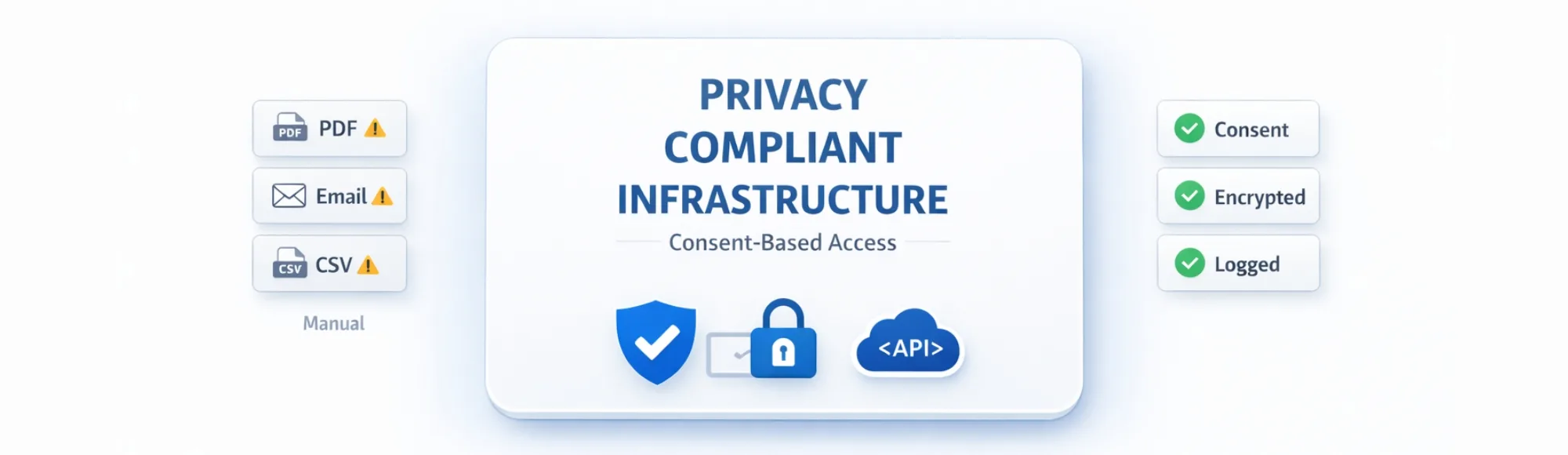
Data privacy compliance gaps creating regulatory risk?
Access consent-based bank data infrastructure meeting GDPR requirements.
UK regulated platforms handling bank transaction data cannot achieve data privacy compliance when financial visibility depends on manual statement uploads and email document exchange. Data privacy compliance in the UK is governed by three primary pillars: the UK General Data Protection Regulation (UK GDPR), the Data Protection Act 2018 (DPA 2018), and the Privacy and Electronic Communications Regulations (PECR).
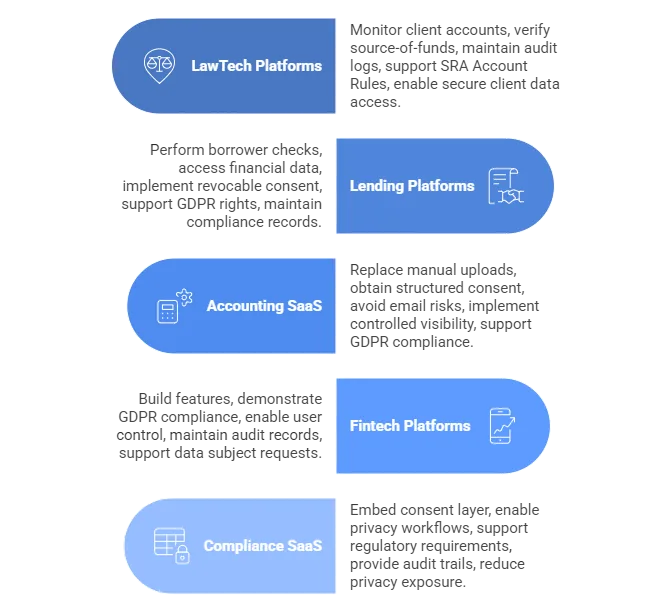
Fintech platforms, accounting SaaS, and LawTech products need consent-based infrastructure enabling secure financial data access meeting GDPR requirements without privacy exposure.
This explains how platforms achieve data privacy compliance using consent-based Open Banking infrastructure, what controls eliminate privacy gaps, and why regulated connectivity supports requirements that manual processes cannot deliver.
Key Takeaways
How does infrastructure enable privacy compliance?
Data privacy compliance requires consent-based data access, secure transmission, and controlled retention. Platforms using Open Banking infrastructure obtain explicit consent, access verified bank data securely, and maintain audit-ready logs.
Why does financial data increase privacy risk?
Bank transaction data reveals sensitive information including income sources, spending patterns, and financial relationships. Platforms handling this data face heightened GDPR obligations requiring proper consent management and security controls.
What privacy gaps break compliance?
Manual PDF uploads lack consent tracking. Email document exchange creates security exposure. CSV storage violates data minimisation. Missing revocation mechanisms prevent user control. Weak retention policies create compliance gaps.
What controls should platforms implement?
Consent management workflows, data minimisation practices, role-based access controls, encryption standards, structured access logs, retention and deletion policies, secure API connectivity.
Where does Finexer enable compliance?
Finexer operates Open Banking connectivity using FCA-authorised infrastructure. Platforms access consent-based bank data securely. Platforms build data privacy and compliance features on top.
Why financial data increases privacy risk
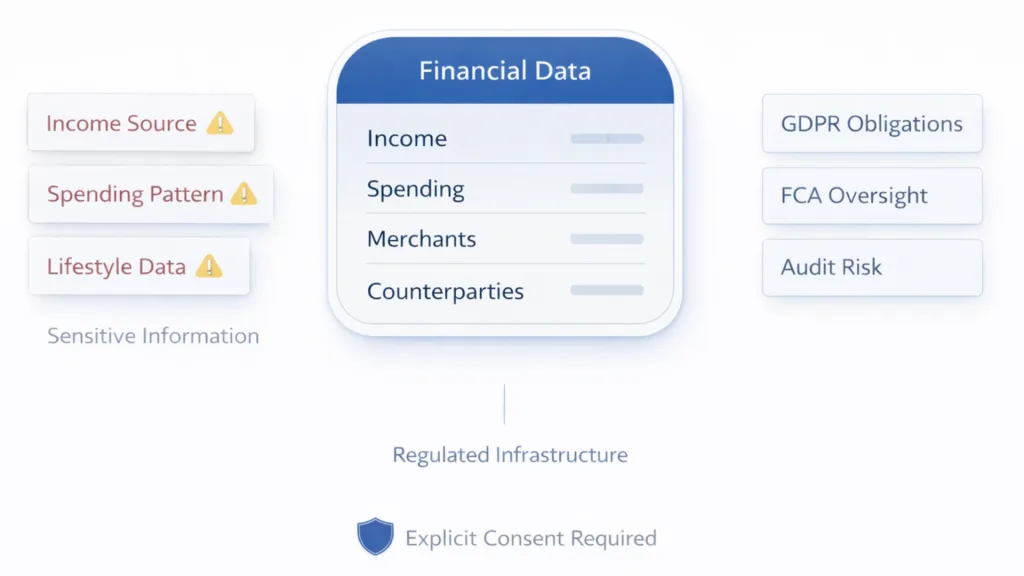
Bank transaction data reveals sensitive personal information beyond simple account balances. Transaction histories show income sources, spending patterns, merchant relationships, and financial behaviours requiring enhanced protection under data privacy compliance frameworks.
Privacy risks from financial data:
– Source-of-funds exposure revealing employment and income
– Transaction patterns indicating personal circumstances
– Merchant data showing purchases and lifestyle
– Financial relationships visible through counterparties
– AML-linked activity requiring regulatory oversight
Platforms handling this data face heightened GDPR obligations requiring robust data privacy and compliance measures. The UK GDPR requires explicit consent for processing personal data. Financial platforms must demonstrate lawful basis, implement appropriate security, and enable user control.
Regulatory audit exposure increases when platforms handle financial data without proper data privacy compliance infrastructure. FCA supervision examines data handling practices. GDPR enforcement targets inadequate consent management. Data breaches involving financial records create serious regulatory consequences.
Common privacy gaps in SaaS platforms
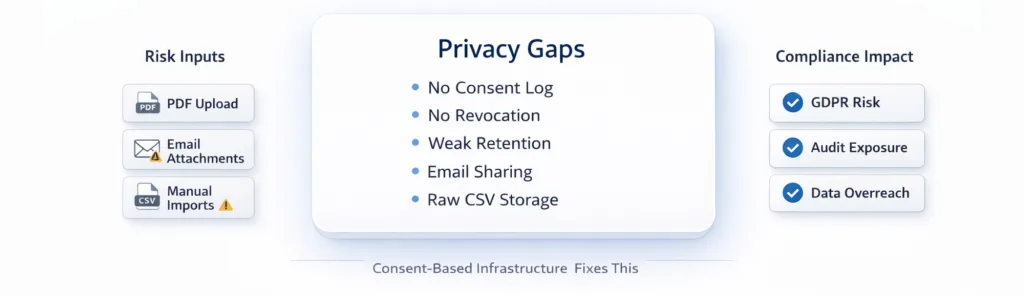
- Infrastructure-level gaps creating compliance problems: Manual PDF statement uploads lack proper consent tracking. Users email documents without structured permission management. Platforms cannot demonstrate explicit consent when data arrives through uncontrolled channels.
- No revocation mechanism: Users cannot withdraw consent easily. Platforms lack infrastructure enabling immediate access termination. GDPR requires revocation capability that manual processes cannot provide.
- Weak retention controls: Platforms store financial documents indefinitely. No automated deletion mechanisms exist. Data minimisation principles violated when retention exceeds legitimate purposes.
- Email-based document exchange: Financial records transmitted via unencrypted email. No audit trail demonstrating secure transmission. Platforms cannot prove appropriate security measures.
- Storing raw CSV exports: Users download complete bank statements. Platforms store excessive data beyond requirements. Data minimisation is violated when unnecessary fields are retained.
For platforms requiring secure data access infrastructure, consent-based connectivity removes privacy gaps.
Privacy compliance infrastructure evaluation
## Privacy compliance infrastructure evaluation| Criteria | Why It Matters | What to Look For |
|---|---|---|
| Consent management | GDPR requires explicit consent and easy revocation | Structured consent flows with automated tracking |
| Data minimisation | Excessive data storage violates GDPR principles | Scoped access requesting only necessary fields |
| Secure transmission | Unencrypted data creates compliance exposure | FCA-authorised APIs with encryption standards |
| Access logging | Accountability requires audit trails | Comprehensive logs with timestamps and user IDs |
| Retention controls | Storage limitation principle requires deletion | Automated policies aligned with data purposes |
| Revocation capability | GDPR mandates right to withdraw consent | Immediate access termination mechanisms |
How Open Banking enables privacy compliance
Open Banking infrastructure provides consent-based financial data access meeting GDPR requirements through regulated framework.
- Explicit user consent: Users authenticate through banking apps. Platforms request specific data access permissions. Users grant consent for defined purposes and periods. Banks provide secure API access only after explicit authorisation.
- Scoped data access: Platforms request only necessary data fields. Users see exactly what information shared. GDPR data minimisation principle enforced through structured consent. Platforms cannot access data beyond approved scope.
- Secure transmission: Bank-to-platform API connectivity uses encryption. No credentials stored by platforms. Tokenised access maintains security. Data transmitted through regulated channels meeting security standards.
- Revocable access: Users withdraw consent through banking apps. Access terminates immediately upon revocation. Platforms receive notification of consent withdrawal. GDPR right to withdraw consent enforced automatically.
- Structured access logging: Every data access logged with timestamps. Platforms maintain audit-ready records. GDPR accountability principle supported through comprehensive logging. Regulatory reviews supported with complete access history.
- Controlled retention: Historical data access limited by consent periods. Platforms implement deletion policies aligned with purposes. GDPR storage limitation principle enforced through infrastructure design.
Core privacy controls for regulated platforms
Platforms handling bank transaction data must implement specific controls meeting data privacy compliance requirements.
Consent management workflows:
- Obtain explicit consent before data access
- Document consent purposes clearly
- Track consent expiry dates automatically
- Enable easy revocation mechanisms
- Maintain consent audit trails
Data minimisation practices:
- Request only necessary data fields
- Avoid storing complete bank statements
- Delete data when purposes fulfilled
- Implement automated retention policies
- Regular data inventory reviews
Role-based access controls:
- Restrict financial data access by role
- Implement least privilege principles
- Log all data access attempts
- Regular access permission reviews
- Enforce separation of duties
Encryption standards:
- Encrypt data in transit and at rest
- Use industry-standard encryption protocols
- Secure API key management
- Regular security assessments
- Incident response procedures
Access logs and monitoring:
- Log all financial data access
- Monitor for unusual access patterns
- Maintain tamper-proof audit trails
- Regular log reviews for compliance
- Incident detection capabilities
How Finexer supports data privacy compliance
Finexer operates Open Banking connectivity using FCA-authorised infrastructure enabling platforms to access bank transaction data meeting data privacy compliance requirements.
Key capabilities:
- 99% UK bank coverage
- FCA-authorised infrastructure
- Real-time webhooks
- Up to 7 years historical data
- Usage-based pricing
- White-label ready
- 2-3x faster integration
- 3-5 weeks onboarding support
- Saves up to 90% on transaction costs
Platforms integrate consent-based APIs through REST endpoints. Users authenticate via secure Open Banking flows meeting GDPR explicit consent requirements. Platforms receive structured transaction information without storing credentials.
Consent lifecycle management: Automated consent tracking with expiry notifications. Users receive renewal prompts before access expires. Platforms implement revocation instantly when users withdraw consent. Complete audit trails demonstrate proper consent management.
Data minimisation support: Structured transaction data includes only relevant fields. Platforms request specific data scopes avoiding excessive information. Transaction enrichment provides merchant intelligence without storing unnecessary personal data.
Security and transmission: Bank-verified data transmitted through encrypted APIs. No credential storage required. Tokenised access maintains security throughout consent periods. Industry-standard encryption protects data in transit.
Critical compliance clarity:
Finexer does not replace internal privacy policies, provide legal advice, or act as Data Protection Officer. Platforms control privacy policies, consent documentation, and regulatory compliance.
Finexer reduces infrastructure privacy risk by providing consent-based, secure, auditable bank data access.
For platforms evaluating data privacy in account aggregation, proper infrastructure eliminates compliance gaps.
Common use cases
What I Feel About Data Privacy Compliance
Most platforms treat GDPR compliance like a checkbox exercise. They add cookie banners and privacy policies. Then store bank statements in S3 buckets with no retention policy.
The real problem? Infrastructure wasn’t built for consent-based data access. Platforms ask users to email PDFs of bank statements. Then claim GDPR compliance because they have a privacy policy.
Here’s what breaks:
- No explicit consent tracking for financial data
- Email document exchange with zero audit trail
- CSV storage violating data minimisation principles
- No revocation mechanism when users want out
- Retention policies that are just “keep everything forever”
I’ve seen platforms get FCA questions about data handling. They can’t demonstrate proper consent. They can’t prove secure transmission. They can’t show data minimisation. Because the infrastructure doesn’t support it.
Open Banking solves this at the protocol level. Users consent through their banking app. Platforms get scoped access to specific data. Revocation works instantly. Every access is logged. Data minimisation is enforced by design.
Yet platforms still avoid it because:
- Migration effort seems high
- Manual uploads are “simpler”
- Compliance problems feel theoretical until audit
The truth? Manual document collection isn’t simpler. It’s just riskier. And compliance problems stop being theoretical the moment regulators ask questions you can’t answer.
Privacy compliance isn’t about policies. It’s about infrastructure that enforces consent, scope, and revocation automatically.
What is GDPR compliance in the UK?
GDPR compliance in the UK requires organisations to protect personal data, obtain lawful basis for processing, implement appropriate security, and enable data subject rights. UK GDPR governs data processing alongside Data Protection Act 2018 and PECR regulations.
What are the 7 principles of GDPR in the UK?
The 7 GDPR principles are: lawfulness, fairness and transparency; purpose limitation; data minimisation; accuracy; storage limitation; integrity and confidentiality (security); and accountability. Organisations must demonstrate compliance with all principles when processing personal data.
Does the UK still abide by GDPR?
Yes, the UK maintains GDPR protections through UK GDPR (retained EU law) alongside Data Protection Act 2018. The framework was modernised by the Data (Use and Access) Act 2025 which entered force February 2026, maintaining privacy standards while enabling innovation.
Enable data privacy compliance with consent-based Open Banking infrastructure and secure financial data access.