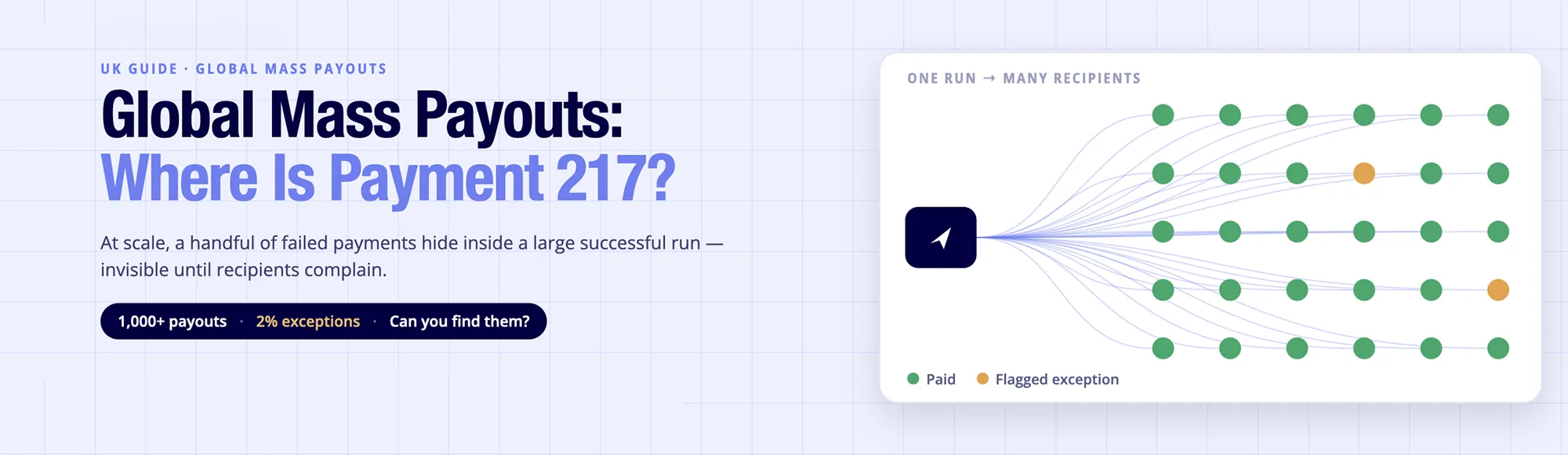
Brief: Global mass payouts are high-volume disbursements from one platform to many international recipients. They break at scale for predictable reasons: batch blindness, partial failures, and reconciliation lag. The fix is architectural: UK-origin Open Banking initiation on the domestic leg, supported payout routes to recipients, and a webhook per payout instead of a report per file.
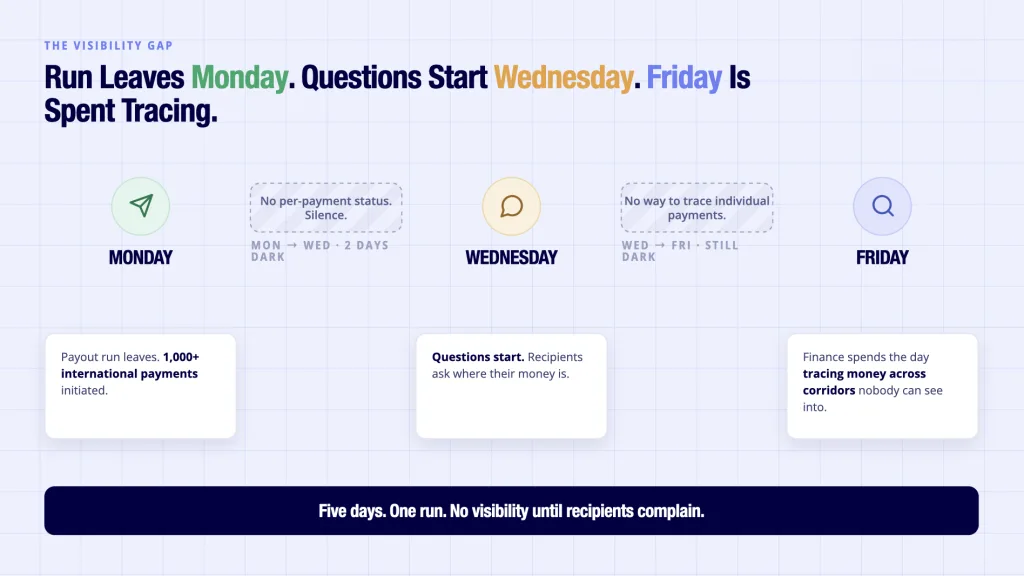
Every platform that pays international contractors knows the shape of the problem: the payout run leaves on Monday, the questions start on Wednesday, and finance spends Friday tracing money across corridors nobody can see into. Sysynkt, an ERP platform serving oil companies, faced this at scale across more than 1,000 global payouts.
After integrating Finexer’s API, it cut its payout time by 15 days, with the UK-side leg completing instant via Faster Payments and international recipients paid through supported routes. That is the real subject of global mass payouts: not whether money can move, but whether an operation can see and control thousands of movements at once. This guide covers why volume breaks visibility, and the architecture that fixes it.
What Are Global Mass Payouts?
Global mass payouts are disbursements from a single platform to many international recipients in one operation: a marketplace settling overseas sellers, a gig platform paying contractors across borders, an ERP pushing supplier payments abroad. The defining feature is volume, typically hundreds or thousands of payments per cycle, triggered from inside the platform’s product.
If you’re new to high-volume payment operations, our bulk payouts explained guide covers the fundamentals, common business use cases, and how bulk payout infrastructure works before you move to global-scale operations.
That volume is what separates them from ordinary global payouts, where a business sends occasional individual transfers and can afford to track each one by hand. At a mass scale, manual tracking stops being inefficient and starts being impossible.
The market context is growing on both sides: the Bank of England expects cross-border payment values to exceed $250 trillion by 2027, while noting these payments remain slower and less transparent than domestic ones.
Why Global Payouts Break at Scale?
Three failure modes account for most of the pain, and none of them is about payment speed.
1. Batch blindness
File-based methods report per file, not per payment. When global payouts are processed in batches, a single status covers a thousand outcomes, and the exceptions hide within the average.
2. Partial failures
In any large run, some payments fail: a wrong IBAN, a closed account, a corridor check. Without a per-payment status, failures surface only when recipients complain, days later, and one support ticket at a time.
3. Reconciliation lag
Finance teams match outcomes to records manually. UK government-backed research found businesses affected by late payments spend an average of 86 hours of staff time a year chasing them, and cross-border exceptions are the slowest to trace because no single party sees the whole chain.
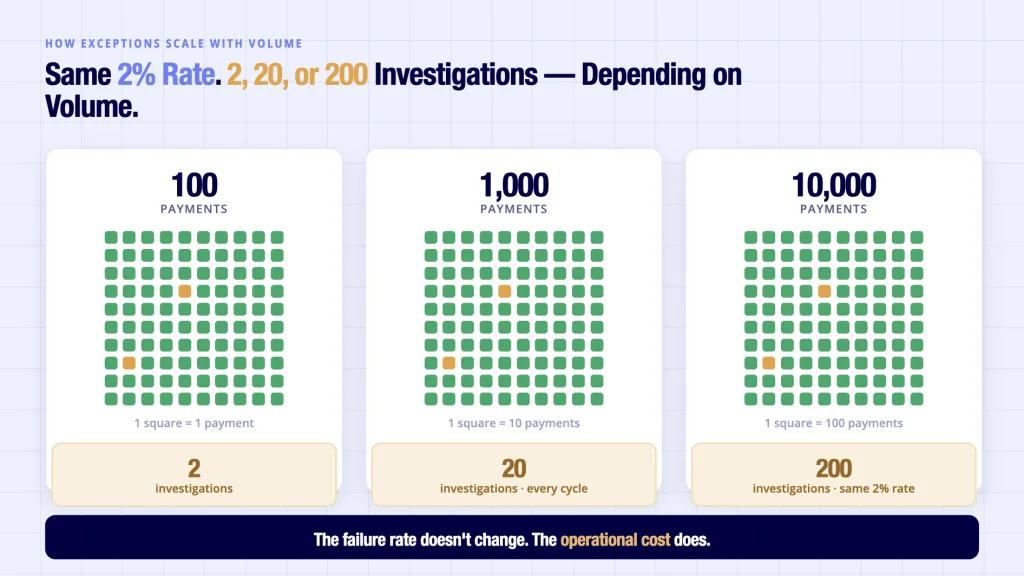
Global mass payouts multiply each of these by the run size. So, it is indicative that a 2% exception rate is 20 investigations at 1,000 payments, every cycle.
How Global Mass Payouts Work? The Two-Layer Architecture
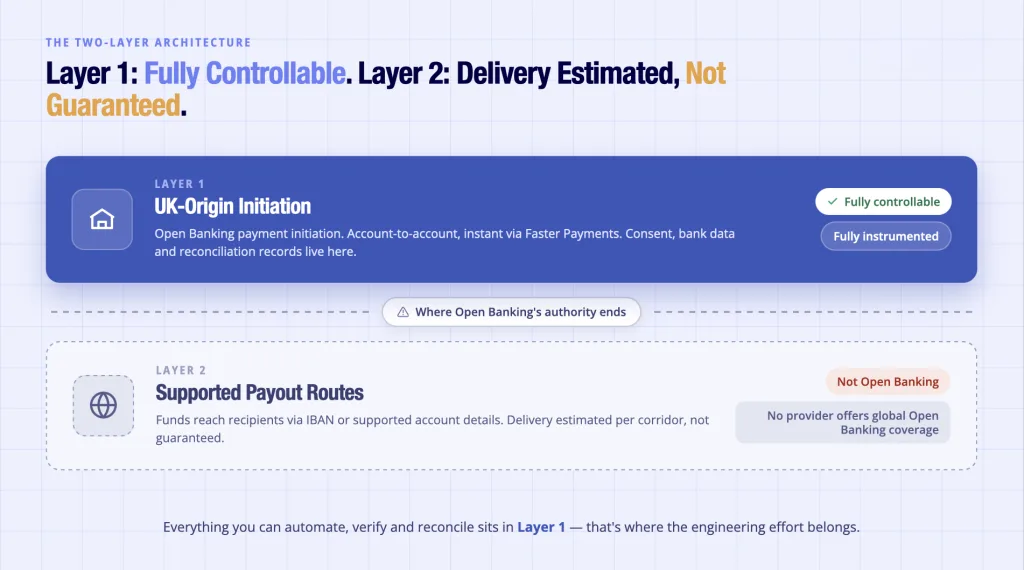
The operations that scale cleanly share one design: they treat the journey as two layers and instrument each honestly.
Layer 1: UK-Origin Initiation
The funding payments leave the UK business account through Open Banking payment initiation, account-to-account, instant via Faster Payments. Consent, bank data, and reconciliation records live here, which makes this the fully controllable half. This layer is mature infrastructure. As of 2026, there are 17.94 million user connections and 2.54 billion API calls (monthly), which altogether facilitated 37.46 million payments.
Layer 2: Supported Payout Routes
Funds reach international recipients via IBAN or supported account details, with delivery estimated per corridor. This layer is not Open Banking, and no provider offers global Open Banking coverage; providers that state their live corridors plainly are signalling exactly this boundary.
For global payouts at volume, the layer split answers the operational question too: everything you can automate, verify and reconcile sits in Layer 1, so that is where the engineering effort belongs. If you are at the stage of comparing providers on corridors, FX models and API quality, our global payout solution for UK platforms guide scores five of them side by side.
Running Mass Payouts: File Uploads vs API
The operating model matters more than the provider logo. Here is how the two approaches behave at volume:
| Factor | File-Based Batch Runs | API-Driven Runs |
|---|---|---|
| Status granularity | One report per file | One webhook per payout |
| Failure discovery | After the cycle, via the recipients | At initiation or mid-run |
| Partial failure handling | Manual investigation of the whole file | Failed payment isolated, run continues |
| Reconciliation | Statement exports, manual matching | Structured data per payout, matched as events |
| Recipient experience | Silence until arrival | Status visible inside the platform |
For teams looking to replace manual batch files with API-driven workflows, our bulk payouts multiple payments guide explains how businesses can process multiple payments in a single authorisation while improving operational efficiency.
The pattern repeats across use cases: global mass payouts for marketplace settlements, contractor networks above roughly 100 recipients, and creator platforms all hit the same wall at the same place, where file-based global payouts stop answering the only question that matters mid-run: where is payment 217?
Where Does Finexer Fit?
Finexer provides API infrastructure for UK-origin international payouts: covering UK-side funding, payout initiation, status tracking, and reconciliation. International recipients are paid via IBAN or supported account details through supported payout routes. Settlement timelines and network coverage depend on recipient location and payout routing.
For platforms running global mass payouts, that translates to:
- One API call per run, one webhook per payout, from creation to completion
- Partial-failure isolation: one failed payment does not hold the run
- Structured reconciliation data connecting payouts to bank-side records
- FCA-authorised (FRN925695) as both AISP and PISP
- 99% UK bank coverage
- Usage-based pricing, white-label deployment, 3-5 weeks of onboarding support
Sysynkt’s 1,000+ global payouts run on this model, with international delivery estimated per corridor, never guaranteed.
The same infrastructure also supports payroll automation. See our Open Banking payroll disbursement API guide to learn how UK businesses streamline employee salary payments using Open Banking-powered disbursements.
Conclusion
Volume does not break global mass payouts, but non-transparency does. The platforms that scale transparently are the ones that split the journey into its two honest layers, instrument the UK-origin half completely, and demand a webhook per payout from whatever carries the rest. One platform got its global payouts cycle back by 15 days on exactly that design.
If your payout runs have outgrown file uploads, explore the full capabilities of the Finexer payments page to see how API-driven payment initiation, payout automation, and reconciliation can support your platform before speaking with our team. Book a demo call with us and bring your hardest cycle.
What are global mass payouts?
High-volume disbursements from a single platform to multiple international recipients in a single operation, such as marketplace seller settlements or contractor payment runs, are called global mass payouts. They differ from individual transfers in scale: at hundreds or thousands of payments per cycle, per-payout status and automated reconciliation become operational requirements rather than conveniences.
Can Open Banking send money internationally?
No. Open Banking initiates payments and reads account data between UK accounts only. In global payouts, it powers the UK-origin layer: funding, verification and reconciliation. The cross-border movement runs on supported payout routes, which is why credible providers never claim global Open Banking coverage.
How do platforms track thousands of payouts at once?
Through per-payout webhooks rather than batch reports. Each payment in a run fires its own status events as it moves, so exceptions surface individually and immediately. Global mass payouts tracked this way turn a three-day investigation into an event in a queue.
Explore Finexer Payments and see how modern payout infrastructure can scale with your platform.
Explore with AI
About the Author

Ravi Ranjan
Ravi Ranjan is Co founder & CEO of Finexer