Introduction
Open banking APIs for developers separate integrations that ship fast from ones that break in production. Which open banking APIs for developers are actually worth building against? That is the question this guide answers.
Documentation quality, sandbox parity, auth model, webhook reliability, and open banking api security handling separate integrations that ship in days from those that take months and break in production. Most developer-facing comparison pages describe what an API does. This one evaluates the experience of building against it.
Open Banking UK processed 2.81 billion API calls in June 2026, a new monthly record. The ecosystem is mature. The developer experience, however, varies significantly between providers. Choosing the wrong one costs engineering time you cannot recover.
For a broader overview of open banking API UK infrastructure, see open banking API UK.
Key Takeaways
- Open banking APIs for developers should be evaluated on docs completeness, sandbox-to-production parity, auth model, error taxonomy, and webhook reliability, in that order
- The open banking developer portal is not a nice-to-have: a live sandbox, error catalogue, webhook tester, and status page are the minimum viable toolset for a clean integration
- Open banking api security requires developers to handle OAuth 2.0 consent flows, SCA redirects, token storage, and consent expiry, not just pass data through
- Time-to-first-successful-call is the most honest integration quality metric. Ask for it before committing to any provider
What Should Developers Audit in Open Banking APIs Before Committing?
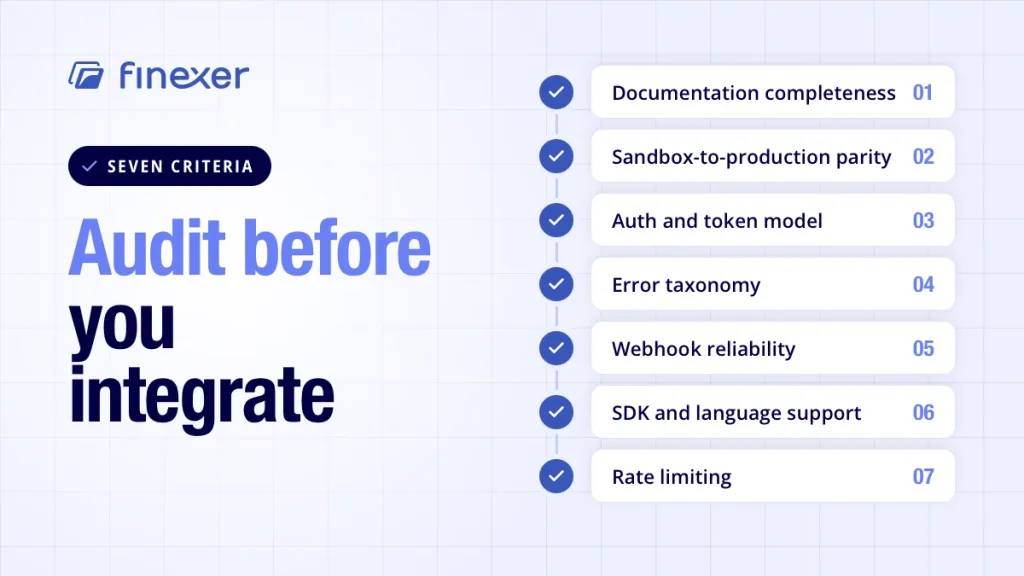
Open banking APIs for developers are only as useful as the experience of integrating them. Before writing a line of production code, audit these seven criteria.
Documentation completeness
Good documentation covers every endpoint, every parameter, every error code, and every edge case. Look for: request and response examples per endpoint, explicit coverage of consent expiry and re-authentication, error taxonomy with reason codes, and a changelog. Documentation that stops at “happy path” examples will cost you in production debugging.
Sandbox-to-production parity
The most common integration failure mode is a sandbox that behaves differently to production. Sandbox-to-production parity means the sandbox mirrors production data structures, error conditions, consent flows, and bank response times. A sandbox that accepts any token without validating consent scope is not testing your integration, it is letting problems through to production.
Auth and token model
Open banking APIs for developers universally use OAuth 2.0 consent flow. What varies is how each provider handles token lifecycle: access token expiry, refresh token scope, and the re-authentication trigger when consent expires at 90 days. Confirm before integrating: what triggers a re-auth prompt? What happens if re-auth fails? How is the token invalidated on consent revocation?
Error taxonomy
A good error model tells you exactly what went wrong and why. Look for: structured error objects (not free-text strings), error codes that distinguish bank-side from provider-side failures, and documented retry guidance. An API that returns a generic 500 on a bank timeout is harder to debug than one that returns a structured reason code for the specific failure.
Webhook reliability
For payment initiation and real-time data access, webhooks are how you know what happened. Ask any provider: Is delivery guaranteed or best-effort? What is the retry policy on failure? Can you replay missed webhook event payloads? Is there a webhook tester in the developer portal? A webhook that fires once and does not retry is a production incident waiting to happen.
SDK and language support
Not every open banking api for developers should write raw HTTP calls. Confirm what SDKs are available, which languages are supported, and whether the SDK version tracks the API version. A stale SDK is worse than no SDK because it gives false confidence.
Rate limiting
Understand the rate limiting model before you build pagination, polling, or bulk data retrieval into your architecture. What are the per-endpoint limits? Are they per-connection or per-application? How are limits communicated ,by header or by error? Building without this knowledge produces architecture that fails under load.
What Should a Useful Open Banking Developer Portal Contain?
An open banking developer portal is where your integration success starts and fails. These are the components that separate a production-grade portal from a marketing page with a docs link.
| Component | What It Should Do | Red Flag |
|---|---|---|
| Live sandbox | Mirror production flows with test bank accounts | Sandbox accepts any token without consent validation |
| Sample payloads | Request and response examples for every endpoint | Examples stop at happy path only |
| Error catalogue | Documented error codes with cause and resolution | Generic error strings, no reason codes |
| Status page | Real-time API availability and incident history | No status page or only self-reported uptime |
| Webhook tester | Replay webhook event payloads and test delivery | No webhook tester; no retry documentation |
| API changelog | Versioning history with breaking change notice | Undocumented version changes |
For open banking api examples covering specific call structures, see open banking api examples.
How Does Open Banking API Security Work for Developers?
Open banking api security is a build-time responsibility, not a provider guarantee. Understanding what you own versus what the provider handles avoids security gaps.
Things that the provider handles
The provider manages: bank connectivity under FCA authorisation, the Open Banking API UK standard conformance, consent collection UI, and the SCA redirect to the customer’s bank. The provider does not store your customer’s banking credentials at any point in the flow.
Things that the developer handles
Developers are responsible for: storing access tokens securely (not in localStorage or client-readable storage), handling the OAuth 2.0 consent flow correctly when the customer authorises, managing the 90-day consent expiry and triggering re-authentication at the right moment, and correctly scoping the data request to the minimum permissions the use case requires. Requesting broader scope than necessary is both a regulatory concern and an open banking API security risk.
SCA redirect handling
When a customer authorises a payment or data connection, they are redirected to their bank’s authentication environment for SCA. Developers must handle the redirect correctly: validate the state parameter on return, handle abandonment (the customer closes the bank app without authorising), and confirm payment status via webhook rather than redirect URL alone.
The redirect URL cannot be trusted to confirm payment success, only the webhook event payload from the provider confirms bank-confirmed status.
For a full breakdown of open banking security principles, see open banking security.
How Do Specialist UK Providers Compare to Global Aggregators?
Open banking APIs for developers in the UK come from two distinct provider categories. The comparison is structural, not a named vendor ranking.
| Dimension | UK Specialist Providers | Global Aggregators |
|---|---|---|
| UK bank coverage | Near-universal, including challengers | Strong on tier-1; variable on challengers |
| Open Banking API UK standard | Directly compliant | May abstract through a proprietary layer |
| FCA authorisation | Held directly; verifiable on FCA Register | May rely on a UK sub-entity |
| Developer portal | Usually purpose-built for UK flows | Portal may be generic across 30+ markets |
| Support model | Direct technical access during onboarding | Ticketed or regional; longer escalation |
| Sandbox fidelity | Mirrors UK bank behaviour specifically | May not replicate UK bank-specific error conditions |
For B2B payment flows specifically and how the API supports them, see b2b payment methods.
What Is Time-to-First-Call and How Do You Measure It?
Time-to-first-call is the most honest metric for evaluating open banking APIs for developers. It measures the elapsed time from signing up for a developer account to receiving a valid API response in the sandbox.
The steps that determine it
- Account creation and credential issuance (hours to days, depending on provider)
- Open banking developer portal access and sandbox environment setup
- OAuth 2.0 consent flow implementation, connecting a test bank account
- First data pull or payment initiation call
- Handling the response and confirming expected structure
A provider where steps 1-5 take under 24 hours in a well-documented sandbox is meaningfully different from one where step 1 alone takes a week. Ask directly: “What is the typical time from signup to first successful sandbox call?” The answer reveals more about the open banking developer portal quality than any feature matrix.
For a structured guide to bank api integration for platform products, see bank API integration.
How Does Finexer Support Open Banking APIs for Developers?
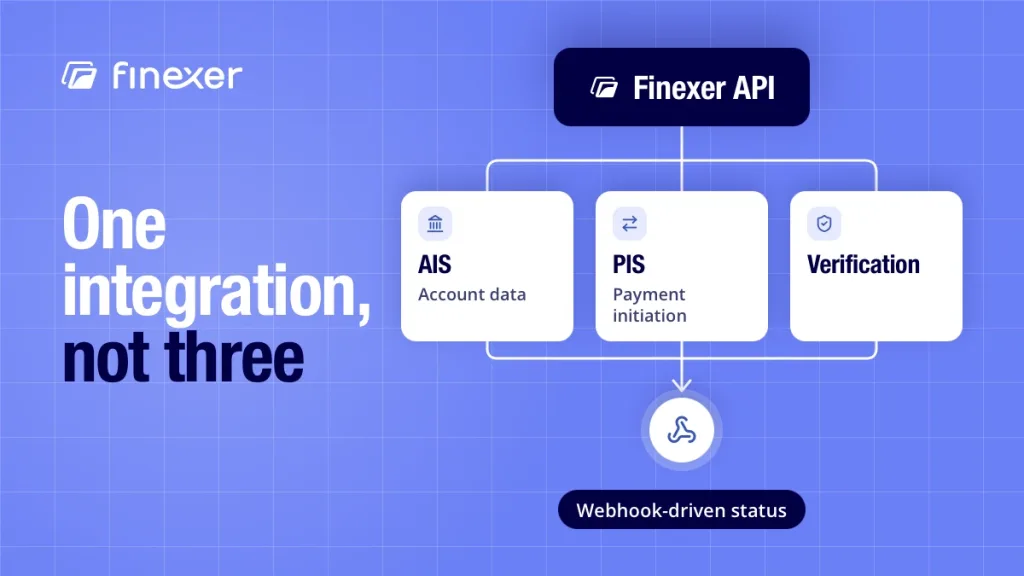
Finexer is an FCA-authorised AISP and PISP (FRN 925695) operating under the Payment Services Regulations 2017. For developers evaluating open banking APIs for developers, Finexer’s integration covers AIS, PIS, and Verification through a single API connection, one auth model, one consent flow, and one webhook schema.
What the open banking developer portal and integration experience look like:
- Sandbox available for integration testing before production commitment
- Single API covering AIS (account data), PIS (payment initiation), and Verification,no separate integrations per capability
- Webhook-driven payment and data status per event, not batch or polling-required
- Almost all UK banks coverage including business and challenger accounts (stated once per policy)
- FCA authorisation independently verifiable at FRN 925695 on the FCA Register
- PCI DSS-compliant infrastructure
- 3-5 weeks onboarding support ,technical team access, not just documentation
- Transparent pricing (no hidden charges)
Open banking api security handling: Finexer manages the OAuth 2.0 consent flow, bank redirect for SCA, and consent lifecycle. Developers handle token storage, scope management, and re-authentication prompts per the standard model described above.
See Finexer Connect for the consent layer and API connectivity details.
Bottom Line
Open banking APIs for developers reward thorough pre-integration audit and punish assumptions. Documentation completeness, sandbox-to-production parity, OAuth 2.0 consent flow clarity, webhook reliability, and open banking api security handling are the criteria that determine whether an integration ships in days or months.
Time-to-first-call is the benchmark that cuts through marketing claims. Previously mentioned June 2026 open banking API UK statistics already made it evident enough to understand that the infrastructure is proven. The developer experience varies. Audit before you build.
What are open banking APIs for developers and how do they work?
Open banking APIs for developers are regulated interfaces that connect applications to customer bank accounts with explicit consent. Developers use them to retrieve account data (via AIS) or initiate payments (via PIS). The flow involves an OAuth 2.0 consent step, a bank redirect for SCA, and webhook confirmation of the outcome. Only FCA-authorised providers can offer open banking API UK access legally.
What should a good open banking developer portal include?
A production-ready open banking developer portal should include: a live sandbox that mirrors production, sample payloads per endpoint, a documented error catalogue with reason codes, a status page with incident history, a webhook tester with replay capability, and a versioned changelog. Portals without these components create production risk.
How does open banking API security work for developers?
Open banking api security divides responsibility between the provider and the developer. The provider holds FCA authorisation, manages bank connectivity, and handles SCA redirects. The developer is responsible for token storage security, OAuth 2.0 consent flow handling, minimum-scope data requests, 90-day consent expiry management, and validating payment status via webhook event payload rather than redirect URL alone.
What open banking API examples help evaluate an integration?
Useful open banking api examples for evaluation include: a consent initiation request showing the scope parameters, a data response showing the transaction payload structure, an error response showing the reason code format, and a webhook payload showing the event schema. If a provider’s documentation does not include all four, sandbox testing is mandatory before committing to production.
What is the difference between open banking API UK providers?
UK specialist providers are directly FCA-authorised, conformant with the Open Banking API UK standard, and optimised for UK bank behaviour including challenger account coverage. Global aggregators may serve more markets but abstract UK-specific behaviour through a proprietary layer. For UK-only integrations, a specialist provider typically delivers higher sandbox fidelity and more direct support.
One integration. AIS, PIS, and Verification. Technical onboarding support included for 3-5 weeks.
Explore with AI
About the Author

Ravi Ranjan
Ravi Ranjan is Co founder & CEO of Finexer