
For five years, UK platforms chose between cards (2–3% fees, 2–3 day settlement, chargebacks) and Direct Debit (3–5 day reconciliation, disputes). Open banking payments reshape that choice: almost instant Faster Payments settlement, zero interchange fees, and bank-enforced SCA that eliminates fraud.
This guide explains how open banking payments work end-to-end, compares them fairly to cards and Direct Debit across cost, speed and risk, covers variable recurring payments for subscription billing, and shows what to evaluate in a provider.
Whether you’re billing utilities, processing payroll, collecting invoices or handling marketplace payouts, the case for open banking payments UK is clear and data-backed.
Key takeaways
- Open banking payments move money directly between bank accounts, authorised by the payer via Strong Customer Authentication (SCA) and settled instantly via Faster Payments. No intermediaries, no card rails, no 3–5 day settlement windows.
- The end-to-end flow: payment request, payer redirect to their bank, SCA authentication, payment submission, instant settlement, webhook confirmation to your system.
- Open banking payments UK market processed 2.81 billion API calls in June 2026, with Open Banking payment fraud remaining significantly below the wider UK payments industry (0.013% vs 0.045% by transaction volume).
- Open banking payments eliminate card interchange fees, reduce chargeback exposure and offer real-time payment status, making them superior to cards for high-volume recurring billing.
- Variable recurring payments (VRP) enable subscription-style collection with pre-authorised limits, splitting billing traffic from one-off payments in the open banking ecosystem.
How Do Account-to-Account Payments Work in Open Banking?
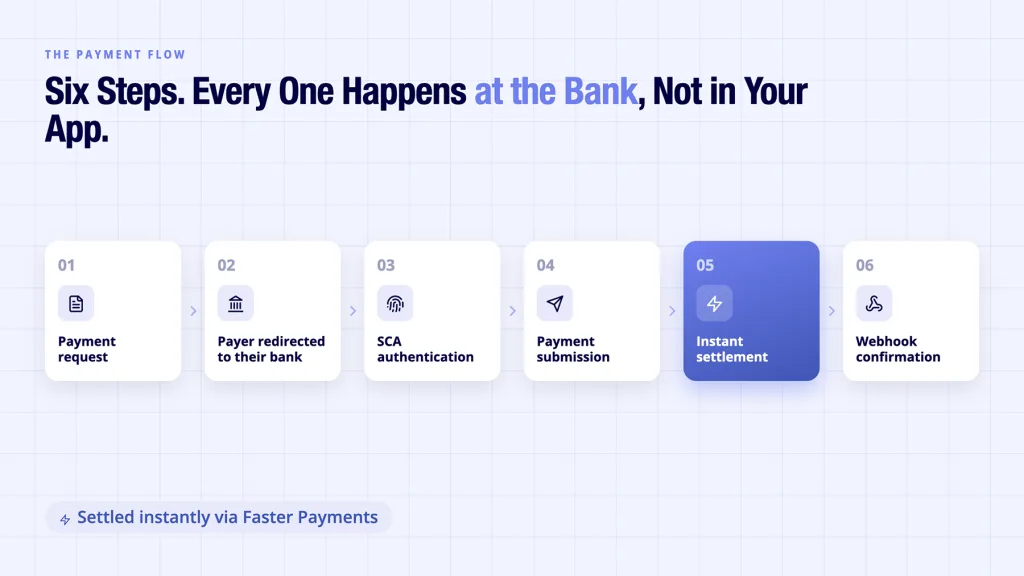
Open banking payments are account-to-account payments; money moves directly between bank accounts governed by PSD2 open banking standards and customer authorisation via Strong Customer Authentication (SCA). Open banking payments follow a strict regulatory sequence, each step governed by SCA and consent rules under PSD2.
This entire process is powered by open banking payment initiation, which securely lets customers authorise payments directly from their bank accounts.
The Complete Account-to-Account Payment Flow with Customer Authorisation
Your system generates a payment request. The payer authenticates at their bank using fingerprint, PIN or app notification- this is customer authorisation via SCA, non-delegable and required under open banking regulations UK.
Once authorised, the account-to-account payment submits to Faster Payments and near-instant settlement. Webhook confirms status to your API. The entire flow takes under 30 seconds from initiation to settlement confirmation.
Why Choose Open Banking Payments over Cards and Direct Debit?
The business case for open banking payments UK depends on three things: settlement speed, cost structure, and failure recovery. Here is how open banking payments compare fairly to the two existing alternatives.
| Factor | Cards | Direct Debit | Open Banking Payments |
|---|---|---|---|
| Settlement | 2–3 days (provisionally) | 3–5 days (Bacs) | Instant (Faster Payments) |
| Cost per transaction | 1–3% + fixed fee | 0.5–1.5p fixed | Usage-based (typically £0.05–0.20) |
| Chargeback/indemnity exposure | Subject to chargebacks | Protected by the Direct Debit Guarantee | Bank-enforced, zero chargeback |
| Failure visibility | Hours or days | Days | Real-time webhook |
| Use case fit | One-off checkout, subscriptions | Low-value recurring | High-volume recurring, B2B invoicing |
The biggest difference is failure visibility. Card payment failures may only become apparent later, and Direct Debit failures typically appear after the Bacs cycle. Open banking payments report failures in real time through webhooks, allowing businesses to retry payments sooner, reduce involuntary churn, and recover revenue faster.
What Are Variable Recurring Payments (VRP)?
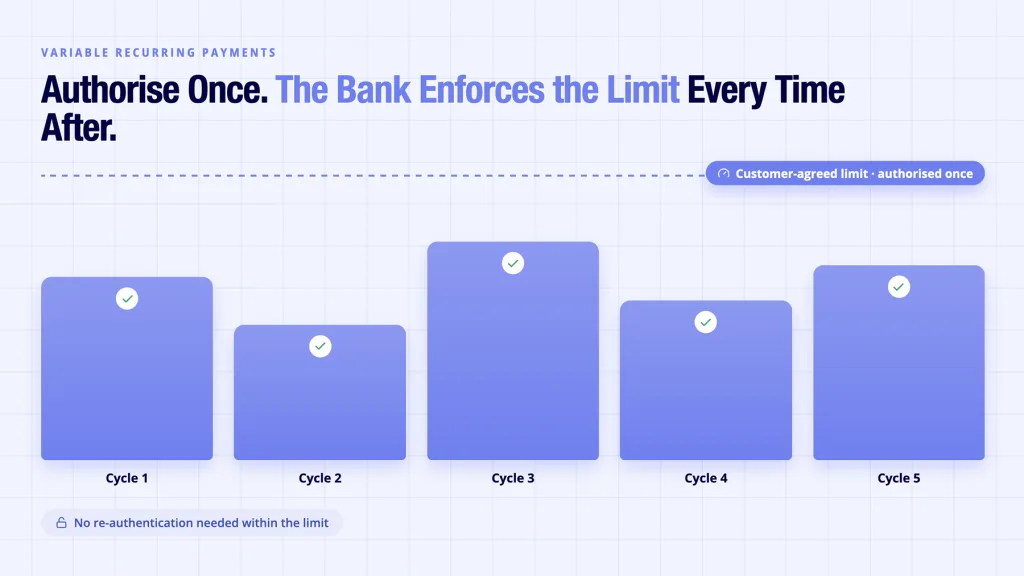
Variable recurring payments are purpose-built for subscription and utility billing. They allow pre-authorised collection up to a customer-agreed limit, then automatic collection every cycle without re-authentication. VRP fraud rates run lower than single payments because the collection process is bank-enforced and the payer’s limit provides natural protection.
Why Do Open Banking Payments UK Matter?
Three drivers are critical to consider in this case:
- Instant settlement vs 3–5 day cycles
- Scale proven (over 1 billion payments were made via open banking as of July 2026)
- Regulatory tailwinds (FCA powers 2026).
Open banking payments are becoming core payment infrastructure for UK platforms, not just an alternative payment method. As adoption grows and commercial VRP expands, businesses that understand and evaluate these rails today will be better prepared to reduce costs, improve payment visibility, and support future payment use cases.
What Open Banking Standards and Regulations Govern These Payments?
Open banking payments UK operate under PSD2 (Payment Services Directive 2) and open banking standards enforced by the FCA. Open banking regulations UK mandate strict SCA and customer authorisation at every step.
Every account-to-account payment is authenticated at the customer’s own bank, never through your interface, and settled via Faster Payments. Compliance is built into the infrastructure, not layered on top.
What Should You Evaluate When Choosing Open Banking Providers UK?
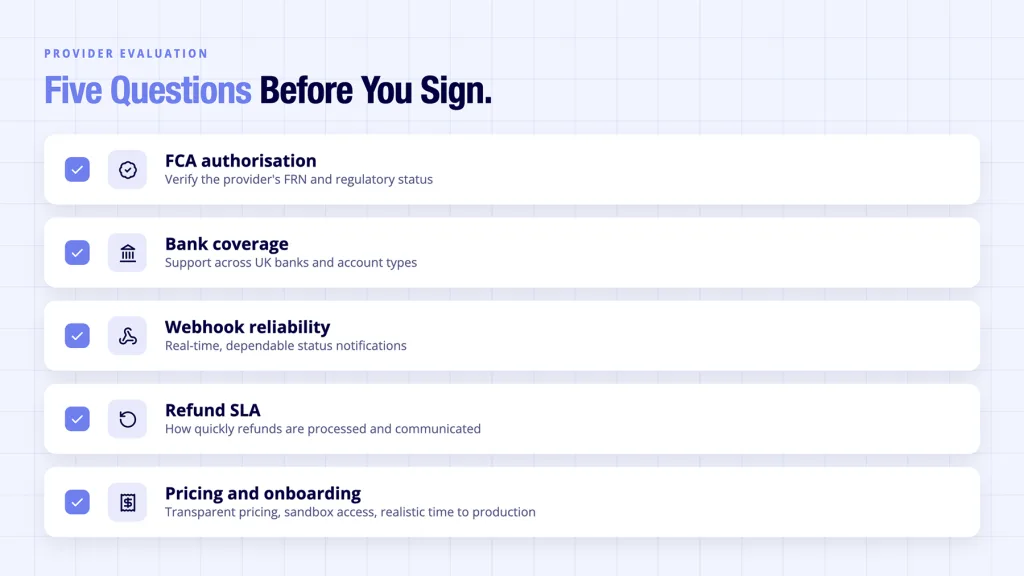
When comparing open banking providers UK, focus on these five factors:
- FCA authorisation: Verify the provider’s FCA registration (FRN) and regulatory status.
- Bank coverage: Check support across UK banks and account types, including business accounts.
- Webhook reliability: Ensure real-time, dependable payment and status notifications.
- Refund SLA: Understand how quickly refunds are processed and communicated.
- Pricing and onboarding: Look for transparent pricing, sandbox access, and a realistic time to production.
How Finexer Mitigates the Challenges Outlined Above?
Finexer (FCA-authorised, FRN 925695) solves the specific problems outlined in this guide: settlement delays, cost structure, failure visibility, and compliance overhead.
Settlement delays: Finexer initiates via Faster Payments -settling instantly, not 2–3 days (cards) or 3–5 days (Direct Debit).
Cost: Usage-based pricing with no card-network interchange fees, helping businesses reduce payment costs as they scale.
Failure visibility: Synchronous webhooks confirm status immediately to your API.
Coverage: 99% of UK banks.
VRP & billing: Finexer’s Payments API handles single and recurring payments with consent lifecycle management and automatic decline handling.
Integration speed: White-label screens, straightforward API calls- weeks to production.
Compliance: FCA authorisation in-house. PSD2, SCA, and regulatory reporting handled end-to-end.
See pay by bank provider comparisons for context on Finexer’s positioning at the merchant layer, and VRP payments for the detailed subscription billing guide.
Use cases: open banking examples in practice
Real-world open banking examples span major payments verticals:
- Utilities -Variable amounts, millions of accounts, instant failure visibility.
- Accounting/ERP -Invoice collection with zero card fees.
- Payroll -Instant settlement to employee accounts.
- Proptech -Rent collection with bank-enforced customer authorisation.
What Questions Should You Ask Before Adopting Open Banking Payments?
Open Banking payments are no longer evaluated on whether they work. The more important question is how well they fit your payment operations over time. Beyond payment initiation itself, businesses should consider the practical aspects of implementation, including bank coverage, webhook reliability, payment status visibility and long-term maintenance.
These factors determine how much operational effort your team spends after launch, particularly as payment volumes grow.
Evaluating providers against operational criteria rather than feature lists helps separate a proof of concept from infrastructure that supports day-to-day business processes. The objective is not simply to initiate payments, but to build an account-to-account (A2A) payment workflow that remains reliable as your business scales.
| Question | Why it matters? |
|---|---|
| Does the provider cover the UK banks your customers actually use? | Coverage directly affects payment success and customer adoption. |
| Are account-to-account (A2A) payments supported for both collections and payouts? | Many businesses need both capabilities as they scale. |
| How are payment status updates delivered? | Reliable webhooks reduce manual reconciliation and improve operational visibility. |
| How are consent and authentication handled? | A smooth bank authorisation journey improves completion rates while remaining PSD2 compliant. |
| Can the integration scale without adding operational overhead? | The ongoing maintenance effort often matters more than the initial API integration. |
The Bottom Line
Open banking payments are becoming a core part of modern payment infrastructure. They help businesses move money directly between bank accounts, improve payment visibility, and reduce reliance on traditional card rails. If you’re evaluating payment options, the best approach is to pilot the technology, measure how it fits your workflows, and scale with confidence.
How do I know if open banking payments UK is right for my use case?
Three signals: (1) you bill thousands of customers monthly, (2) you care about involuntary churn, (3) you want to reduce payment costs. Open banking payments UK excel when all three signals are present. Test it in your sandbox first.
Are open banking payments safer than cards?
Yes. Open banking payments use bank-enforced Strong Customer Authentication (SCA), with customer authorisation completed directly through the customer’s bank. This makes them a secure alternative to traditional card payments.
What is the regulatory basis for open banking payments?
Open banking payments operate under PSD2, which mandates that FCA-regulated payment initiation service providers have write access for payment instruction under strict customer authorisation and open banking standards. In 2026, the FCA will gain new open banking rule-making powers to strengthen these open banking regulations UK further.
See how Finexer simplifies account-to-account payments through one API.
Explore with AI
About the Author

Ravi Ranjan
Ravi Ranjan is Co founder & CEO of Finexer