UK payment visibility. Settlement confirmation. Reconciliation-ready data.
A Open Banking PIS and AIS for finance teams that need more than a status page.
The customer pays. You get confirmation. Then you wait for the money to show up.
That is not a startup founder describing a problem. That is the daily experience of UK finance operations teams. The payment tracker shows “sent.” The bank knows what happened next. Nobody else does.
Most payment tracker tools were built to answer one question: did the payment instruction leave? Finance teams running at volume need three more. Did it arrive? Was the reference intact when it did? Is the data structured enough to close the reconciliation without a manual step?
Those three questions are where most payment trackers break down.
Research published in March 2026 found that 85% of UK firms still rely on fully or mostly manual reconciliation. Not because they haven’t invested in technology. Because the payment tracker is showing them initiation status, and the reconciliation needs settlement data.
“The payment tracker problem isn’t usually the tool. It’s what the tool has access to. A tracker connected only to initiation events can tell you the payment left. It can’t tell you it arrived. That gap is where the finance team spends Friday afternoon.” – Ravi, Finexer
TL;DR
A payment tracker monitors payment status from initiation through to settlement. Most UK payment tracker implementations stop at initiation – they show that a payment went out, not that it arrived, whether the reference survived transit, or whether the data connects to the reconciliation layer. Industry research from March 2026 found 85% of UK firms still reconcile manually. The fix is not a better tracker. It is connecting the tracker to bank-confirmed settlement data via Open Banking AIS – delivering per-payment webhook confirmation and structured transaction data at the point of settlement, not in the following morning’s batch file.
Key Takeaways
What is a payment tracker? A payment tracker monitors payment status from initiation through settlement, surfacing reference data and timestamps at each stage. Its usefulness depends on what data it receives. A tracker connected to initiation only shows a payment left. One connected to bank settlement data shows it arrived.
Why does international payment tracking break down? Three problems compound: references are stripped by correspondent banks, settlement timelines vary by corridor with no fixed window, and status updates arrive in T+1 batch files rather than at settlement. The result is a payment tracker showing “processing” for 24-48 hours with nothing actionable.
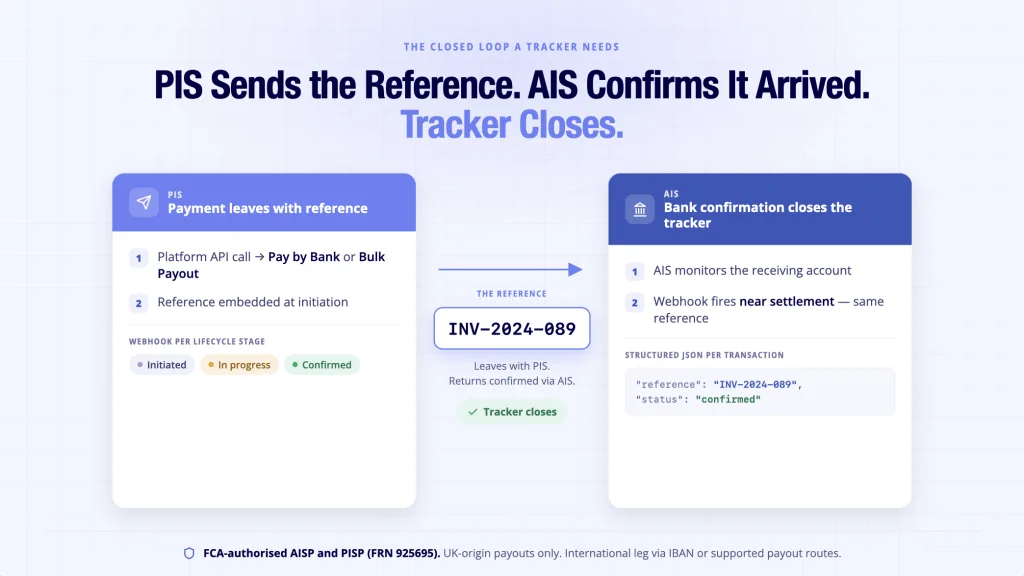
What does a connected payment tracker actually require? Per-payment webhook at settlement – not batch updates. References embedded at initiation and returned confirmed at bank settlement. When PIS embeds a reference and AIS returns it confirmed, the tracker closes the loop between the payment that left and the credit that arrived.
Why Do UK Payment Trackers Still Fail Finance Teams?
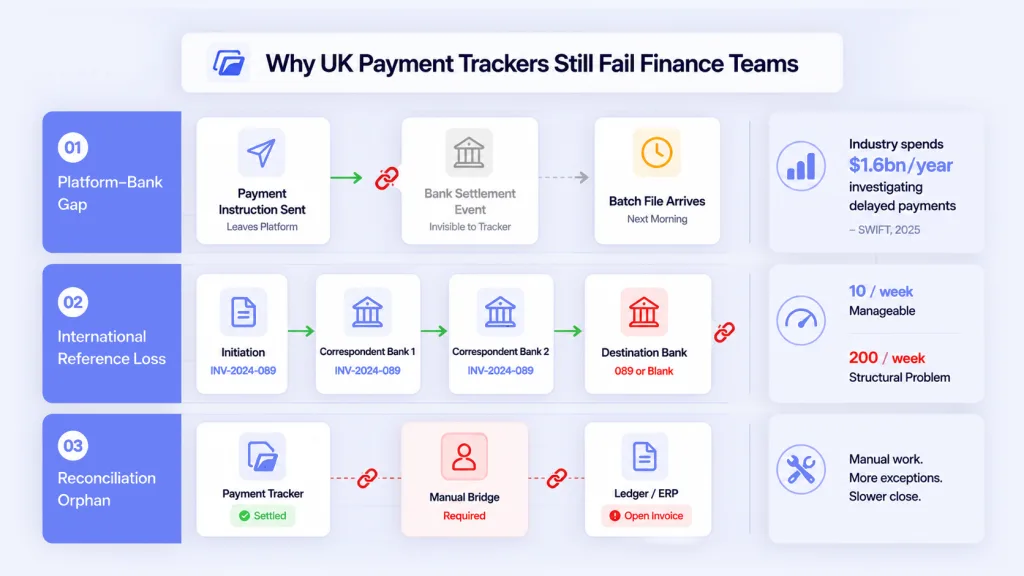
What Is the Real Scale of the Payment Visibility Problem in the UK? The payment visibility problem has a number attached to it.
SWIFT reported in April 2025 that the financial industry spends an estimated $1.6 billion annually investigating delayed and missing payments – each investigation typically taking five to ten working days to resolve. That cost sits almost entirely in manual investigation time.
In the UK specifically, 85% of firms still rely on fully or mostly manual reconciliation. The same research found that 39% of UK firms only see their FX costs after settlement – nearly four in ten businesses lack real-time visibility over one of their biggest cross-border cost drivers.
The payment tracker market has grown. The manual work has not shrunk.
Three structural reasons explain why:
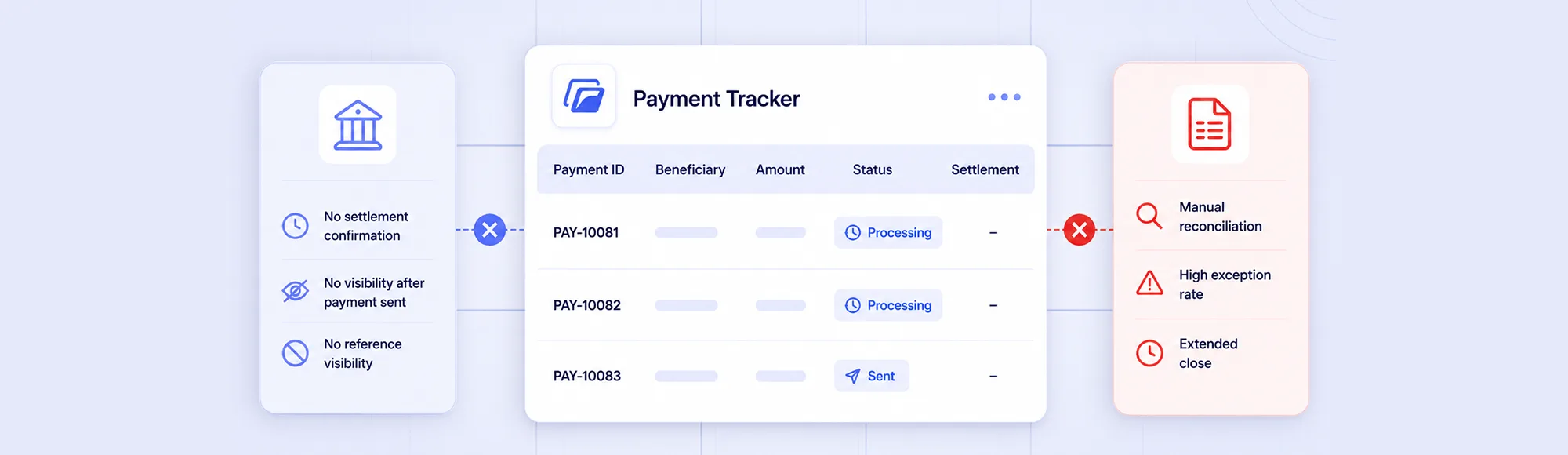
The tracker connects to the platform, not the bank. Most payment tracker tools surface data from the payment platform – the instructions that went out. The bank settlement event is a different system. When the bank rejects a payment or settles it with a modified reference, the payment tracker has no event to update on. It shows “processing” until the next batch file arrives.
The finance team sees “sent.” The bank statement the following morning shows the credit. The 16-hour gap in between is invisible to the tracker.
International payment tracking breaks at correspondent banks. SWIFT’s own research identified lack of visibility over funds once sent as a core problem in international payments – tracking visibility is lost as payments pass through intermediary banks. A reference embedded at initiation – “INV-2024-089” – regularly arrives at the destination as “089” or nothing at all. The international payment tracking layer receives a settled credit with no usable identifier.
A human investigates. At 10 international payments a week, this is inconvenient. At 200, it is a role.
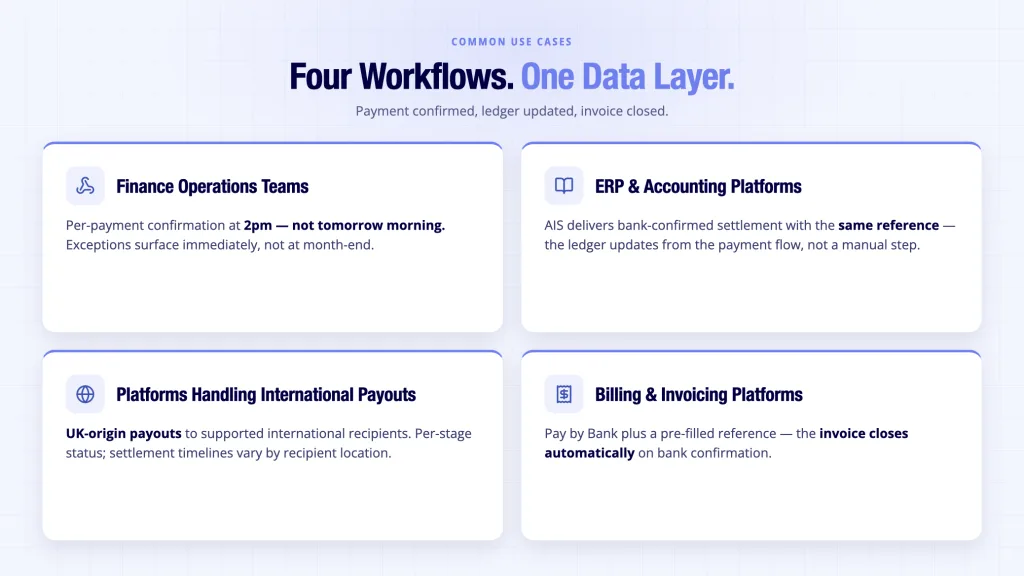
Reconciliation data arrives too late. The payment tracker and the accounting system are separate tools. The tracker shows “settled.” The ledger shows the invoice as open. Someone manually connects them. This step exists because the payment tracker was not built to push settlement data into the reconciliation workflow.
For finance operations teams evaluating how payment infrastructure changes the data available to a payment tracker, the real-time transaction monitoring guide covers how webhook-based settlement events differ from batch-based status updates in production environments.
What Does Effective International Payment Tracking Actually Require?
How Should a Connected Payment Tracker Work Across Domestic and International Flows?
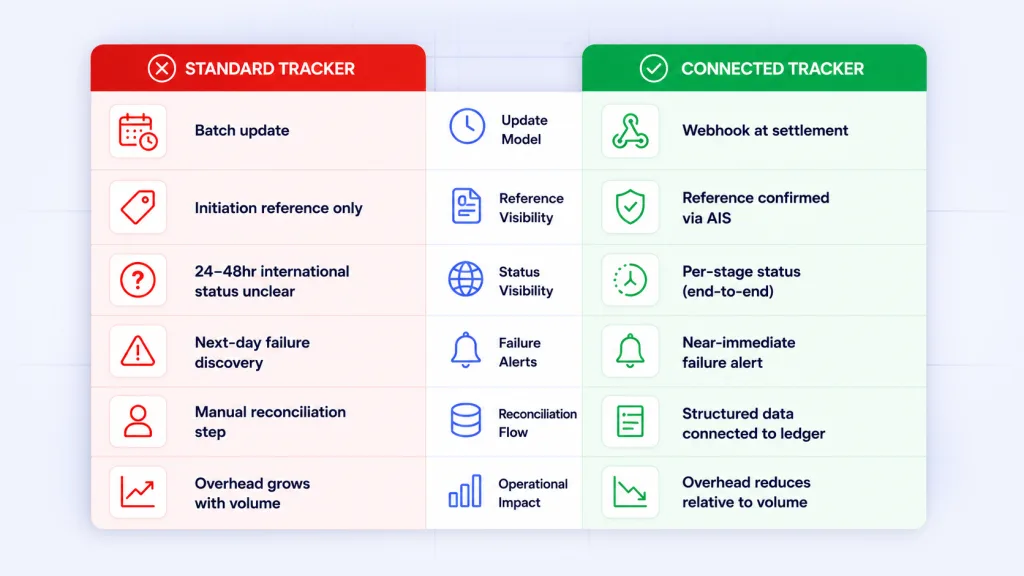
| Tracking Requirement | Standard Payment Tracker | Connected Payment Tracker |
|---|---|---|
| Settlement confirmation | Not available – shows “processing” until next batch update | Per-payment webhook at bank settlement – status confirmed near settlement |
| Reference continuity | Initiation reference only – no visibility into whether it survived transit | Reference embedded at initiation, confirmed at bank settlement via AIS |
| International payment tracking | Status unclear for 24-48 hours – no per-stage updates through correspondent chain | Per-payment status at each stage – initiated, in progress, confirmed |
| Failed payment detection | Discovered in next-day statement or via recipient complaint | Webhook failure notification near-immediately with reason code |
| Reconciliation connection | Manual step – tracker data does not connect to accounting system | Structured transaction data with reference connects to reconciliation layer |
| Scale | Manual overhead grows linearly with payment volume | Structured data layer reduces manual overhead relative to volume |