Touchless payment options let customers pay without handling a card terminal or typing in card details manually. In 2026, that covers more than just contactless card tap. It includes mobile wallets, QR-initiated bank payments, and payment links sent by text or email.
Open banking payments in the UK exceeded 40 million per month by June 2026 (Open Banking Limited). The Bank of England confirmed in February 2026 that the average cost to UK merchants of accepting card payments is around 0.6% of transaction value, with the smallest merchants paying more than four times as much as very large merchants.
These two data points frame the merchant decision: cards are ubiquitous but costly at scale; open banking is growing fast and carries lower per-transaction overhead.
This guide compares the main touchless payment options on cost, settlement speed, authorisation, and sector fit so you can decide which flexible payment options to offer alongside or instead of traditional card-present payments. For a broader view of the alternatives landscape, see alternative payment options.
Key Takeaways
- Touchless payment options span four main types: contactless card, mobile wallet, QR-initiated bank payment, and payment link. Each has different cost, settlement, and authorisation characteristics
- The contactless payment limit in the UK is £100 per transaction. There is no standard contactless limit per day set by regulation, but individual banks may apply daily caps
- Pay by bank UK is growing fast. Open banking payments exceeded 40 million per month by June 2026 (Open Banking Limited)
- Finexer supports bank-authorised payment links and QR-initiated payments. Finexer does not provide contactless card acceptance or card acquiring
What Are the Main Touchless Payment Options for UK Merchants?
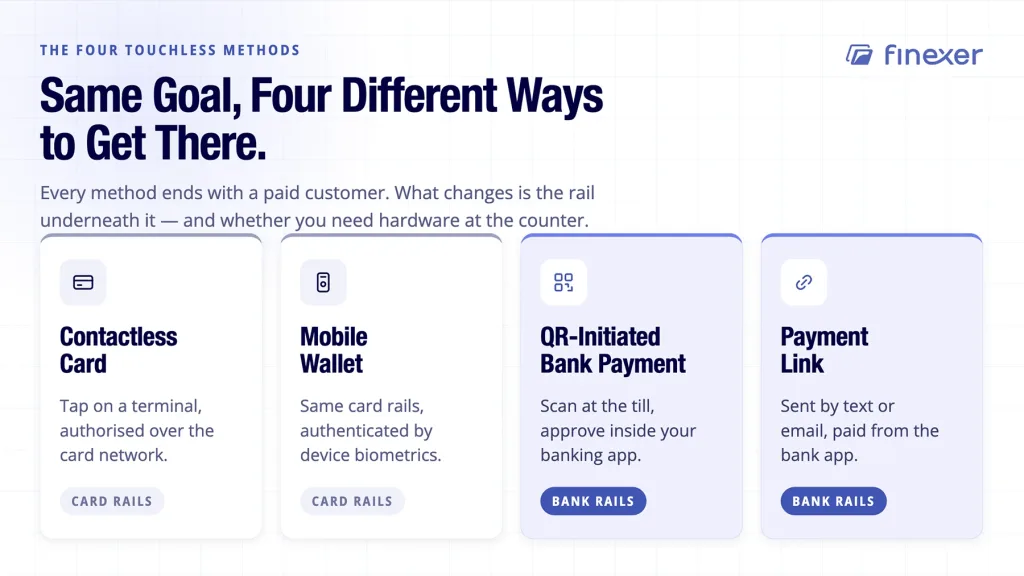
Touchless payment options remove the need for physical card handling at the point of payment. UK merchants now have four practical types available.
For a full comparison of online payment systems, see online payment systems.
Contactless Card
Contactless card is the most widely used touchless payment option in the UK. The customer taps their card on a card terminal, which authenticates through the card network. No PIN is required below the contactless payment limit.
The current contactless payment limit in the UK is £100 per transaction. There is no universal daily contactless limit set by the Payment Systems Regulator; individual banks set their own daily caps, typically between £200 and £300. Some banks require a PIN entry after five consecutive contactless payments regardless of value, as an additional security check.
Mobile Wallet
A mobile wallet (Apple Pay, Google Pay, Samsung Pay) tokenises the customer’s card and authenticates via biometrics or device PIN. Mobile wallet payments use the same card rails as contactless card, but with stronger authentication.
Mobile wallet adoption in the UK has grown sharply over recent years. Mobile wallet is not a separate cost category from cards for merchants; it uses the same merchant card acceptance infrastructure and card network fees apply in the same way.
QR-Initiated Bank Payment
A QR code displayed at the point of sale links directly to a bank-authorised payment request. The customer scans with their phone, is redirected to their banking app, authenticates with SCA, and the payment moves instantly via Faster Payments. No card terminal is required.
This is an open banking payments method: the QR-initiated payment moves money account-to-account without touching card rails. Settlement is instant. No contactless limit applies.
Payment Link
A payment link sent by text, email, or embedded in a receipt opens the same bank-authorised payment flow on the customer’s phone. The customer selects their bank, authenticates, and pays. Useful for trades, services, utilities, and anyone taking payment remotely or after the service is delivered.
How Do Touchless Payment Options Compare?
Not all touchless payment options carry the same cost, settlement speed, or authorisation requirements- the table below maps the key differences so you can evaluate each method against your business model:
| Method | Requires Terminal | Settlement | SCA | Contactless Limit | Cost Model |
|---|---|---|---|---|---|
| Contactless card | Yes | 1-3 business days | Periodic (PIN fallback) | £100 per transaction | Merchant card acceptance fees |
| Mobile wallet | Yes | 1-3 business days | Device biometrics every time | £100 per transaction | Merchant card acceptance fees |
| QR bank payment | No | Instant via Faster Payments | Bank-native SCA always | No limit | Lower per-transaction |
| Payment link | No | Instant via Faster Payments | Bank-native SCA always | No limit | Lower per-transaction |
What Flexible Payment Options Does Open Banking Add at the Point of Payment?
Open banking payments extend the range of flexible payment options available to merchants, particularly where a card terminal is not practical or cost-effective.
Pay by bank UK works by generating a QR code or payment link that connects directly to the customer’s banking app. The customer authorises with their bank’s own SCA (biometrics or PIN within the banking app). Funds move instant via Faster Payments, directly into the merchant’s account.
Where pay by bank merchants are already using this
The trajectory matters. Amazon launched pay by bank UK in early 2026, giving millions of UK customers the option to pay directly from their bank account. eBay pay by bank followed shortly after. For merchants evaluating whether customers will use this method, Amazon pay by bank and eBay pay by bank confirm that consumer readiness exists at scale.
The 2026 numbers stated earlier confirm the scale. Amazon pay by bank and eBay pay by bank launched in early 2026, confirming that consumer adoption is accelerating at the retail end.
For further context on pay by bank merchants and provider options, see pay by bank.
Online payment options via payment link
Payment links work as online payment options for merchants who invoice customers after delivery or for remote services. A plumber, solicitor, or utility company can send a payment link via text or email. The customer pays from their banking app. No card terminal, no card details at risk.
This is where bank-authorised payment links outperform card-based online payment options for smaller merchants: there is no card-not-present fraud risk, no chargeback mechanism to manage, and instant settlement confirms payment before closing the job.
What Are the Honest Limitations of These Touchless Payment Options?
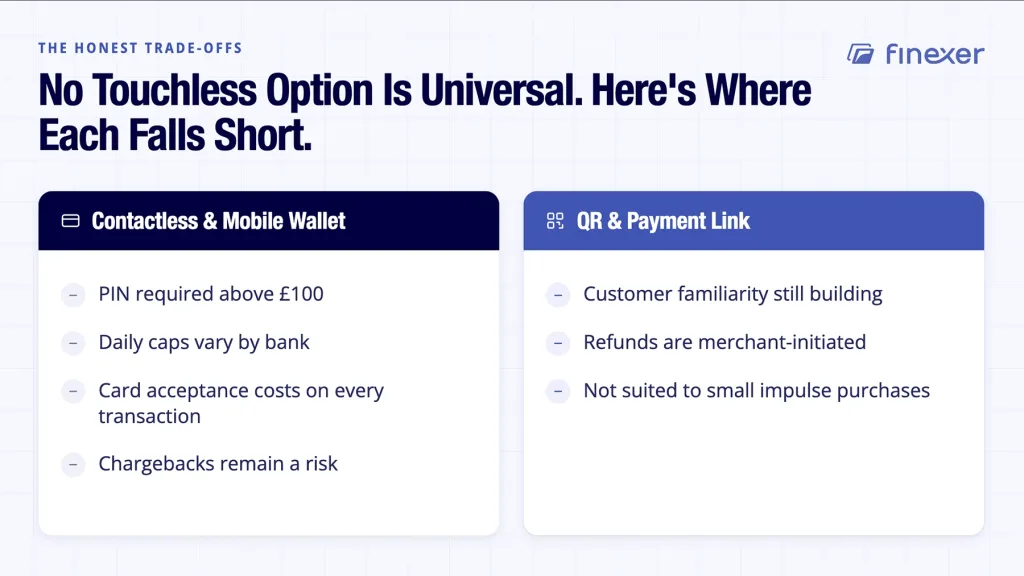
No touchless payment option is universal. The honest trade-offs are:
Contactless and mobile wallet limitations
- The contactless payment limit of £100 means a PIN is required for higher values, breaking the touchless experience
- The contactless limit per day, while not regulated, is set by each bank and can limit repeat-purchase merchants
- Merchant card acceptance costs apply on every transaction; for low-margin sectors this compounds quickly
- Chargebacks remain a structural risk on card-based methods
QR and payment link limitations
- Customer familiarity is still building. Younger buyers and mobile-first customers adopt quickly; older customers may prefer card
- Refunds are initiated by the merchant, not the customer, and must be managed through the payment provider. There is no equivalent of a card chargeback for the customer to trigger
- Not suitable for every basket type: impulse purchases below £30 still default to contactless tap in most retail environments
Which Sectors Benefit Most From Flexible Payment Options?
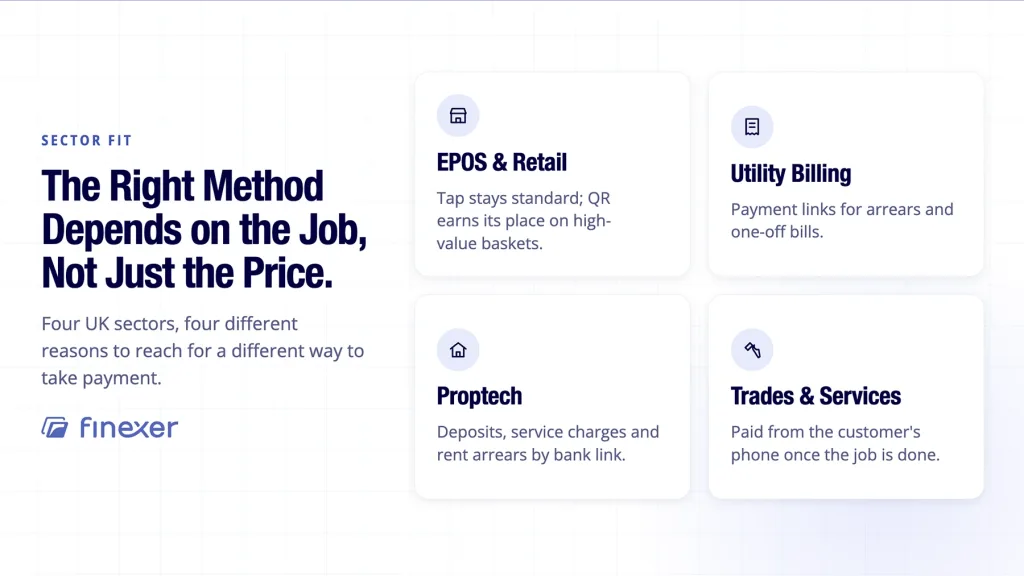
Different flexible payment options suit different merchant types.
EPOS and Retail
Contactless card and mobile wallet remain standard for most retail environments. QR-initiated bank payment is gaining ground for high-value purchases where the cost saving on a large transaction is material. See how epos systems are integrating open banking payments into point-of-sale flows.
Utility Billing
Utility companies benefit from payment links as online payment options for arrears collection and one-off billing. Instant settlement reduces cash flow risk on large payments. The bank-authorised payment eliminates chargeback risk on disputed bills.
Proptech
High-value, time-sensitive transactions (deposits, service charges, rent arrears) suit bank-authorised payment links specifically. The QR-initiated payment flow works for viewings and on-site payments where handing over a card feels inappropriate for large sums.
Trades and Services
Trades workers taking payment on-site or after job completion benefit most from payment links. The customer pays from their phone after the work is done. No terminal. No card details. Instant confirmation of payment.
How Does Finexer Fit the Touchless Payment Options Landscape?
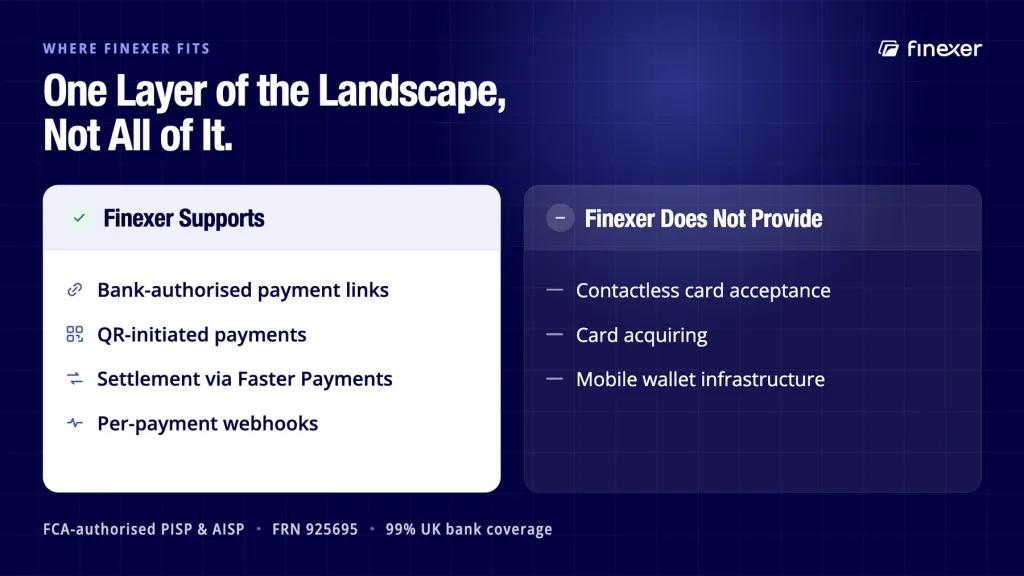
Finexer is an FCA-authorised PISP (FRN 925695) and AISP. Finexer supports bank-authorised payment links and QR-initiated payments that settle instant via Faster Payments. Finexer does not provide contactless card acceptance, card acquiring, or mobile wallet infrastructure. That boundary matters: Finexer’s role is the open banking payments layer specifically.
What Finexer’s Payments product delivers for merchants needing bank-based flexible payment options:
- Bank-authorised payment links and QR payments generated via a single API call
- Customer authorises through their own banking app using SCA built in natively
- Settlement instant via Faster Payments, directly into your account
- Per-payment webhooks confirming status in real time, not batched
- Almost all UK bank coverage across consumer, business, and challenger accounts
- No card terminal required, no card network overhead, no chargeback mechanism
- PCI DSS-compliant infrastructure with no card details required, stored or processed during the bank-authorised payment flow.
- direct one to one bank connections with customisation.
- 3-5 weeks onboarding support for mid-market SaaS and fintech platforms
See Finexer’s payments API to explore how the integration works for your merchant or platform use case.
Bottom Line
Touchless payment options in 2026 span contactless card, mobile wallet, QR-initiated bank payment, and payment link. Cards remain dominant, but open banking payments have reached 40 million per month in the UK and major retailers like Amazon and eBay are now offering pay by bank UK at checkout. For merchants managing the contactless limit per day, card costs, or settlement delays, flexible payment options built on bank authorisation offer a genuine operational alternative. The choice is not cards or bank payments. It is knowing which flexible payment options fit which part of your customer journey.
When should a business choose QR bank payments over mobile wallets?
Choose QR bank payments when you want customers to pay directly from their bank account without a card terminal. Mobile wallets are better for quick contactless payments through existing card acceptance.
What infrastructure is needed to launch payment links?
Payment links require a payment API, secure customer authentication and payment-status webhooks. They provide online payment options without requiring a physical card terminal.
How does open banking fit alongside existing card acceptance?
Open banking payments can complement card acceptance rather than replace it. Pay by Bank UK is useful for remote, higher-value or cost-sensitive transactions, while cards remain convenient for contactless checkout.
Which touchless payment options are best for different business needs?
Touchless payment options such as mobile wallets, QR bank payments and payment links suit different checkout journeys. Flexible payment options let businesses offer customers more than one way to pay.
How can businesses use Pay by Bank for online payments?
Pay by Bank lets businesses accept account-to-account payments through an online payment link, QR code or checkout flow. Customers authenticate with their bank, while businesses receive payment confirmation through the payment infrastructure.
Bank-authorised payments with instant Faster Payments settlement.
Explore with AI
About the Author

Ravi Ranjan
Ravi Ranjan is Co founder & CEO of Finexer