Brief: Transaction matching software pairs bank transactions with the invoices, payouts, or ledger entries they settle, using rule-based logic for exact matches and AI for the complicated cases. Both approaches share a common point: the quality of the bank data they are fed. Late, batched, and non-transparent statement data breaks matching before any algorithm runs, which is why the fix usually sits in the data layer rather than the matching engine.
Finance teams evaluating Trintech, HighRadius, or FloQast usually frame the decision as a logic question: whose matching engine is smarter? Then the pilot runs, the match rate lands nowhere near the demo, and the vendor gets the blame.
The uncomfortable finding is that the transaction matching software was fine, and the bank data feeding it was the problem. This explainer covers how the two matching approaches actually decide, where each one fails, and the input-data question that determines match rates before a single rule fires.
If your team is scoring tools this quarter, read this before the demos, because it changes what you test.
What Is Transaction Matching Software?
Transaction matching software automatically pairs records from different systems that describe the same money movement: a bank credit with the invoice it settles, a payout with the ledger entry that booked it, a card settlement with the day’s sales.
It sits within the financial close and reconciliation stack, where tools such as Trintech, HighRadius, FloQast, and BlackLine operate, and its job is to automatically clear the bulk of transactions so finance teams can review exceptions rather than everything.
The true cost depends on your exception rate. When most transactions clear automatically, month-end becomes a review of the residue instead of a rebuild of the whole picture. This is why match rates are a key selling point for vendors. However, it’s important to understand how those figures are measured.
Rules vs AI: How Transaction Matching Software Decides?
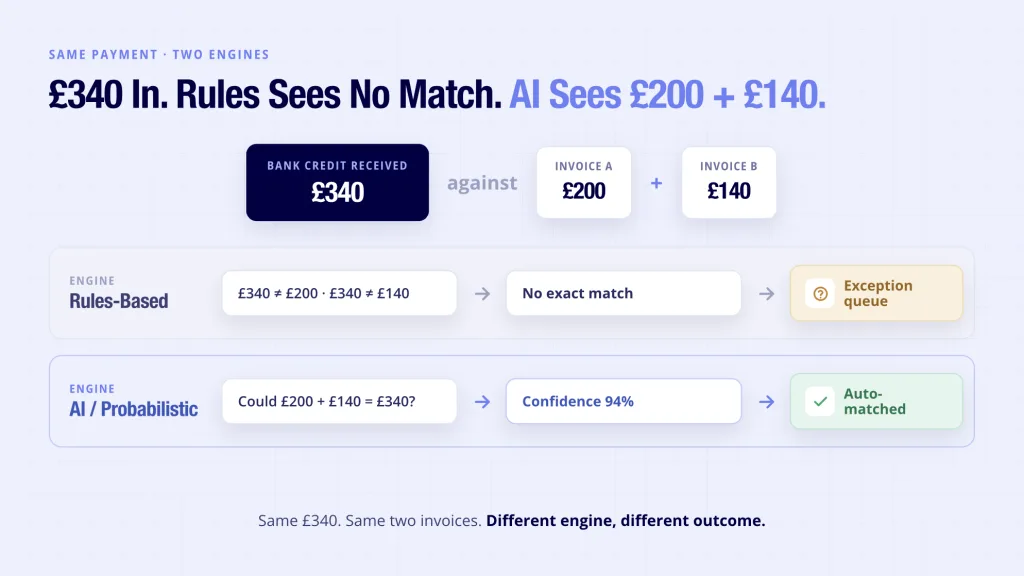
Regardless of the vendor, every matching engine works in one of two ways. Most modern solutions combine both methods for better accuracy:
| Factor | Rules-Based (Deterministic) | AI / Probabilistic |
|---|---|---|
| How it decides | Exact-field comparison: amount, date window, reference | Scores likelihood across many weak signals: amounts, dates, name similarity, historical behaviour |
| One-to-one, clean references | Excellent, near-instant | Equally good, unnecessary overhead |
| Partial payments | Fails: amounts do not equal, so no match | Strong: scores a partial against the open balance |
| One-to-many and batches | Fails: one bank line, many invoices | Strong: decomposes a batch credit across candidate invoices |
| Noisy or missing references | Fails silently into the exception queue | Degrades gracefully: matches on remaining signals with a confidence score |
| Auditability | Fully explainable: the rule either fired or did not | Needs confidence thresholds and review workflows to stay defensible |
Where AI Transaction Matching Delivers the Most Value?
AI transaction matching adds the most value where rule-based matching falls short, such as partial payments, overpayments, split payments, and incorrect payment references. For instance, a payment that differs slightly from the invoice amount or contains a minor reference error can still be matched with a high confidence score.
Behavioural signals feed the score too, which is where recurring transaction detection patterns help. For example, if a customer usually pays on the 28th of every month, an unlabelled payment received on the 28th is likely to be theirs.
The Common Point Both Approaches Share
Here is the part vendor comparisons skip: rules and AI transaction matching consume the same input, and neither can recover information that the input never contained. A model cannot decompose a batch credit if the bank feed collapsed twenty payments into one statement line with a summary descriptor. It cannot score a payer’s behaviour from data that arrives a day late. Probabilistic matching widens what is matchable; it does not manufacture missing data.
The Clean-Data Assumption Enterprise Tools Make
Enterprise financial-close platforms are built for organisations whose data arrives structured: ERP-fed invoices, standardised ledgers, disciplined references. Read their implementation guides, and the assumption is explicit, since onboarding starts with mapping clean source systems. That assumption holds for the ERP side of the match. It quietly fails on the bank side, because the bank feed is the one source system that the finance team does not control.
When teams evaluate transaction matching software on demo data, both sides are clean, and match rates look exceptional. In production, the ERP side stays clean, and the bank side arrives as exports: overnight files, truncated descriptors, batch-collapsed lines. The tool did not get worse; its input did. This is also why AI transaction matching pilots underperform their benchmarks most often at businesses with high payment volumes through batch rails, where statement granularity is poorest, exactly where matching pressure is highest.
When Bank Data Itself Is the Problem?
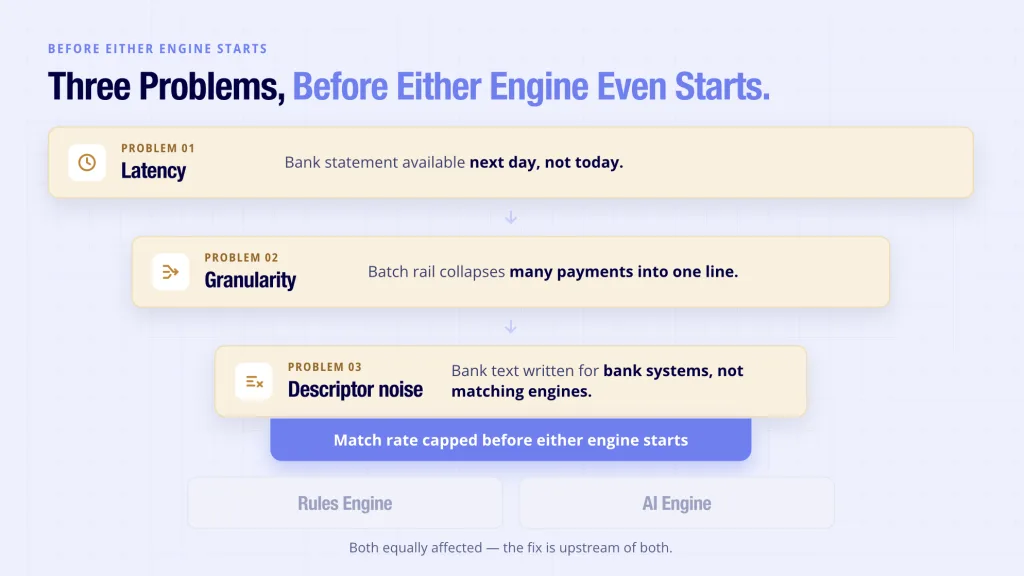
Three properties of traditional bank data do the damage, and each one caps the match rate upstream of any algorithm:
- Latency: Bank statements are usually available only after payments are processed, often the next day. As a result, matching is delayed, and unresolved exceptions continue to build up. UK government-backed research found businesses affected by late payments already spend an average of 86 hours of staff time a year chasing them; stale bank data adds an internal version of the same chase.
- Granularity: Batch rails and some feeds collapse many payments into single lines. One-to-many matching cannot begin when the “many” was never delivered.
- Descriptor noise: Bank transaction descriptions are written for bank systems, not matching engines. Accurate, but unstructured, which is why an intelligence layer on top matters; we cover how that works in transaction categorisation accuracy.
The upstream fix is structural rather than clever: consume bank data through AIS APIs instead of statement exports. Instead of waiting for batch files, transaction data is delivered instantly for each payment, giving matching engines the detailed information they need.
The rails for this are mainstream now, with the UK’s Open Banking ecosystem recording 2.54 billion API calls, 37.46 million Open Banking payments, and 17.94 million active user connections across AIS and PIS services. This underlines how real-time bank data access has become an established infrastructure for modern financial operations.
Where Does Finexer Fit?
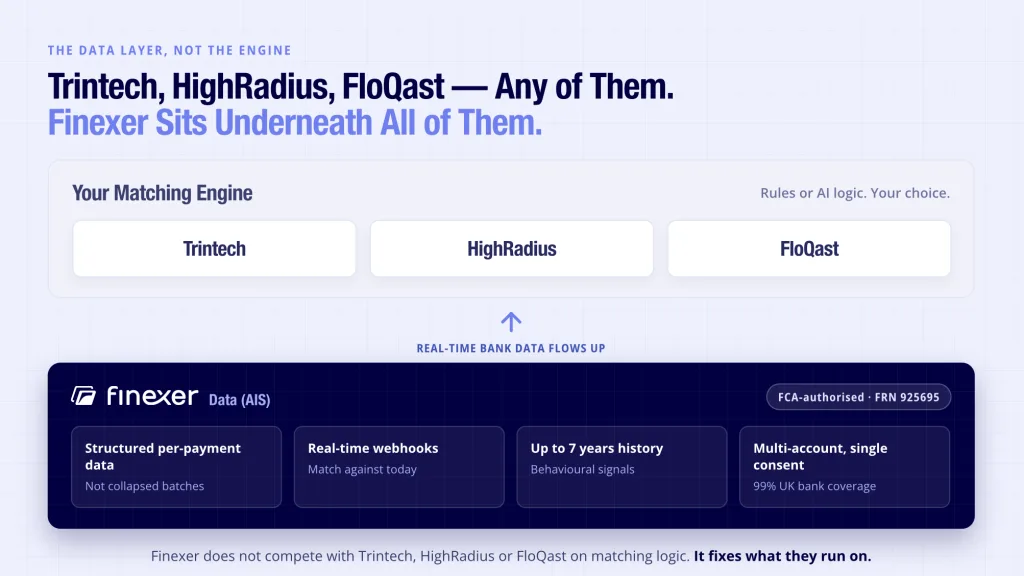
To be precise about the boundary: Finexer does not compete with Trintech, HighRadius or FloQast on matching logic, and this is not another matching engine. Finexer is the data layer underneath, delivering the real-time bank data that transaction matching software is starved of when it runs on exports. Through Finexer’s Data product, platforms and finance systems consume, with the account holder’s consent:
- Structured transaction data for every payment, delivered individually instead of as collapsed batch records
- Real-time webhooks on new transactions, so matching runs against today, not yesterday
- Up to 7 years of transaction history for behavioural signals and back-matching
- Multi-account access under a single consent
- FCA-authorised (FRN925695) as both AISP and PISP
- 99% UK bank coverage
- Usage-based pricing, white-label deployment
Watch the Finexer Open Banking Demo
See how Finexer delivers real-time bank data, Pay by Bank payments, and bank-based verification across UK banks.
Looking for the complete walkthrough? Visit our Finexer Open Banking Demo page .
The practical sequence for an evaluating team: fix the input first, then score the engines. The same AI transaction matching pilot, rerun on event-level API data, is the fairest test any vendor will face and the cheapest match-rate improvement most teams will ever buy.
Conclusion
The evaluation question most teams ask is “Which transaction matching software has the best engine?” The question that predicts the outcome is “what data will we feed it?” Rules and probabilistic models both hit the same ceiling: they can only match what the bank feed actually delivers, at the granularity and speed it delivers it. Fix the data layer, and every tool on your shortlist gets better at once.
What types of transactions are hardest to match automatically?
Batch payments covering multiple invoices, transactions with generic or missing references, and bank entries from legacy payment rails with truncated description fields. These represent the highest-volume exception categories in most reconciliation workflows. Structured bank data – with merchant IDs, per-payment confirmation, and embedded references – reduces these categories significantly but does not eliminate them entirely.
How does AI transaction matching work?
AI transaction matching uses machine learning to identify likely matches between financial records when exact fields do not correspond directly. It analyses amounts, dates, references, counterparty names, and historical patterns to suggest matches. Its performance improves with structured input data – and degrades when bank descriptions are generic, references are missing, or data arrives in batch aggregates rather than per-payment.
Why do reconciliation systems fail?
Most reconciliation systems fail at the data input layer. Generic bank description strings, missing payment references, batch settlement entries that cover multiple invoices, and overnight data delays all reduce the quality of inputs available for matching. The algorithm cannot compensate for an input that contains no usable identifying information.
How does Open Banking improve transaction matching?
Open Banking AIS delivers per-payment bank data with merchant IDs, category codes, and consistent references. When PIS embeds the invoice reference at initiation, that reference travels through Faster Payments and returns with the AIS bank confirmation. The matching software receives a structured pair – reference on both sides – and can match without manual review.
If your match rates look nothing like the demo, Finexer’s team can show you what your bank data looks like as structured, real-time events, against your own transaction volume.
Explore with AI
About the Author

Yuri
Yuriy Yakushko is a fintech founder and software engineer with over 20 years of experience building financial technology. He’s passionate about creating scalable, secure infrastructure that helps businesses modernise how they access financial data and manage payments.